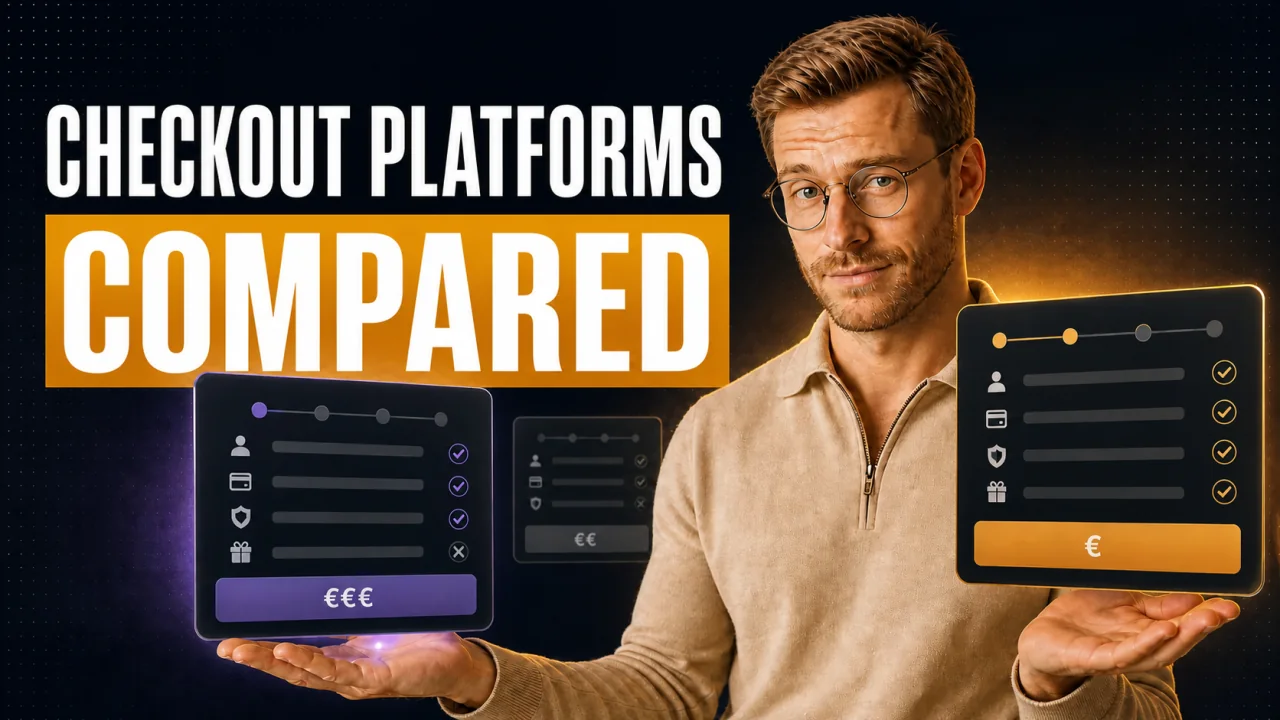
The checkout landscape for digital products comes down to three models. Reseller platforms act as the seller and take a share of every sale. Then there are your own payment accounts with a checkout layer in front.
The third model is the international cart. Those run into tax rules, contract law and direct debit the moment you sell into Europe. Which model fits you is not decided by the feature list.
Your average deal size decides. On a 47-euro product the question is academic. On offers starting at 4,000 euros it flips.
There the wrong model costs you more per deal than the right one costs you all year. Truth is, most people still pick their tool on gut feel.
This guide maps the whole field. The three models with a clear verdict on each, plus the big provider table. And the five criteria, the real cost math and the clean switch.
From four-figure deals upwards, your own account with a checkout layer in front wins. Reseller platforms are convenient. Their revenue share eats more per deal at High-Ticket than the right tool costs all year. Deal size decides, not the feature list.
- Three models: reseller with a revenue share, your own account plus a checkout layer, international carts. Who owns the revenue decides everything.
- Reseller platforms typically take 5 to 8 percent per sale. At 300,000 euros in monthly contract value that is a five-figure line item.
- Your own checkout costs a flat software fee instead of a revenue share. From about 4,000 euros per deal it almost always pays off.
- Honest take: for getting started and for affiliate-driven products the reseller model is strong.
- A High-Ticket checkout needs more than a payment page: a signed contract, instalments, dunning and live control during the call.
- When you switch, never cancel too early or running instalments break.
If you sell offers below 1,000 euros, you do not need this guide. Seriously.
First, sort the category: a checkout platform is not a store system
Google mixes up three things here. They have little to do with each other. A store system like Shopify or BigCommerce is a shop with a catalogue, a cart and stock.
A payment provider like Stripe or PayPal is the pipe the money flows through. A checkout platform sits between them. It takes your one offer and turns it into an order page.
From there it handles the contract, the payment, the instalments and the dunning. For a High-Ticket coaching offer you do not need a catalogue. You need exactly that layer.
Checkout platform: software that turns a single offer into an order page and handles the entire purchase, from price and payment method through contract and signature to instalments and dunning. Unlike a store system it manages no product catalogue; unlike a plain payment provider it covers the whole flow.
This is nothing like the express checkout of a classic online shop. Express checkout means a one-click purchase through a stored wallet. It exists for the fast impulse on small amounts.
Nobody buys a 20,000-euro engagement in one click. Here the opposite of speed counts: clarity, a contract and a human steering the call. Harsh, but true.
My take is simple. Anyone who builds a store system for High-Ticket solves a problem they do not have. Three others stay unsolved.
This is where most people trip, because they perfect the catalogue and forget the contract. So sort the market by model first. Features come second.
Three models, three completely different bills
Almost every discussion about checkout tools happens on the wrong level. People compare interfaces, bump features and templates. The real decision sits one level above.
Who owns the revenue? And who is legally the seller? That single question drives fees, tax duties and payout rhythm.
It also decides whose name is on your customer’s invoice. Which is why the three models add up completely differently. Classic.
The three models at a glance
| Model | Who is the seller | Cost logic | Strong for |
|---|---|---|---|
| Reseller / Merchant of Record | the platform | share of every sale (5 to 8 percent) | getting started, affiliates, no tax overhead |
| Your own account plus checkout layer | you | fixed software fee, transaction costs only | High-Ticket from about 4,000 euros |
| International cart / all-in-one | you | fixed fee, often in US dollars | US market, standardised products |
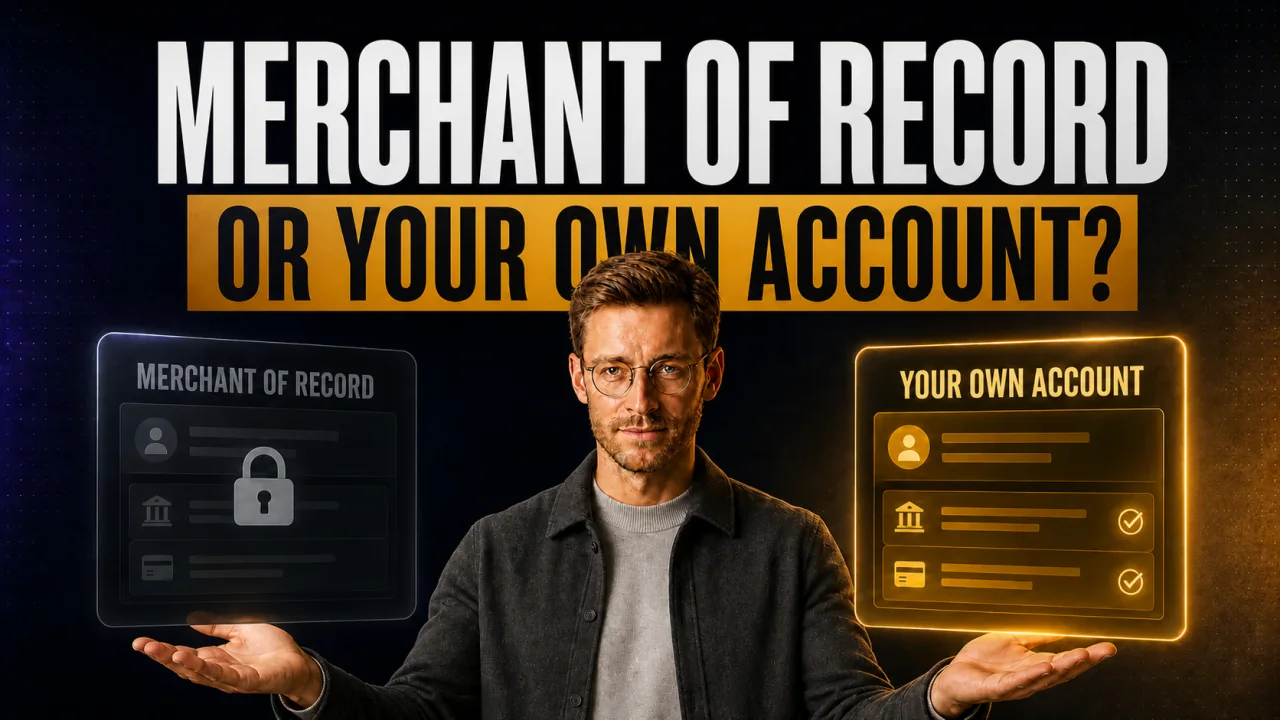
Reseller and merchant of record. The platform sells in its own name. It handles VAT and pays you the rest.
In return a fixed percentage leaves with every sale. You also lose direct access to your customer’s payment. For getting started, this model wins convenience outright.
Your own account plus a checkout layer. You keep your own payment providers. The money arrives straight in your bank account. Software on top handles the offer, contract, instalments and dunning.
From four-figure deals upwards this is the superior model. Only the plain transaction fees remain, and the margin stays with you. The price is real: VAT, legal texts and payouts stay your job.
International carts and all-in-one builders. Quick to set up, solid conversion craft. Often they own the best upsell and order-bump mechanics on the market.
For the US market and standardised products they win on speed. Selling into Europe, they trip over the same four things. SEPA direct debit, local legal texts, the right of withdrawal and a contract the customer actually signs.
That bites you the day a customer withdraws after three weeks and you have no signed document. Then you are arguing over an order confirmation. Good luck with that.
Reseller or your own account: the most expensive decision you never made consciously
Behind the friendly word reseller sits a legal construction. The platform buys your product the moment your customer clicks. Then it resells it immediately.
Your customer’s receipt carries their name. Not yours. That has three consequences.
The platform takes on VAT and the EU side completely. That is the real upside. Sounds good, right?
In return you pay a percentage. Your money arrives collected and delayed. And part of the customer relationship belongs to them.
Myth
A merchant of record takes the tax off my hands, so it is the most convenient choice even at High-Ticket.
Reality
It takes the tax off your hands and takes a share of your revenue every month. On small amounts the percentage is pocket change. On 15,000-euro deals it becomes one of your largest single line items. A checkout without a revenue share flips the math exactly at the point where your revenue starts to grow.
The other side stays fair. For affiliate-driven products and small ticket prices, the outsourced tax is worth it. The same goes for anyone who wants bookkeeping as lean as possible.
The model is not bad. It was designed for a different deal size.
It blows up in your face the moment your monthly revenue jumps from 50,000 to 300,000 euros. The percentage simply scales with it.
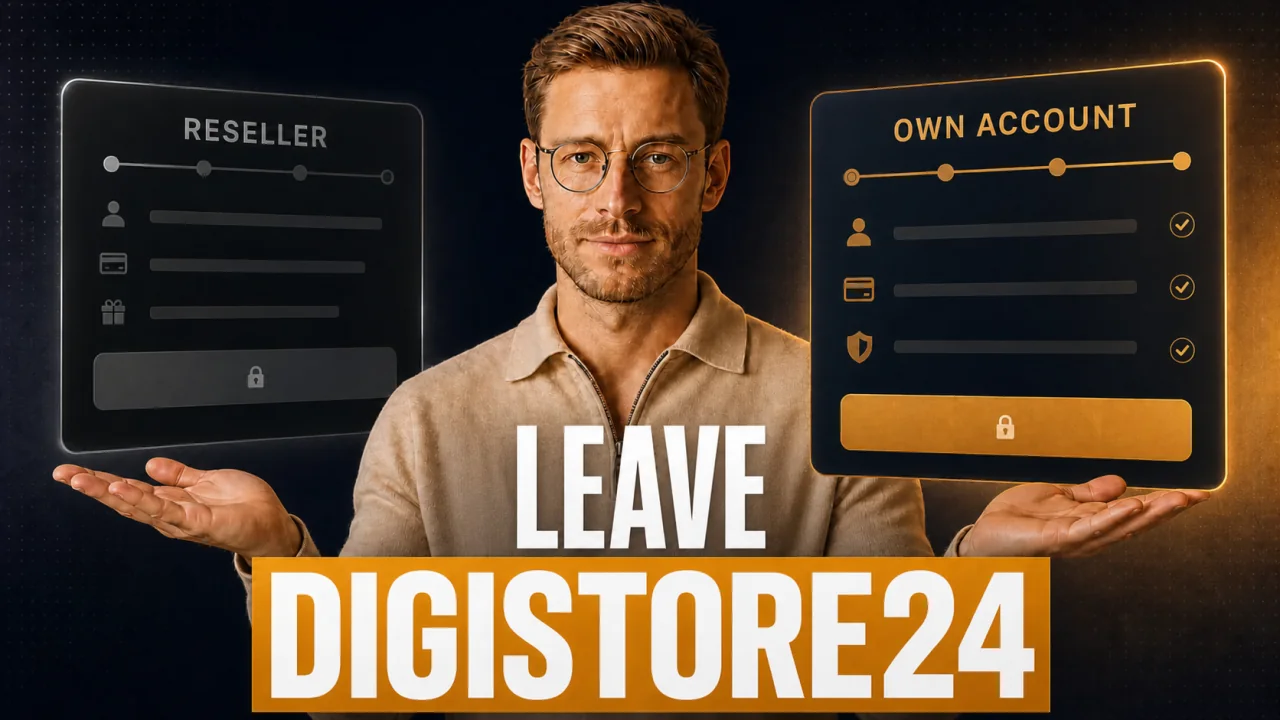
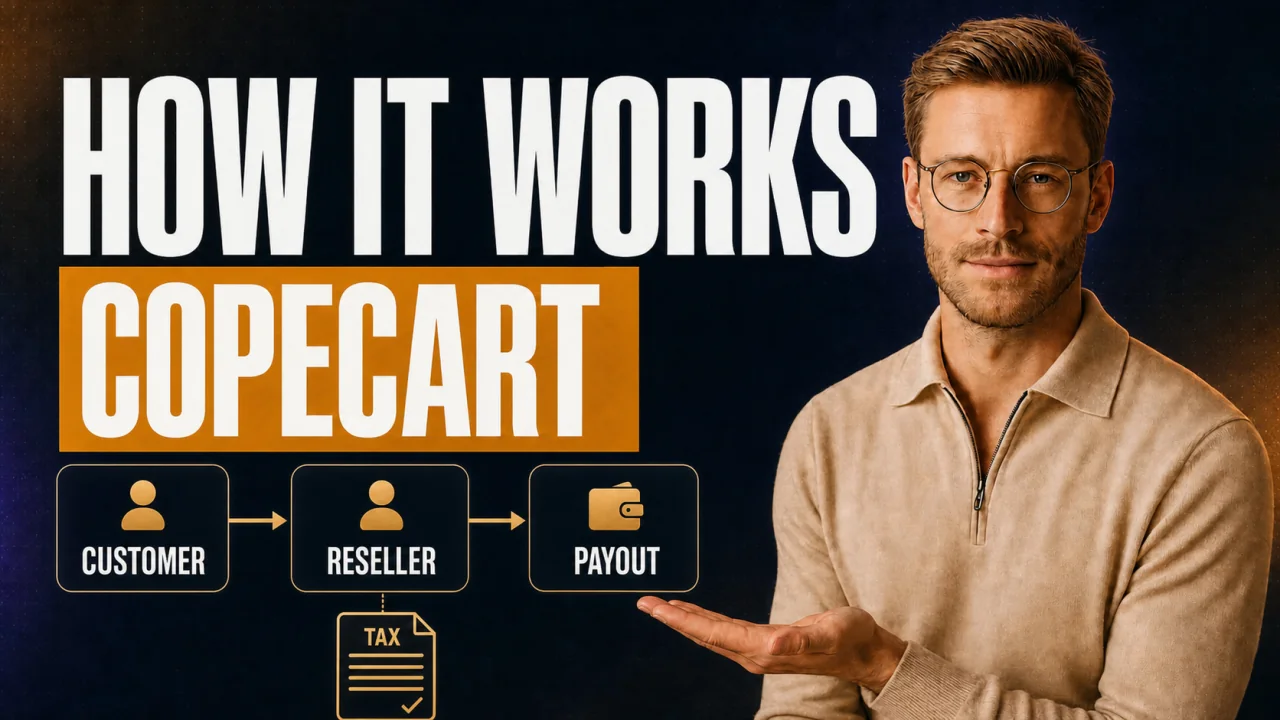
In Europe this model runs through platforms like CopeCart and Digistore24. The detail articles break down how a CopeCart reseller checkout actually works and which fees Digistore24 charges.
Would you rather see both worlds on one concrete case? Then take the comparison of Stripe versus Digistore24. It runs the same math with real numbers.
The providers side by side: which tool belongs in which model
Before you compare tools, sort them by model. Almost every well-known platform maps onto one of the three bills. That mapping tells you more than any feature list.
Providers sorted by model
| Provider | Model | Cost logic | Strongest at |
|---|---|---|---|
| Gumroad, Lemon Squeezy, Paddle | Reseller / MoR | revenue share plus fixed fee | affiliate sales, EU VAT outsourced |
| ThriveCart, SamCart | US cart | fixed fee, mostly US dollars | order bumps, upsells, US market |
| WooCommerce, FluentCart | WordPress cart | fixed fee plus your own hosting | full design control in your own shop |
| Stripe plus checkout layer | your own account | fixed software fee, 0 percent revenue share | High-Ticket with contract and instalments |
Every row has its place. ThriveCart and SamCart build strong upsell craft. For the US self-serve purchase they are first choice.
For High-Ticket sold into Europe they lack the local contract. They lack SEPA direct debit. And they lack a dunning process that catches failed instalments.
Skip this sorting step and you notice the gap at the first bounced debit. By then the tool is paid for and the process is still missing. Moving on.
The detail articles under this guide take each provider apart with real numbers. Coming off a US cart, you will find the ThriveCart alternative built for High-Ticket there. Next to it sit the alternatives to SamCart and the head-to-head on ThriveCart versus SamCart.
For the WordPress route, the check on the new FluentCart is worth reading. It shows what the cart handles. And where it runs out of road at High-Ticket.
My take after years in High-Ticket: the model question beats the tool question every time. A strong tool in the wrong model loses to a solid tool in the right one.
The five criteria that decide everything
Fee model. A percentage of revenue or a fixed software fee? This is the only point where your bill changes with every additional deal.
That makes it the most important one. A percentage looks small. It grows quietly along with your revenue.
Contracts and signature. Can the customer sign inside the checkout, or do they just tick a box? On a 20,000-euro engagement you want a signed PDF with a timestamp and an IP log.
Add a documented waiver of the withdrawal right. A plain order confirmation is not enough. Here is the annoying part.
Instalment control. Almost every tool can do instalments. The real question is who gets to steer them.
A closer who can adjust the deposit, the term and the start date during the call closes deals. Deals that die on a fixed pricing page. Plenty of people wreck it here, losing closes that were already agreed verbally.
Dunning. Once your open instalment volume hits six figures, a failed payment stops being an edge case. It turns into a process with stages, deadlines and escalation.
If your tool does not cover it, you rebuild it in spreadsheets. And you forget it in the day-to-day. That is how it goes.
Local fit. Legal texts in the language your buyer reads, plus correct VAT handling. That includes reverse charge and any small-business exemption.
Add the payment methods your market actually uses, like SEPA direct debit in Europe. And a checkout with no translation gaps.
This is where most international tools drop out. Not on the feature list.
These five criteria do not carry equal weight. Below 1,000 euros the fee rate decides almost everything. Beyond 4,000 euros, contract, instalment control and dunning become hard knockout criteria.
That still does not make your own account a no-brainer. Weighed up honestly, it looks like this:
Where your own account wins
- Zero revenue share, only a fixed software cost and plain transaction fees
- Money lands directly in your account, full visibility into every single payment
- Your own branding, your own sender address, your own order numbers on the checkout
What it costs you
- VAT, invoicing and payouts stay your job
- You need your own payment provider like Stripe in the background
- When you switch, you have to let running instalments wind down under control
What your own checkout really costs: the math at 50k, 100k and 300k
Run it against your real numbers. Not against examples from a brochure. Take a reseller share of 6 percent and put a fixed software fee next to it.
The gap widens with every jump in revenue. Not pretty, but it happens.
Reseller share versus a fixed checkout, per month
| Monthly revenue | Reseller (6 %) | Your own checkout | Difference / year |
|---|---|---|---|
| 50,000 euros | 3,000 euros | around 100 euros | approx. 35,000 euros |
| 100,000 euros | 6,000 euros | around 100 euros | approx. 71,000 euros |
| 300,000 euros | 18,000 euros | around 100 euros | approx. 215,000 euros |
Honest about it: the roughly 100 euros are pure software cost. The payment fees from Stripe or Klarna apply in both models. They are comparable.
The decisive difference is the revenue share. On your own account that is zero. The exact rates differ by provider, and some sit below 6 percent.
The pattern never flips regardless. Percentage models scale with your revenue. Fixed software costs do not.
The second cost block appears on no price list. It is called control: your own sender address, your own order numbers, your own branding. Add full visibility into every payment instead of a lump payout every two weeks.
With six figures of instalments outstanding, that difference is anything but cosmetic. You want to know which payment pulls tomorrow and which one bounces. Before the customer writes to tell you.
Leave this block out of your math and you underestimate your true cost. By a five-figure sum, for years. It happens.
The switch I made far too early
I made this mistake myself. Back then my sales ran through a reseller platform. I had the new checkout standing in one afternoon.
Two days later I cancelled the old platform. On paper everything was clean. New customers ran through my own account, the legal texts were in place.
What I had forgotten: fourteen instalment plans were still running over there. The first payment bounced on the first of the month. Then the next one.
In total, roughly 90,000 euros of open instalment volume sat on that old platform. Which had already shown me the door.
Three customers wired the money on their own. Four I had to call individually and set up again from scratch.
Two stopped paying altogether and never came back. All in, that one impatient click cost me about 31,000 euros in contract value. Plus two weeks in which I did nothing but sort out payments.
And yes, I built that trap myself. Wide open. Since then I do it the other way round.
Overlap first, cancel second. That costs you roughly six weeks of running both. And it saves you every single one of those night shifts.
High-Ticket changes the requirements completely
From the first deal above 4,000 euros, what a checkout has to deliver changes. On a small amount a payment page is enough. A High-Ticket checkout has to do four extra things.
That is where most tools fall down. First, the contract.
A signed document carries a timestamp and a logged IP address. It beats any order confirmation once a deal turns disputed.
Second, the instalment plan with default risk. Split 15,000 euros across twelve months and you have eleven debits. Eleven that can bounce.
At CloserCart this closer-steerable instalment plan is called the Split. It runs through your own Stripe account. Anyway.
Third, the dunning. Once six-figure instalment volumes sit open, a failed payment demands its own workflow. It needs escalation steps and hard deadlines.
Fourth, live control during the call. High-Ticket gets closed on the phone or over Zoom, not through a shopping cart. The closer has to adjust price, plan and payment method during the conversation.
From practice: the link decides the cash
In the call I send exactly one link. Behind it I steer the amount, the split and the payment method live while we talk. No second link, no follow-up email in which the decision cools off. The difference between "I'll send it over in a bit" and "pay right here" is real money on 20,000-euro deals.
A checkout layer like CloserCart bundles exactly these four in front of your own account. A contract with signature, the Split through your own Stripe and automatic dunning. Plus a closer console for live control, without your closer touching your payment backend.
Miss one of the four and the first disputed deal wrecks your month. Want the whole setup, from checkout to providers to the payment link? That is the guide on payment processing for High-Ticket.
My take: a tool without those four is not a High-Ticket checkout. It is a payment page with gaps.
Tax and legal reality: who is liable as the seller
The point international tools most often miss is not technical. It is legal. Selling into the EU, your checkout needs legal texts in your buyer’s language and correct VAT.
It also needs a buy button that meets local disclosure rules. Selling into the US, sales tax and nexus rules apply instead. Anchor the principle in your own market’s framework.
Under the reseller model the platform carries the seller role and the VAT. With your own checkout both land on you. Clear this with a tax advisor before you switch.
That goes double for cross-border EU sales and reverse charge. Enough of that.
On top comes the VAT treatment per offer. So added, included, or none on B2B reverse-charge sales, a US LLC or a small-business exemption. A tool that knows only one fixed US sales-tax rate cannot map that.
And this is where it catches up with you. If a customer withdraws inside the statutory window, only your documented disclosure counts.
Without it in the checkout, you refund. No discussion.
How VAT on coaching and digital products really works gets unpacked in the tax guide for digital products. From the OSS scheme all the way to the reseller trap.
My take: most international carts fail on local fit. Not on feature scope. A clean local contract in the checkout is the difference between “pays” and “withdraws after four weeks”.
Which model is right for whom
No model is right for everyone. Three questions decide, in this order.
Sounds like a toss-up? It is not.
First, deal size. Under 1,000 euros the pricing model is nearly the whole story, and convenience beats margin. Above 4,000 euros, signature, instalment control and the dunning process turn into knockout criteria.
The reason is simple. One broken case costs more than a year of software. Second, the sales route.
If your offer sells self-serve through a funnel, conversion craft counts. Then an international cart can fit. If it gets closed on a call, you need live control, and carts do not have it.
Third, your appetite for tax. If you want nothing to do with VAT and payouts, the reseller is worth the money. If you want to keep margin and customer relationship, there is no way around your own account.
Take the wrong turn here and you only notice twelve months later. Revenue is there, and the margin still is not.
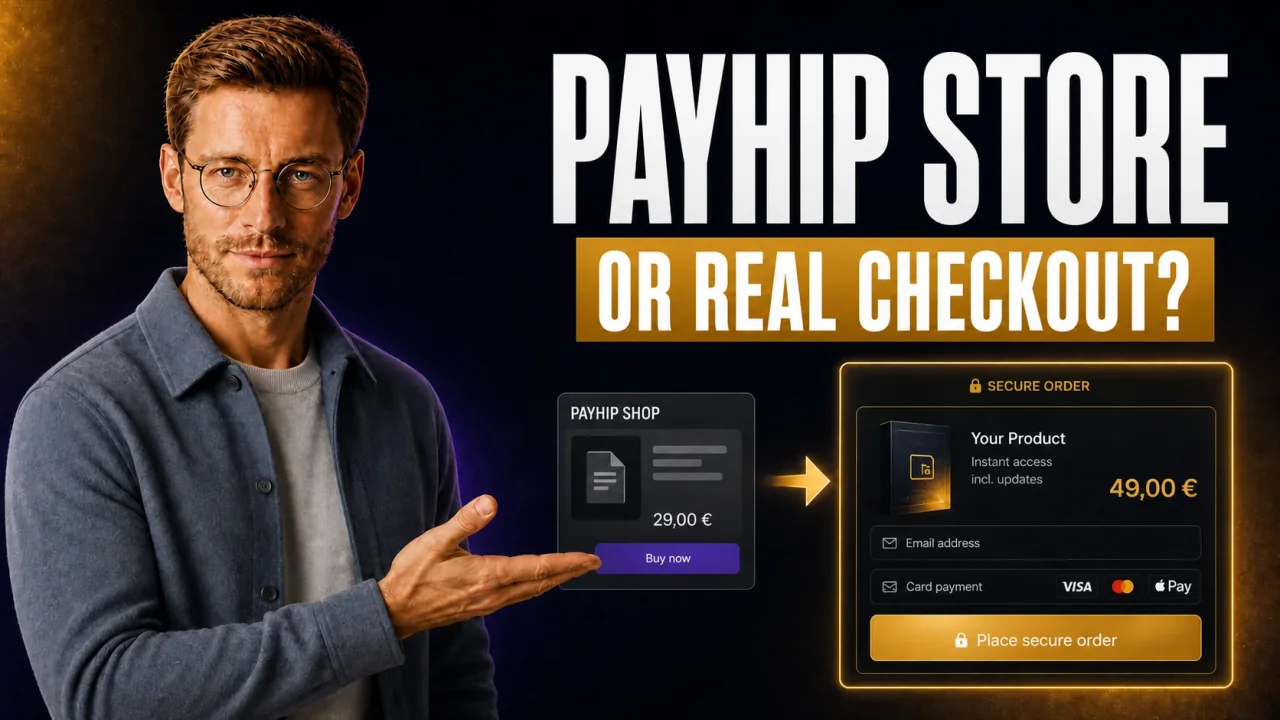
Where you come from shortens the decision. From a downloads shop you lack the contract and the Split above four figures. That exact jump gets described in the piece on moving from a Payhip download shop to a real checkout.
From a reseller platform it is not really a tool question. It is a tax and process question. Which options are realistic there is sorted out in the overview of Digistore24 alternatives.
From plain Stripe you do not miss the payment provider. You miss the layer above it. The case for keeping Stripe and upgrading it instead of replacing it is laid out in detail there.
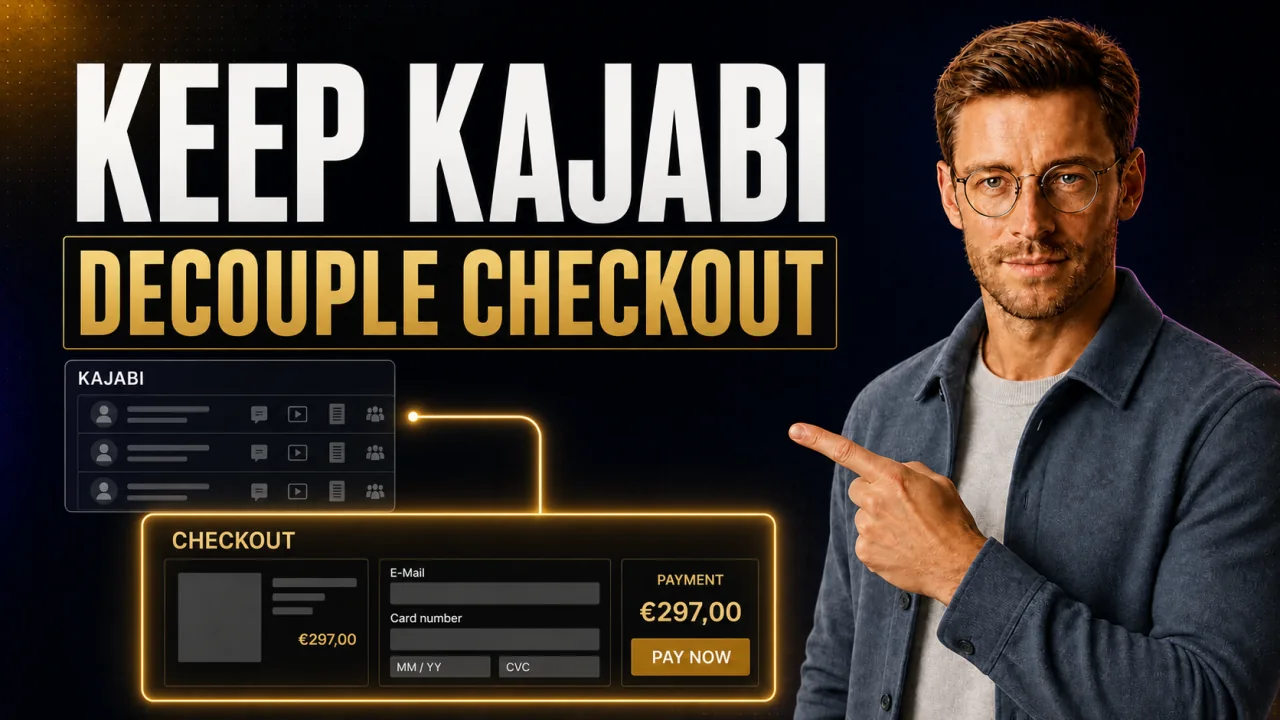
From a course platform you keep the course, community and CRM. You decouple only the checkout in front. What that looks like in practice is shown by the Kajabi alternative with a decoupled checkout.
Selection checklist: the questions you ask every provider
- Does the provider take a revenue share or a fixed fee?
- Whose name appears as the seller on my customer's invoice?
- Does the money land directly in my account, or collected and delayed?
- Is there a contract with digital signature right inside the checkout?
- Can a closer steer the amount, the split and the payment method live?
- Does a dunning process catch failed instalments automatically?
- Are local legal texts, SEPA and the VAT modes covered?
For every further starting point you will find the matching detail article below. The individual provider comparisons are broken down one by one down there. From the WordPress carts to the course platforms to the all-in-one suites.
Switching without losing revenue
The switch itself has one trap. It costs real money.
And then the classic. Everyone debates features, nobody debates timing.
The most expensive mistake when switching
Never cancel the old platform while instalments are still running there. Shut it down too early and you risk failed debits and confused customers. Add payment defaults on deals that used to run cleanly. With a six-figure open instalment volume this is not an edge risk.
The second mistake already happens at selection. The platform gets picked by feature list instead of by model. Feature lists converge over the years, the fee model does not.
It decides on every euro you will bill in the years ahead. The clean sequence is always the same. No matter which provider you are coming from.
- Set up the new checkout and connect your own Stripe account.
- Enter your legal texts, VAT modes and bank details cleanly.
- Route new customers through your own account from a fixed cut-off date.
- Let existing instalments on the old platform wind down under control.
- Only once nothing is debited there anymore do you cancel the old platform.
The step-by-step version lives in the guide on switching payment provider without losing revenue. How you then cancel the old platform cleanly, without losing a euro, sits in the detail articles below.
My take: the switch is not a big bang, it is an overlap. Run both in parallel, cancel at the end, and you lose no deal.
FAQ on checkout platforms
The most common questions around comparing checkout platforms, answered short and direct.
What is a checkout platform?
A checkout platform turns a single offer into an order page and handles the whole purchase: price, payment method, contract, signature, instalments and dunning. It is neither a store system with a catalogue nor a plain payment provider. For High-Ticket offers it is the layer that closes the sale cleanly and with legal cover.
Checkout platform, store system or payment provider: what is the difference?
A store system like Shopify manages catalogue, cart and stock. A payment provider like Stripe only moves the money. A checkout platform sits between them and covers the whole flow, from one offer to a paid, contractually documented order. Anyone selling High-Ticket needs the checkout platform, not the store system.
Reseller or your own account: which is cheaper at High-Ticket?
From about 4,000 euros per deal your own account is almost always cheaper. A reseller takes a revenue share of typically 5 to 8 percent that grows with your revenue, while your own checkout costs a fixed software fee, independent of deal size. At 100,000 euros in monthly revenue the difference quickly runs into five figures a year.
What is a merchant of record?
A merchant of record is the legal seller of your product. The platform buys your offer the moment your customer clicks and resells it, handles VAT and pays you the rest, with its name on the invoice. That removes tax overhead from you, but costs a revenue share and full control over the payment.
Can I switch from a reseller platform without losing revenue?
Yes, if you switch with an overlap instead of flipping hard. Set up the new checkout, connect your own account and route new customers there from a cut-off date. Let running instalments wind down under control on the old platform and cancel only once nothing is debited there anymore. That way you lose no deal.
Which checkout fits High-Ticket coaching with instalments?
For High-Ticket coaching with instalments you need a checkout layer in front of your own payment account. What matters is a contract with digital signature, a steerable instalment plan running on your Stripe and automatic dunning for failed instalments. Plain payment pages and international carts usually miss these three points when you sell into Europe.
What does your own checkout cost per month?
As a software layer it usually sits in the low double to low triple digits per month, independent of revenue. On top come only your provider's plain payment fees, like Stripe or Klarna. There is no revenue share, unlike the reseller model, which is exactly what makes it cheaper from four-figure deals upwards.
What is express checkout?
Express checkout is a one-click purchase through a stored wallet like PayPal, Apple Pay or Google Pay, built for the quick impulse buy on small amounts. For High-Ticket it is unsuitable, because a high-priced offer needs clarity, a contract and usually a sales conversation, not speed.
Your own account, zero revenue share
Short version: three models, and deal size decides. At High-Ticket the self-owned account with a front-mounted layer wins almost every time. Only there do margin and control stay with you.
CloserCart is exactly that layer. You plug in your own providers: Stripe for card, Klarna and PayPal as direct payment methods. AffiliCon and Ablefy come in as redirects, and the revenue lands straight in your account.
There is no revenue share, and you handle your own VAT. The software costs 49 euros a month on Starter or 99 euros on Pro. Every additional closer adds 49 euros.
Contract plus signature, the Split of your instalments and the dunning system are included regardless of deal size.
You can try it for 1 euro.
Curious how a checkout without a revenue share comes together? Take a look at the feature page Connect payment providers. It also walks through hooking up your own accounts.