
SamCart looks like the perfect checkout at first glance. Over 100,000 sellers, clean templates, upsells everywhere. The gaps only show up once your deals get big: no contract, no signature, no real dunning. Here is where SamCart genuinely wins and which alternative actually fits you.
Run your own checkout instead of SamCart. SamCart is a strong cart for digital products sold on instant checkout. For deals closed on a call it has no contract, no signature and no real dunning.
- SamCart costs $79 to $199 a month plus 2.9% and $0.30 per transaction.
- One currency per marketplace and it locks the moment you create the account.
- No contract, no signature and no dunning beyond retry emails.
- Alternatives here: your own checkout, bare Stripe, a marketplace or ThriveCart.
If you sell digital products under $500 through a funnel with upsells, you can stop reading here.
For everyone else the core question comes first. Instant checkout or a checkout built around a sales call? Then we go through the four alternatives one by one.
SamCart versus your own high-ticket checkout
| Criterion | SamCart | Your own checkout |
|---|---|---|
| Use case | Digital products, self-serve funnels | Deals from $5,000 closed on a call |
| Strengths | Upsells, order bumps, page builder | Contract, signature, dunning, live price control |
| Limitations | No contract, no dunning, one currency | No marketplace, you set it up |
| Cost model | $79 to $199 a month plus processing | Fixed monthly fee, 0% revenue share |
What SamCart actually is and where it shines
SamCart calls itself CheckoutOS. Over 100,000 sellers run on the platform. The focus is digital products and funnel selling.
And honestly, SamCart is good at that. Page builder, cart abandonment, a courses app and AI tools sit in every plan. For a $97 product with an upsell chain that is a strong package.
I tested the tool years ago for a US experiment. My first checkout was live in 40 minutes. Plenty of providers could learn something there.
Our business is a different animal though. We close deals worth $15,000 to $30,000 on a call. Ignore that difference and you buy a tool for a business model you do not run.
SamCart: A US checkout platform for digital products that positions itself as CheckoutOS. It bundles payment pages, one-click upsells, order bumps, a page builder and a members area. Pricing starts at $79 per month, and payment processing runs through SamPay or Stripe.
What speaks for SamCart
- Strong conversion features: one-click upsells, order bumps and A/B testing in the Pro plan.
- Broad package with page builder, courses app and cart abandonment in every plan.
- No platform revenue share, you pay a fixed price plus processing.
What speaks against it
- SEPA direct debit and pay-by-invoice are not documented as native payment methods.
- No contracts and no e-signature, so service deals need a second tool.
- One currency per marketplace, hard-wired when the account gets created.
The price question: what SamCart really costs
The official numbers, as of July 2026. Core is $79 a month and Pro is $199 a month. Enterprise is on request.
Annual billing saves 25% and the trial runs 7 days. Sounds fair, right? Okay, here comes the annoying part.
Almost every feature that moves revenue sits in the Pro plan. One-click upsells and order bumps are Pro only. A/B testing, the Affiliate Center and the Subscription Saver are too.
Core accounts can also connect SamPay, Stripe and PayPal only. Use the platform seriously and you land at $199 per month.
On top comes processing at 2.9% plus $0.30 per transaction through SamPay or Stripe. SamCart takes no platform revenue share, which is genuinely fair. Tax collection through SamCart costs extra at 50 basis points on Core and 35 on Pro.
One detail slips past most people. Live support by chat or call is a $19 per month add-on. Need fast help on a stalled $20,000 deal and you pay for it separately.
The currency trap: eight options, one choice
SamCart supports eight currencies. That reads well on a feature page. The catch sits in the knowledge base.
Each marketplace runs exactly one currency, fixed when the account is created. The knowledge base says it plainly. After that you do not change it.
Want to sell in USD and EUR? You need separate marketplaces on separate subdomains. Two checkouts, two setups, double the upkeep.
Most people trip over this long after the account is live. Been there. It cost me a weekend and a lot of copy-paste.
The expensive mistake
Spinning up the SamCart account fast in USD and planning to switch it to EUR later. The currency is hard-wired after account creation. A second currency means a separate marketplace on its own subdomain, with a fresh setup and split reporting.
Payment methods: strong on cards, thin everywhere else
Let's look at what your buyer can actually pick. SamCart handles cards from Visa to Amex. PayPal including Venmo is in, and so are Apple Pay and Google Pay.
Buy now pay later runs through SamPay. So what is missing? The methods a European or corporate buyer expects on a large amount.
SEPA direct debit and pay-by-invoice do not appear in the official payment docs as native methods. On a $27 product nobody cares. On an $18,000 deal the buyer often wants a bank transfer or a direct debit.
If your checkout cannot do it, you negotiate the payment over email afterwards. Not pretty. That is exactly what ends up happening.
BNPL through SamPay does not close that gap either. SamPay aims at the US market first. A buyer used to Klarna notices the difference right away.
Myth
SamCart takes no revenue share, so the plan price is what I pay.
Reality
The revenue share part is true and it is a real advantage over marketplace models. The plan price is the floor though, not the total.
Processing runs at 2.9% plus $0.30. Tax collection is another 35 to 50 basis points and live support is $19 a month. Add the jump to Pro and the real number looks different.
Contract and signature: the gap that hurts at high-ticket
Now to the core. Above $5,000 you are not selling a download. You are selling work, and that needs a signed agreement.
SamCart has no built-in contract or e-signature feature. Nothing of the sort is advertised on the pricing or feature pages. So your service agreement needs a separate tool.
In practice that means checkout here, signature tool there, manual matching in between. The buyer signs in system A and pays in system B.
This is where a lot of people get burned. Two or three days pass between signature and payment.
A checkout that carries agreement and payment in one flow closes that gap. Your closer sets the terms live and the buyer signs and pays in the same session.
The trap A friend of mine ran a $24,000 deal through a US cart plus a separate signature tool. The client signed on Monday and the payment link went out on Wednesday. He dropped off in those two days and the signature alone was worth nothing.
The fix Signature and payment now run in one flow for me. The client signs and pays in the same session, with a timestamp and IP in the PDF. There is no longer a day of air between yes and money.
Dunning: Subscription Saver is not a replacement
Spread payments across months and some of them will bounce. That is not an if, only a when. What matters is what your system does automatically at that point.
SamCart has no real dunning. No dunning stages, no collections workflow. The one recovery feature is the Pro-only Subscription Saver with retry logic and card update emails.
Retry emails are fine for a $29 subscription. On a bounced $2,500 installment you need stages with deadlines. In the hard cases you need a path to collections. That full sequence is in our guide to automating your dunning process.
Run the math quickly. Twelve installments of $2,500 across 150 live deals is 1,800 charges a year. If 3% bounce and nobody chases them, $135,000 sits open.
Insider tip
On every checkout platform I read the failed-payment docs before any conversion feature. If all I find is retry and card update, the platform is out for installment deals above $10,000. That one search saves you months of bad surprises.
Alternative 1: your own checkout on your own accounts
The cleanest alternative for high-ticket is not a second funnel cart. It is your own checkout running on your own payment accounts. The money lands with you, without a layer in between.
You connect your own Stripe account for cards, Klarna and PayPal. Bank transfers and standing orders go straight to your bank account. How that connection works is on the page about connecting your own payment providers.
On top comes sales logic that a funnel cart simply does not have. One link per customer, with the closer steering price and payment method live. Contract, e-signature and dunning stages are built in instead of bolted on.
And here is the part that only lands once you have three closers. Each one builds their own price points and payment options, without touching your Stripe backend. No closer sees total revenue and none of them can trigger a refund.
Installments are called Split at CloserCart and run embedded through Stripe. The buyer stays on your page with no redirect. Above $15,000 that is exactly what makes the whole thing feel serious.
Here is how it plays out on a call.
- You send the prospect exactly one link before the call.
- On the call you unlock the amount you just agreed on.
- His page updates instantly, with no reload and no second email.
- He signs and pays in that same session.
Sounds like a small thing. On a live call it is the difference between closed and postponed. Every minute the buyer waits for a new link works against you.
Staying honest matters here. You do not get a marketplace or a ready-made affiliate network. And the monthly fee keeps running in a weak month.
Alternative 2: bare Stripe if you want to build it yourself
Stripe on its own is a real option and plenty of people underrate it. Payment links, hosted checkout and subscriptions all work out of the box. The card rate is the same 2.9% plus $0.30 with no monthly platform cost on top.
For a lean digital product that is hard to beat. Fair point: on pure payment cost, bare Stripe wins against every platform in this article.
What you do not get is the layer above it. No contract, no signature, no closer console and no dunning stages. You assemble all of that yourself or you live without it.
We mapped the exact limits in our breakdown of Stripe for coaches and consultants.
Alternative 3: a reseller marketplace for affiliate reach
Reseller marketplaces work on a completely different model. The platform sells in your name and handles the invoice, the tax and an affiliate network. For fast digital offers with an affiliate push that is genuinely convenient.
The price of the model is a cut of every single sale. Reseller platforms remit the tax through their own books and pay you your share afterwards. On a $20,000 deal a four-figure amount walks out the door, per close.
Skip that math for a year and the share quietly outgrows your whole software budget. A fixed fee stays flat while the cut grows with every sale. We broke the line items down in our look at what a reseller marketplace really costs.
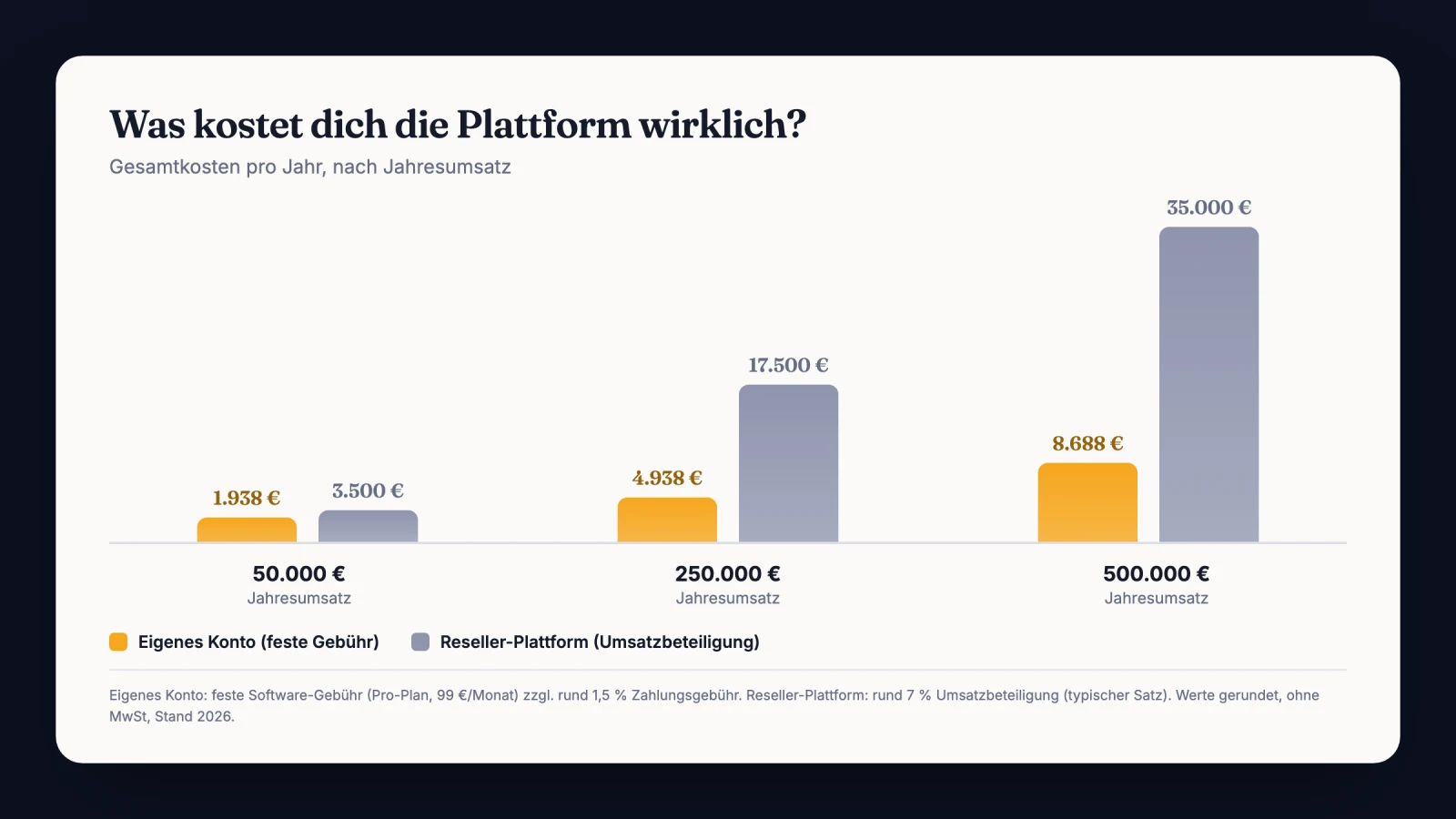
Honestly. If you want affiliate reach for a $200 product, this is the right neighborhood. If you close $20,000 deals on a call, you do not need the model at all.
Alternative 4: ThriveCart as a one-time investment
ThriveCart is the other big US cart and it got famous through its lifetime model. Pay once and use it forever.
After a few years that beats any subscription on paper. For funnel sellers with an English-speaking audience it stays attractive.
It shares most of the high-ticket gaps with SamCart though. No contract flow, no signature and no dunning stages. The full breakdown sits in our piece on ThriveCart alternatives for high-ticket.
Anyway. Picking between two funnel carts does not answer the high-ticket question at all. The full market overview across every model is in the guide to checkout platforms.
SamCart and the alternatives at a glance
| Provider | Focus | Setup effort | High-ticket |
|---|---|---|---|
| SamCart | US funnel cart | Low | No contract or dunning |
| Own checkout | Sales-call deals | Medium | Very strong |
| Bare Stripe | Payments only | High | You build the layer |
| Reseller marketplace | Affiliates and reach | Low | Share eats the margin |
| ThriveCart | US cart, lifetime | Low | Same gaps |
How a US cart nearly killed a signed deal
Quick detour into practice. In one of my best months the pipeline held over 400,000 euros in contract volume. One deal in there sat at 22,000 euros, with a client in Munich.
Back then part of my checkouts ran through a US cart as a test. The client had said yes on the call and wanted to pay right away. Then he opened the link.
Dollar signs in the header. An English error message on his card. No option for a bank transfer anywhere.
He wrote back asking whether this was a legitimate European company. On a 22,000 euro deal that question is poison.
I saved the deal, but only with two extra phone calls and bank details sent by hand. The money came in three days later by transfer. The checkout had processed exactly none of it.
My rule since then is simple. The payment experience has to match the size of the offer and where the buyer sits.
A buyer with 22,000 euros in hand wants his own payment methods and your brand on the page. Everything else costs trust at the most expensive moment in the funnel.
Forget the feature comparison, measure your collected rate
The usual advice on tool choice is to line up features and price. I think that is the wrong yardstick entirely. $79 against $199 is not the math that decides anything here.
The number that matters is your collected contract value. So how much of the signed volume actually reaches your account.
A checkout with an agreement and dunning lifts that rate. It works through drop-offs and stalled installments systematically.
An example at real scale. On $6 million in annual contract volume, two points of collected rate is $120,000. Compare monthly fees instead and you optimize the smallest line in the whole business.
So the upsell comparison between SamCart and the rest is close to irrelevant for us. Upsells optimize $97 purchases.
Collected rate optimizes $20,000 contracts. That is the whole thing.
What I would do in the first 7 days
Want off the funnel cart idea and onto something clean? One focused week is enough. Enough talk, here is the plan.
- Go through your last 20 deals and note which payment methods people asked for.
- Connect your own Stripe account and run one test payment end to end.
- Create your product, your price points and your tax setting.
- Load your agreement with e-signature and click through it once yourself.
- Define Split options for your typical deal sizes.
- Turn on dunning stages and watch the escalation once in test mode.
- Invite your closers and close the first real deal through it.
Skip that test run and you find the broken step in front of a real buyer. Do it properly and you have something no funnel cart gives you. A closing flow built for five-figure offers.
Checklist before you decide
- Target market clear: where do most of my buyers actually sit?
- Payment methods checked: do my buyers need transfers, direct debit or invoices?
- Contract question answered: do my deals need a signature inside the flow?
- Dunning checked: what happens automatically when an installment bounces?
- Currency thought through: is one currency per account enough for me?
- Total cost calculated: plan plus processing plus tax fee plus support add-on.
Sources
- SamCart Pricing (official)
- SamCart Payment Options (official)
- SamCart Knowledge Base: General Marketplace Settings (eight currencies, currency locked at account creation)
- SamCart Knowledge Base: Connecting Payment Processors
- SamCart Knowledge Base: Language Settings
- SamCart Knowledge Base: Digital Wallets
Frequently asked questions about SamCart alternatives
What does SamCart cost per month?
Core is $79 per month and Pro is $199 per month, with Enterprise on request. Annual billing saves 25% and processing runs at 2.9% plus $0.30 per transaction. Tax collection costs 35 to 50 basis points and live support is a $19 add-on.
Does SamCart take a revenue share?
No, SamCart takes no additional platform share of your sales. You pay your plan's fixed price plus the processing fees from SamPay or Stripe. Only automatic tax collection through SamCart costs extra, at 35 to 50 basis points depending on your plan.
Can I sell in more than one currency with SamCart?
Not inside one marketplace. SamCart supports eight currencies, but each marketplace is locked to a single currency at account creation. Selling in USD and EUR means running separate marketplaces on separate subdomains, with separate setups and separate reporting.
Can SamCart handle contracts and signatures?
No, a signature or contract feature is not part of the product. High-ticket deals with a service agreement need a separate tool, and you connect signature and payment yourself. A checkout with a built-in signature closes both inside one session.
Which SamCart alternative fits high-ticket best?
For call-closed deals from $5,000 up, your own checkout on your own accounts fits best. It combines an agreement with an e-signature, live price control and automatic dunning in one flow. Bare Stripe works too if you want to build that layer yourself.
Agreement, signature and payment in one checkout
CloserCart runs on your own accounts with Stripe for cards, Klarna and PayPal. Contract, e-signature and dunning sit inside the same checkout.
Start now for €1 14 days for €1. Cancel monthly. 0% revenue share.