Payhip is a likeable little store for ebooks and templates. The moment you sell offers from $5,000 up, the limits show fast. Here is an honest look at where Payhip is enough and which alternative actually handles high-ticket.
Keep Payhip for downloads and move high-ticket to your own checkout. The other candidates are a hosted cart platform and plain Stripe. Payhip knows no contract, no signature and no payment schedule per deal.
- Payhip is a self-service store for downloads, courses and memberships.
- On the free plan a $10,000 deal costs $500 in platform fees.
- Contract, signature, dunning and per-deal installments are all missing.
- Candidates: your own checkout, a cart platform, plain Stripe, a reseller.
- For offers from $5,000 up you want your own checkout on your own accounts.
If you only sell $19 ebooks and want to keep it that way, you can stop reading here.
The title promises alternatives, so here they are. Four routes, each with its own section below.
- Your own checkout on your accounts: contract, signature and installments per deal.
- A hosted cart platform: order bumps, upsells, better self-service conversion.
- Plain Stripe: bare payment links, nothing else.
- Reseller platforms: someone else's account, tax handling included.
Which route fits comes down to one question. Store or checkout?
Payhip and a dedicated high-ticket checkout compared
| Criterion | Payhip | Your own checkout |
|---|---|---|
| When it fits | Downloads, courses, memberships | Offers from $5,000 up |
| Strengths | Fast start, storefront included | Contract, signature, installments per deal |
| Limits | No contract, no dunning | No marketplace, setup on you |
| Cost model | $0, $29 or $99 plus 5, 2 or 0 percent | Fixed monthly fee, 0 percent share |
What Payhip genuinely does well
Credit where it belongs. Payhip covers digital downloads, online courses, memberships and even 1:1 coaching with Zoom and Calendly hooks. On top there is a store builder with a custom domain at no extra charge.
Every plan includes every feature. Unlimited products, unlimited revenue. That is fairer than a lot of the field.
So you never pay to unlock a feature. You only pay to hand over a smaller percentage. I find that split honest.
Physical products run through the same store. For a coach with a book, a workbook and a course that is convenient. Everything sits in one system.
The money side gets something right too. Payouts run straight through your own Stripe or PayPal account. The cash sits with you the second the transaction clears, with no platform payout cycle.
Taxes? Payhip collects and remits EU VAT and UK VAT automatically. US sales tax and the Canadian equivalent are automated as well, other countries like Australia are not.
For a template shop doing 500 sales a month that is a tidy package. It only gets tight once your offer goes four figures and a closer does the closing.
Where Payhip is strong
- Payouts land in your own Stripe or PayPal account, available instantly.
- EU VAT gets collected and remitted automatically.
- Every feature on every plan, unlimited products and revenue.
Where Payhip quits
- No proposal or contract creation, no digital signature.
- No dunning for failed installments on large contract sums.
- No individual payment plans per deal, self-service purchase only.
What Payhip actually costs
The pricing is simple. Free Forever costs $0 a month plus a 5 percent transaction fee. Plus costs $29 plus 2 percent, Pro costs $99 with no transaction fee.
Sounds decent, right? Now the annoying part.
On every plan you also pay the standard payment processor fees, typically around 2.9 percent plus 30 cents. Pro plan included.
There are no setup or connection charges. That part is clean. All numbers here sit on the official pricing page, as of 2026.
Run the math on a real month. At $90,000 in revenue the free plan pulls $4,500 in platform fees. Pro costs $99 flat in the same month.
So the gap runs four figures, month after month. That is exactly what the price ladder is built for. The model scales with unit count, not with deal size.
Now scale that same model up to high-ticket. A single $10,000 deal costs $500 in platform fees on the free plan, on top of the processor cut. Fine for a self-serve shop, brutal for deals closed on a call.
The break-even points are easy to work out. Free and Plus cross at around $970 in monthly revenue. Plus and Pro cross at around $3,500.
For you that is not even a decision anymore. At your volume Pro is cheapest after the first selling day of the month. The interesting question comes right after.
Self-service checkout: A buying process where the customer picks a finished product at a fixed price on their own. No sales call, no contract, no individual payment schedule. Payhip is exactly that: strong for downloads and courses, but not built for negotiated high-ticket deals with installments over a contract sum.
One store, one currency: the international check
Payhip prices its plans in USD, which suits a US seller fine. Inside the store you pick a currency, one of 39 supported. But only one currency per store.
Same pattern with language. A store runs in one of 15 languages, and again only one per store. The seller dashboard stays English.
Sell into the UK, Canada and the EU and it gets tighter. Every visitor sees the same currency tag. A London buyer converts your price in their head.
This is where most people stumble. Navigation, collection names, product titles and custom email subjects are manual work. I once spent half an afternoon rewriting button labels by hand.
Sounds like a small thing. On a $200 course it is one.
For a client putting $15,000 on the table, details carry weight. Any wording that reads off at the wrong second costs trust.
Payment methods: solid base, one gap that hurts B2B
On payment methods Payhip delivers a decent base. Credit and debit cards from Visa to Mastercard to Amex, plus PayPal, Apple Pay and Google Pay. Regional methods like iDEAL arrive through the gateway.
Available gateways include Stripe, PayPal, Square and Mollie. For international download buyers that is plenty.
One real advantage sits in that list: you pick the processor yourself instead of inheriting one. Already running a Mollie or Square account? Just hook it up.
On five-figure amounts, business buyers still ask for other routes.
- An invoice with net terms their AP team can approve.
- ACH debit for monthly installments running over a year.
- A payment schedule written into the signed contract.
That is where the gap opens for high-ticket. ACH debit and pay-by-invoice are not advertised checkout methods. Two of the three wishes on that list drop out.
It comes back to bite you the moment a buyer says on the call: "Send me an invoice, we will wire it." With a card-only store you have no clean process for that. Which providers handle it better is in the big checkout platforms comparison.
The real deal-breaker: no contract, no installments per deal
Now the core. Payhip has no proposal builder, no contract feature and no digital signature. There are also no individual payment plans per deal, meaning installments over a negotiated contract sum.
On a $20,000 program that is not a nice-to-have. Without a signed contract you hold nothing when a dispute starts. How that runs cleanly is in sign a contract digitally.
Then there is dunning. Payhip has no dunning for failed installments on large contract sums. On memberships you only get the standard retry from the payment processor.
This blows up in your face when installment four of a $24,000 deal bounces. Nobody chases, nobody escalates. What to do at that point I wrote up in customer not paying installments.
Picture the moment right after the yes on the call. Your buyer has committed and now wants a signature and a schedule. A product link cannot hold that moment.
One thing for context: this is not a failure on Payhip's side. The product is deliberately built for low-ticket volume, downloads and courses. High-ticket was never the goal.
The expensive mistake
Selling a $15,000 program through a download store. With no contract, no signature and no dunning, a failed installment leaves you without proof and without a process. One default costs more than years of software fees.
The trap I used to rebuild payment schedules as membership subscriptions, because the store could do nothing else. On a $24,000 deal split over twelve months, the card died in month five. The processor's standard retry ran twice, then silence.
The fix Today every schedule hangs off a signed contract over the full sum. Every installment gets monitored, chased and escalated when it has to be. The same deal type would have collected out without drama.
Alternative 1: your own checkout on your own accounts
This is the route for anyone who sells on a call. You connect your own payment provider accounts to a checkout built for deals. Contract, signature and schedule hang off every single order.
Staying honest: for a pure download catalog this is overkill. The route only pays once a human does the closing.
The flow revolves around one link. Your closer sends it during the call, sets price and schedule live behind it, the buyer signs and pays. At CloserCart that schedule is called a Split.
The difference to the store model sits in the detail. A store sells a finished product at list price to everyone. A deal checkout carries what you negotiated: deposit, installment size, start date.
Okay, quick detour. Your team benefits too.
A closer builds price tiers and Splits without any access to your payment backend. How to set the plan up cleanly is in offering payment plans as a coach.
The money runs through your accounts, same as with Payhip. No middleman, no revenue share. How the connection works sits on the connect your own payment provider accounts page.
Here is roughly what the switch looks like.
- Connect your own provider accounts to the checkout.
- Create the product with price tiers and tax settings.
- Add the contract with a digital signature.
- Run a test deal, then sell live.
This is where plenty of people trip, because they skip the test deal. Your first real customer then finds every config error for you.
Insider tip
I create a small test order for every new setup step and pay a token amount myself. That way I watch receipt, contract and payout run end to end, before a $20,000 deal goes through the link.
Alternative 2: a dedicated cart platform
Hosted cart platforms are the obvious step up from a simple store. ThriveCart and SamCart are the names you hear most in the US. They build around the checkout itself, with order bumps, one-click upsells and A/B tests.
For course sellers at mid price points that is a solid move. Fair enough: on checkout conversion tooling these platforms are ahead of a plain storefront.
The upgrade pays off best on offers in the hundreds. A sharper checkout page plus a bump lifts average order value across volume. That is real everyday value.
Check one thing before you decide: does the platform take a percentage of your revenue, and what does the license actually cover? On a single $20,000 deal every point shows up immediately. I mapped the field in the SamCart alternatives.
For negotiated high-ticket deals it stays a product catalog with a buy button. Closer logic with an individual deal per customer is a different game.
Alternative 3: plain Stripe with Payment Links
You can also work with no platform at all. Stripe directly, one payment link per offer. No platform fee, just the normal processing cost.
One point clearly favors it. Nothing extra rides on top of your revenue. On five-figure amounts you feel that right away.
The catch is everything around it. No contract, no signature, no dunning, no deal management. You build it yourself or it does not exist.
The work lands entirely on your desk. Every deal means: build the link, write the contract, track due dates in a calendar. Not pretty, but that is how it goes.
For a developer with time it is doable. A sales team closes deals between $15,000 and $30,000 every week. That DIY setup turns into the bottleneck fast.
More candidates for this use case sit in the ThriveCart alternative for high-ticket.
Alternative 4: reseller platforms for the tax work
There is a fourth route, and it is common on both sides of the Atlantic. Reseller platforms formally buy your product and resell it.
That makes them your customer's contract party. They remit sales tax and VAT per country and issue the invoice. On sales across many countries that saves real accounting time.
Honestly. For a product sale with no call attached it is a comfortable model.
The price sits in the fine print. Your money runs through someone else's account and reaches you on their payout schedule. On top comes a share of every dollar you earn.
What that does over a year reads best as a curve.
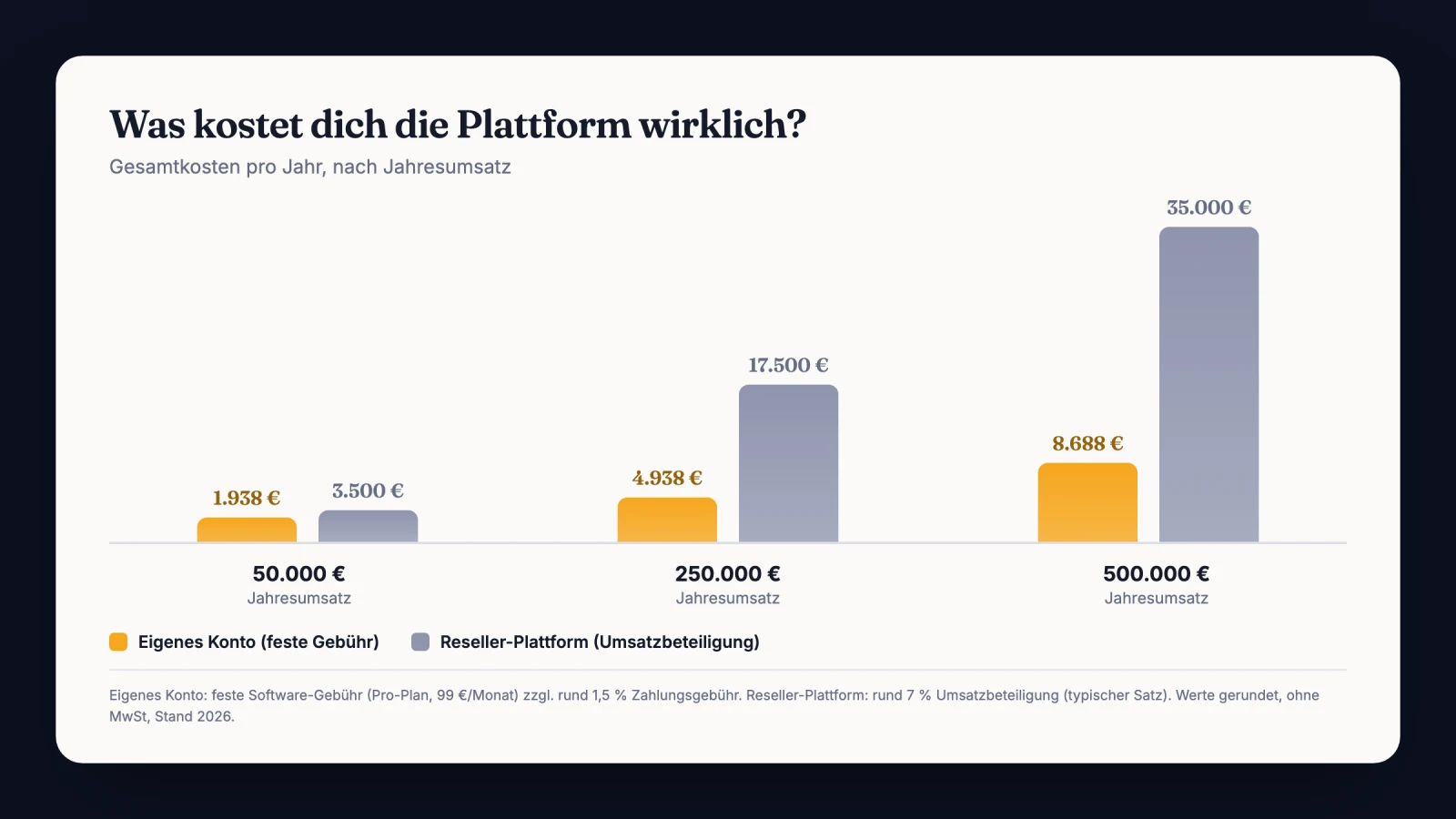
Run it on your numbers. Five percent on $90,000 in monthly revenue is $4,500, so $54,000 a year. In return you get a payment flow.
This is where it tips as your volume climbs. Double the revenue and the cost doubles with it. The platform does the exact same work either way.
Enough one at a time. Here is the overview.
Payhip alternatives at a glance
| Provider | Type | Strength | High-ticket |
|---|---|---|---|
| Payhip | Download store | Simple start | Not built for it |
| Own checkout | Deal checkout | Contract plus installments | Very strong |
| Cart platform | Hosted cart | Bumps and upsells | Solid to middling |
| Plain Stripe | Own account | Full flexibility | No contract logic |
| Reseller platform | Reseller | Tax included | Costly at volume |
How a download checkout cost me a close
Short story from before my setup existed. We were running around $300,000 in contract volume a month back then. The process behind it was still handwork.
A client bought a program for $18,000, right there on the call. He wanted three installments and a written agreement.
My checkout at the time could not do exactly that. So I sent him three separate purchase links and an informal PDF by email. He was supposed to click each link in the right month, on trust.
He paid the first installment. Then his accountant joined and asked for the signed contract. There was none, only my email and two open links.
The conversation after that was awkward. He suddenly felt unsure, even though the program was excellent. We went back and forth for two weeks until installment two landed.
The third never came. I had no contract, no waiver of the right of withdrawal, no clean basis. In the end I wrote off $6,000.
One lesson stuck with me. The checkout has to fit the deal, not the product catalog. Everything else is self-deception.
Forget the 0 percent fee as a decision criterion
The standard advice on picking a platform: take the plan with the lowest transaction fee. I think that is the wrong metric. Zero percent buys you nothing if the platform cannot represent your deal type.
Count in secured deals instead. A signed $25,000 contract with monitored installments beats three points of savings on a checkout with no safety net.
The better number is net payout per closed deal. So what actually lands after fees, defaults and write-offs. The cheapest store loses that contest regularly.
Put two numbers side by side. On the left your annual software cost. On the right the amount you write off when a schedule breaks.
At high-ticket the number on the right is almost always bigger. That is why the safety net decides, not the fee line. Staring at percentages optimizes the smaller side.
Once you have seen that math, you cannot unsee it. A single rescued payment plan funds years of a fixed monthly fee.
Myth
Payhip acts as Merchant of Record for all my taxes worldwide, so I never have to think about any of it.
Reality
Payhip is Merchant-of-Record-like for certain taxes only. EU VAT and UK VAT get collected and remitted automatically, US and Canada are automated as well.
Other jurisdictions like Australian GST are not covered. So it is not a complete hands-off package.
What I would do in the first 7 days
Nothing here needs rushing. Payhip can keep running while you build the high-ticket path. One week is enough for a clean move.
- Split your revenue: what is self-service, what is a sales-call deal?
- Add up your Payhip fees from the last quarter, honestly.
- Create your own checkout and connect your provider accounts.
- Add the contract with digital signature and withdrawal waiver.
- Build price tiers and Split options for your core offer.
- Run a complete test deal including a small test payment.
- Close your next real sales call through the new checkout.
Stick to that order. The contract has to exist before the first link goes out. Otherwise you are selling with no basis again.
Downloads stay where they are well served. Only the big deals move. If you want out completely, Gumroad alternatives for more than $10 products helps you map the store world.
Before your first high-ticket deal runs through the new checkout
- Own payment provider accounts connected and a test payment cleared.
- Contract with signature clicked through end to end yourself.
- Split plan created for your core offer.
- Tax setting checked on every product.
- Thank-you page and receipt branded to your company.
Frequently asked questions about Payhip alternatives
What is the best Payhip alternative?
There are two sensible ones. For downloads and courses at mid price points, a hosted cart platform is the obvious upgrade, because bumps and upsells lift the order value.
For negotiated deals from $5,000 up you want your own checkout with contract, signature and Split. Payhip is not bad, it is just built for self-service.
What does Payhip really cost?
Free costs $0 plus a 5 percent transaction fee, Plus $29 plus 2 percent, Pro $99 with no transaction fee. On every plan the processor fees from Stripe or PayPal come on top, typically around 2.9 percent plus 30 cents per payment.
Can I run Payhip in another language or currency?
Your store runs in one of 15 languages and one of 39 currencies, but only one of each per store. The seller dashboard stays English. Navigation, collection names, product copy and custom email subjects have to be translated by hand.
Does Payhip offer installments for large amounts?
Individual payment plans per deal, meaning installments over a negotiated contract sum, do not exist on Payhip. There is no dunning for failed installments either. For Splits on offers from $5,000 up you need a checkout that handles deals instead of products.
Can I use Payhip and my own checkout side by side?
Yes, and that is the most relaxed route. Downloads and cheap courses stay in the store, your sales-call deals run through your own checkout with contract and Split. You lose nothing and you test the new path without risk.
Sources
Connect your own accounts and close real deals
CloserCart connects your own payment provider accounts, at 0% revenue share. Contract, signature and Split run live behind a single link, steered by your closer.
Start now for €1 14 days for €1. Cancel monthly. 0% revenue share.