
AffiliCon takes invoicing, VAT and payouts off your plate. That's genuinely convenient, and it carries a price on every single sale. Once you're closing real High-Ticket deals, your own checkout on your own accounts is the better structure. Here's a fair look at when AffiliCon fits and which alternatives are worth the move.
Build your checkout on your own accounts and keep AffiliCon where it still earns its place. The 7% + €1 per sale is fair on small products, brutal on a €15,000 deal. At High-Ticket you need a contract, a signature and your own collections, all outside the Reseller model.
- AffiliCon charges no base fee, but takes 7% + €1 on every sale.
- As a Reseller it handles VAT and invoicing, which is strong for EU sales.
- Custom contracts, signatures and negotiated payment plans sit outside the model.
- For deals from €4,000 up: your own checkout, with AffiliCon still connected as a handoff.
If you only sell small digital products through affiliates, you can stop reading here. You probably want nothing to do with tax handling anyway.
For everyone else, let's start with the question underneath all of this. Reseller or your own account?
AffiliCon and your own checkout compared
| Criterion | AffiliCon | Own checkout |
|---|---|---|
| When it fits | Digital products, affiliate sales | Offers from €4,000 up |
| Strengths | VAT handling, no base fee | 0% revenue share, your own accounts |
| Limits | 7% + €1, no selling in your name | Setup and VAT sit with you |
| Cost model | Fee per transaction | Fixed monthly fee |
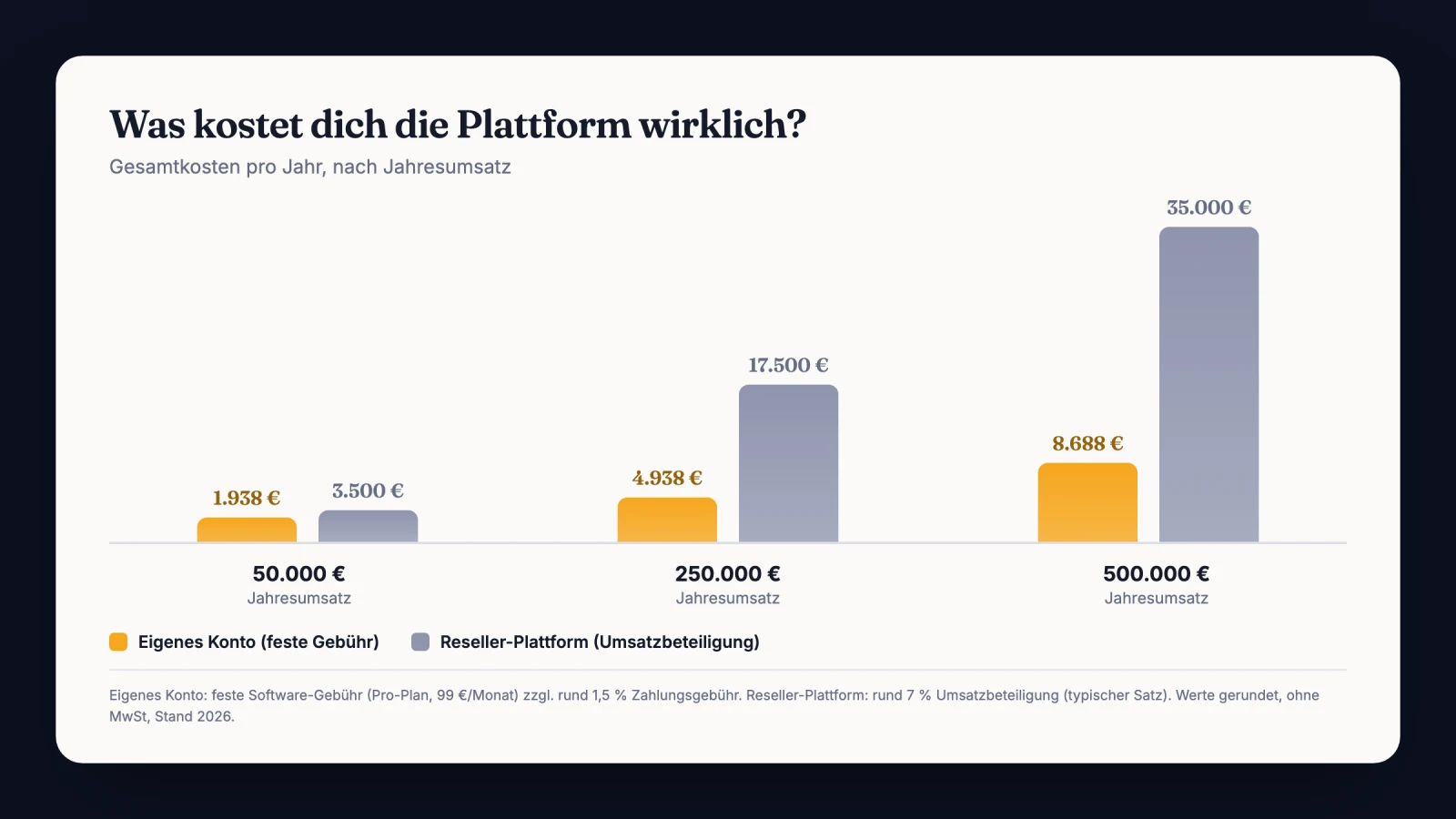
The difference isn't the brand, it's the cost model. A percentage grows right along with your revenue. A fixed fee doesn't:
What AffiliCon actually does well, honestly
Credit where it's due first. AffiliCon sits in Cologne, according to its own website. It has been in the market for over 14 years.
Platform, support and accounting are fully German. That's a real edge if a chunk of your buyers sit in the EU.
The fee model is transparent. No base fee, no setup cost, just 7% + €1 on every successful transaction. On a €119 product that works out to €9.33, by AffiliCon's own math.
At your ticket sizes, the same formula reads very differently. A €18,000 coaching program costs you €1,261 in fees. Per deal, every time.
Then there's the VAT handling. AffiliCon is the invoicing party, calculates the country-specific VAT rate and remits it. If you sell a lot across EU borders, the whole OSS headache disappears.
Payouts are cleanly solved too. Weekly, biweekly or monthly, free of charge, via SEPA or PayPal from €100 net balance. Nothing to complain about there.
So where does this blow up anyway? The moment your ticket goes five figures and the customer expects a contract with you personally.
What speaks for AffiliCon
- No base fee, you only pay when a real sale happens.
- VAT and compliant invoicing are handled entirely by the platform.
- Built-in affiliate network with automatic commission splits.
Where the limits are
- 7% + €1 becomes your biggest cost block at high tickets.
- The purchase contract forms with AffiliCon, not with you.
- Negotiated payment plans, your own contracts and signatures sit outside the model.
The Reseller model decides this, not the provider
Before you compare alternatives, you need to understand the model. AffiliCon sells your products in its own name. The customer enters a purchase contract with AffiliCon GmbH, not with you.
Reseller model: A payment provider becomes the official seller and invoicing party for your digital products and services. The end customer legally buys from the platform, which calculates the VAT, remits it and pays you out net. You save yourself the tax work and give up the contractual relationship with your customer.
That brings real upside, especially on cross-border EU sales. It also has a hard ceiling. You aren't selling in your own name.
Anyone selling a bespoke service under their own contract doesn't fit that template. How the model works in detail is covered in what is a Reseller, definition and VAT consequences.
This comes back to bite you the day you want to enforce an unpaid balance in your own name.
Myth
No base fee means AffiliCon is the cheapest option.
Reality
No base fee only means your costs grow with your revenue. On a €15,000 deal, 7% + €1 is exactly €1,051, charged on the gross price. A fixed monthly fee is dramatically cheaper from that level up.
In a month with €300,000 in contract volume, 7% is exactly €21,000 in fees. Scale to half a million a month and you're into six figures a year. You just never feel it, because the cut happens before the payout hits you.
Alternative 1: your own checkout on your own accounts
This is the structure that carries High-Ticket best. You connect your own provider accounts. Every payment lands directly with you.
Stripe covers card, Klarna and PayPal. And here's the part most people miss: AffiliCon keeps running alongside it as a redirect provider, next to Ablefy. You don't have to cancel anything to change your structure.
The core of it is a single link per customer. Your Closer controls price, payment method and split live behind it. The customer sees every change instantly, with no new link.
Payment plans deserve their own chapter here. At CloserCart they're called splits, and they run embedded through Stripe with a down payment and flexible installments. That's exactly what a Reseller checkout can't model for a negotiated deal.
On top of that comes the legal layer a bare payment link never gives you. Contract, digital signature and waiver of withdrawal belong in the system as a timestamped PDF. The customer buys from you, with your name on the document.
Which providers you can actually connect is laid out on the connect payment providers page. Without that foundation, you lose exactly the moment when the third installment bounces.
Insider tip
After switching, I leave AffiliCon active in the checkout as a redirect option. Existing products just keep running while new deals go through my own accounts. The move then happens offer by offer, instead of as one risky cutover date.
Alternative 2: Digistore24 and CopeCart
These are the two obvious moves in the German-speaking market. Both are reputable and work cleanly. The model, though, is nearly identical to AffiliCon's.
Digistore24's strength is its marketplace. The affiliate network is huge and brings genuine reach. If you scale through outside sellers, you'll find more volume here.
CopeCart is the second large Reseller in that corner. Its focus leans more toward coaches and info products. How that model runs is covered in what is CopeCart, how the Reseller checkout works.
Neither one solves your actual problem. You swap one Reseller for the next and keep the percentage fee. For a wider provider comparison, see Digistore24 alternatives, the best providers compared.
Honestly? As an AffiliCon alternative, that's a sidestep. It makes sense if the affiliate network matters more to you than your margin.
Alternative 3: Ablefy
Ablefy has carried that name since late 2024, before which the platform ran as elopage. It's the most flexible German option on this list.
You can work there in Reseller mode or as the seller of record. That's a real difference from pure Resellers.
For courses, memberships and payment plans, Ablefy is mature. German invoicing logic, a solid interface. Plenty of course sellers are rightly happy with it.
Sounds like the answer, right? The catch sits somewhere else.
Ablefy is a product sales platform. It isn't built for Closer-led calls with live price control and a custom contract.
To stay fair: if you sell standardized products through self-checkout, Ablefy serves you well. If you negotiate deals on the phone, you hit the same ceiling as with any catalog checkout.
Alternative 4: plain Stripe with Payment Links
The most radical route is Stripe with nothing around it. No revenue share, just the normal transaction fee. Full control over your money.
In exchange you're completely exposed. No contract, no signature, no dunning, no per-product VAT logic. Everything AffiliCon took off your plate suddenly lands back on it.
This is where most people trip. The link is quick to build, the process behind it is missing. On a €20,000 deal with six installments, that process is the actual product.
For a dev team with time, plain Stripe is still an honest option. For a sales floor with no engineer, less so.
Okay. Here are the four routes side by side.
AffiliCon alternatives at a glance
| Provider | Model | Cost | For High-Ticket |
|---|---|---|---|
| Own checkout | Your own accounts | Fixed fee | Very strong |
| Digistore24 | Reseller | Per sale | More of a marketplace |
| CopeCart | Reseller | Per sale | Same model as AffiliCon |
| Ablefy | Reseller or seller | Depends on plan | Solid for courses |
| Plain Stripe | Your own account | Transaction fee only | No contract logic |
Payment plans are where this actually breaks
At High-Ticket, almost nobody pays the full amount at once. Splitting into installments is the norm. And this is exactly where the Reseller model parts ways with your own checkout.
AffiliCon supports subscriptions and recurring payments. If a charge bounces, the platform automatically sends a payment reminder with bank details. That's handled properly.
It's just AffiliCon's reminder, not yours. As the Reseller, AffiliCon is the creditor. Your name appears on none of those documents.
Custom payment plans for negotiated deals aren't listed on the official payment methods page. A down payment today, the rest over five monthly installments starting after onboarding, that's a sales-call construction. The model simply isn't built for it.
And structurally there's no collections process in your name. You aren't the customer's contractual counterparty. Most people only discover that months later, when the first balance stays open.
The expensive mistake
Running five-figure deals with installment logic through a catalog checkout that knows no contract in your name. If an installment stays open, you have no enforceable claim with a signature and a paper trail. Then you negotiate from the weak position and write off four-figure amounts.
The trap A €24,000 deal, negotiated as a down payment plus ten installments. I used to stitch that kind of construction together from individual payment links. After installment four it went silent, and I had neither a contract nor a clean history in one place.
The fix Today every negotiated deal runs through a checkout with a signed contract and a monitored split. Every installment has a receipt and a dunning stage. That old case came in fully after two reminders, and I haven't written anything off since.
How a cutover date almost cost me €18,000
Short story from my own kitchen. On my first structural switch, I wanted it clean and fast. Old provider out, new checkout in, all over one weekend.
Monday morning my Closer was on a call with a hot prospect. €18,000 contract volume, decision still live in the conversation. He sent the checkout link from his old notes.
The link went nowhere. The customer sat staring at an error page while my Closer pitched the price. For ten minutes our whole operation looked amateur.
The Closer saved it. He stayed calm, built a fresh order live in the new system and sent the link during the call. The customer signed twenty minutes later.
Saved, but barely. The lesson: a switch isn't a cutover date, it's a period of parallel operation. Old links only die once the whole team is using the new ones.
We've had a rule ever since. Every migration runs on both tracks for at least two weeks. Not elegant, and it hasn't cost us a single deal since.
Forget the question about the cheapest fee
The standard advice in every forum: run the numbers on all providers and take the cheapest. I think that's the wrong question. The fee is only one line of your P&L.
The number that matters more is your net payout per closed deal. That includes bounced installments, lost disputes and abandoned checkouts. Half a percent in fee savings is nothing against a single written-off €20,000 balance.
So I'd choose the structure first and compare prices second. Do you sell in your own name with a contract, or does a platform sell for you? That answer sorts the providers almost by itself.
Once you've run it that way, you see it immediately. The fee question answers itself in the end. For an overview of all the models, see the big checkout platforms comparison.
What I'd do in the first 7 days
You don't need a migration project. One focused week is enough to get the new structure standing. After that you decide product by product what runs where.
- Run your last 90 days honestly: revenue times fee rate against a fixed monthly fee.
- Connect your Stripe account and test one small real payment including the receipt.
- Add AffiliCon as a redirect provider for the products that should stay there.
- Set up your contract with a digital signature and sign it once yourself as a test.
- Build your first price point plus a split the way you actually offer it on calls.
- Close your first real deal through the new checkout, in parallel with the old route.
- Only now plan which legacy products you migrate, calmly and with no deadline.
Anyway. The critical piece is running both in parallel. The right sequence for active installments is laid out in switching payment providers, a guide with zero lost revenue.
Before you cancel anything
- A real payment has run through the new checkout with a clean receipt.
- Contract, signature and VAT setting are checked per product.
- All Closers are using only the new links.
- Active subscriptions and installments at the old provider are documented and running out.
Sources
Frequently asked questions about AffiliCon alternatives
Is AffiliCon reputable?
Yes. It's a German company headquartered in Cologne, with more than 14 years on the market by its own account. Support and billing run in German, in euros.
Invoices to end customers are compliant, and VAT is remitted by the Reseller. So the question isn't reputability, it's whether the model fits your offer.
What does AffiliCon really cost?
There's no monthly base fee and no setup cost. Every successful transaction carries 7% + €1 on the gross sale price, so €9.33 on a €119 product. Payouts are free, weekly, biweekly or monthly from €100 net balance.
That's what the official fee page states, checked in 2026. On an €18,000 deal, that comes to €1,261.
Do I have to cancel AffiliCon if I move to my own checkout?
No. In CloserCart, AffiliCon is integrated as a redirect provider alongside Ablefy. Card, Klarna and PayPal run next to it directly through your own Stripe account.
You simply let existing products and active subscriptions keep running there. New High-Ticket deals go through your own accounts in parallel, with a contract and a split.
Who handles VAT if I sell in my own name?
You do. With your own account you're the invoicing party and remit VAT yourself. For cross-border EU sales, that typically runs through the OSS scheme.
In exchange you receive the full payment and set VAT per product. B2B cases like reverse charge are handled cleanly too.
Does AffiliCon offer payment plans for High-Ticket deals?
AffiliCon supports subscriptions and recurring payments, including an automatic reminder when a charge bounces. Custom payment plans for negotiated deals aren't listed on the official payment methods page. For a down payment plus flexible installments with a contract, you need a checkout on your own accounts.
Your accounts, your contract, AffiliCon still connected
CloserCart connects Stripe, Klarna, PayPal, AffiliCon and Ablefy in one checkout with 0% revenue share. Contract, signature and splits are controlled live behind a single link.
Start now for €1 14 days for €1. Cancel monthly. 0% revenue share.