
Gumroad is perfect for the $10 ebook someone buys at 2am on impulse. For an offer from $5,000 up it is the wrong tool. Here is where Gumroad shines and which alternative actually holds up once your prices go four figures.
Keep Gumroad for low-ticket. Move everything from $5,000 up to your own checkout. Gumroad takes roughly 13 percent per direct sale and knows no contract, no signature and no dunning.
For high-ticket you need exactly those three things.
- Gumroad costs 10% plus $0.50 per direct sale, plus payment processing.
- Through the Discover marketplace the fee jumps to 30% per sale.
- No contract, no signature, no dunning: high-ticket needs all three.
- Three ways out: your own checkout, a reseller marketplace or plain Stripe.
If you only sell ebooks and templates under $100 to a global audience, you can stop reading here.
The title says it already. Past a certain price point the math flips. Let's put the two worlds side by side.
Gumroad and your own checkout compared
| Criterion | Gumroad | Your own checkout |
|---|---|---|
| When it fits | Low-ticket, impulse buys, global | Offers from $5,000 up |
| Strengths | No monthly fee, MoR handles the tax | 0% revenue share, contract, splits, dunning |
| Limits | Roughly 13% cut, no contract logic | Fixed monthly fee, setup on you |
| Cost model | 10% plus $0.50, Discover 30% | Fixed fee, payment fees direct |
What Gumroad is actually built for
Honestly, Gumroad made creator selling simpler than almost any other platform. Upload a product, share a link, done.
There is no monthly plan and no setup fee. Costs only start when you sell. For small digital products that is a fair deal.
The tech side holds up too. Memberships run without extra fees. Paid products carry files up to 16 GB, which covers courses, presets and ebooks easily.
Payouts run weekly, on Fridays. US creators get free direct deposit. Internationally it goes by bank transfer or PayPal depending on the country.
The problem starts somewhere else. Gumroad is built for the purchase that needs no conversation.
The moment a buyer wants two calls first, you are outside the system. The platform only knows the click-to-buy.
That comes back to bite you the day a $15,000 offer runs through a bare payment link.
What Gumroad does well
- No monthly fee, you pay only on real sales.
- As Merchant of Record it handles sales tax and VAT worldwide.
- Memberships and large files are included at no extra cost.
Where Gumroad slows you down
- Roughly 13% total cut per direct sale, 30% through Discover.
- No digital signature, no contract PDF, no dunning.
- Built for anonymous click-buys, not for deals closed on a call.
What Gumroad really costs per sale
The official number sounds harmless. 10 percent plus $0.50 per direct sale. Sounds fair at first, right?
Now the annoying part. Payment processing lands on top. Card processing sits around 2.9 percent plus $0.30.
Effectively a direct sale runs at roughly 13 percent total. On a $49 product that is pocket change. On a $20,000 engagement it is about $2,600, per deal.
The math flips the moment your average close hits five figures. The percentage scales with the ticket. Your delivery behind it does not.
If the buyer comes through the Discover marketplace, a different tier applies. Gumroad then takes 30 percent per transaction, processing included. That is the price of borrowed traffic.
One fair point for US sellers. The fees are denominated in USD, so there is no currency friction on your side. Bill in euros or pounds and the spread quietly eats a little more.
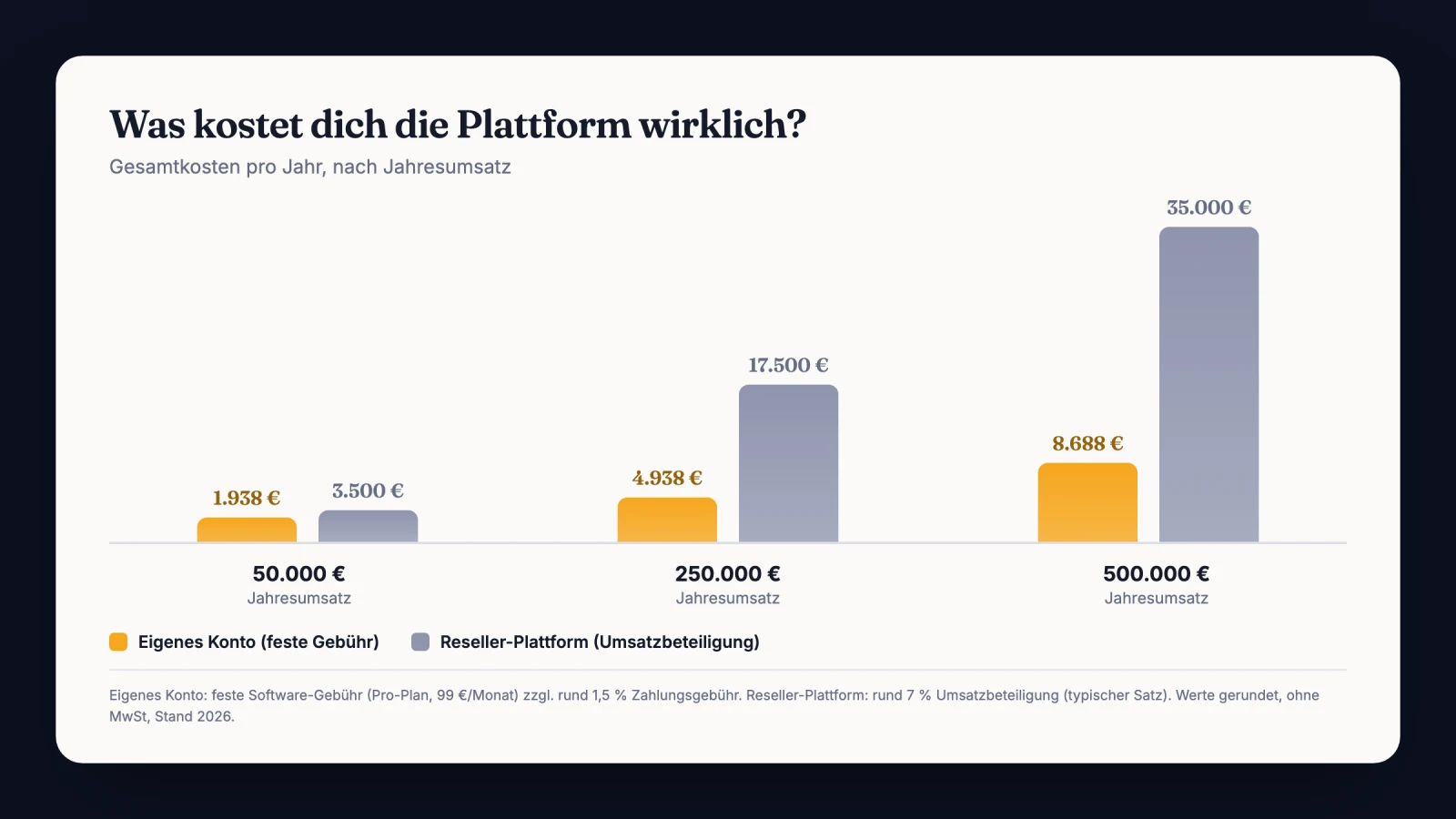
Here is how percentage cuts develop against a fixed fee over a year:
The expensive mistake
Selling a four-figure offer through a percentage platform and never running the numbers. At roughly 13 percent on a $20,000 deal you lose about $2,600 per close. Five closes a month and a six-figure amount is missing at year-end.
Merchant of Record: Gumroad sells, not you
Since early 2025 Gumroad is Merchant of Record. Sales tax, VAT and GST get calculated, collected and remitted worldwide. The tax settings in your dashboard are switched off.
For low-ticket that is a strong argument. You never touch tax rates in 40 countries. Gumroad handles all of it.
Merchant of Record (MoR): A provider that legally sells your products in its own name. The customer buys from the platform, not from you. The provider calculates the sales tax or VAT, remits it and pays out your share minus fees.
You gain convenience and give up the customer relationship.
In practice that means Gumroad is the seller facing your buyer, not you. The receipt does not carry your name.
On a $29 product nobody cares. On a $20,000 engagement it looks different, because your corporate client expects a clean invoice from YOU. Plenty of people get burned right here, because they never questioned the model.
Myth
Merchant of Record is always better, because the platform handles all the tax.
Reality
MoR is convenient for anonymous mass sales into many countries. With consultative offers you sell to known clients, often B2B.
There you want to be the contract party yourself, with your own invoice and your own tax logic. Otherwise reverse charge and custom contract terms never map cleanly.
What Gumroad is completely missing for high-ticket
Now the core. High-ticket is not an impulse buy, it is a close after a conversation. The checkout then needs three things Gumroad does not have.
First the contract. Gumroad offers no digital signature and no contract PDF. There is no waiver or B2B documentation either, because that was simply never the audience.
Second, real installments. Gumroad does subscriptions, and those are cancel-anytime.
A buyer can walk after payment two. That is not an owed plan over the full contract sum.
Third, dunning. When a payment fails there is no automatic reminder and no collections on open installments. You notice eventually, and then you chase the money by hand.
This blows up in your face when a $24,000 engagement runs over twelve monthly payments. The client cancels his subscription after payment three, and the rest is gone. Not fun.
An installment plan without a signed contract is a subscription with hope attached. Legally the client owes you only what he has already paid. Everything after that is goodwill.
Alternative 1: your own checkout on your own accounts
This is the alternative that fits best from $5,000 up. You connect your own payment provider accounts. The money lands with you directly, with no revenue share.
That is exactly what CloserCart is built for. Through your own payment provider accounts cards, Klarna and PayPal run straight through Stripe. Redirect providers hook in on top.
No platform sits between you and your revenue.
Then comes the contract layer. The client signs digitally, with timestamp and IP in the PDF. At CloserCart that is called a Split, an owed schedule running through your Stripe account.
And your sales team works inside it. A closer sets price and payment method live behind a single link. No access to your payment backend needed.
Staying honest here. This model costs a fixed monthly fee, and you set the checkout up once yourself. Below four-figure tickets that effort simply does not pay off.
Here is what getting started looks like:
- Connect Stripe and your other providers in the dashboard.
- Create the product with price points and tax settings.
- Add the contract with digital signature.
- Send a test link and close the first real deal.
Insider tip
I test every new checkout with a real one-dollar payment through my own Stripe account. Five minutes later I know whether receipt, payout and thank-you page run clean. Only after that do the big tickets go through the link.
Alternative 2: reseller marketplaces
ClickBank, Paddle and Lemon Squeezy are the well-known names in this model. The platform sells in your name and handles invoicing and tax. That is the Gumroad MoR principle with a bigger affiliate layer on top.
For reach that is a real step forward. Affiliate networks, familiar payment methods, a checkout buyers recognize. If you want marketplace traffic, you are in decent hands here.
The cost model stays percentage-based though. Every per-sale cut scales with your ticket. I wrote the details up in the ClickBank alternatives.
The invoice question also stays identical to Gumroad. In the reseller model the platform sits on the receipt, not your company. On a B2B engagement your client's accounting team asks about that sooner or later.
Then there is the payout rhythm. The money runs through the platform first and reaches you on their schedule. On small amounts that is irrelevant, on six-figure months you plan around it.
And the contract gap remains. Reseller platforms are built for the click-buy as well, not for the close after a sales call. Sell after two calls and a contract review and you are working against the tool.
What the model means in principle, the article what is a reseller walks through calmly.
Alternative 3: plain Stripe with Payment Links
You can also replace Gumroad with bare Stripe. Payment Links cost no platform share, only the normal transaction fee. For technical people that is tempting.
The catch is everything around it. Plain Stripe has no contract, no signature and no dunning. You also lose the MoR convenience, so tax lands back on your own desk.
This is where most people stumble. The payment works, but the legal and sales layer is missing entirely. When an installment plan breaks you stand there with no document and no process.
I ran it that way myself for two months. One-time payments were clean. The first installment client ended it.
For simple one-time payments to tech-savvy founders, plain Stripe is still solid. Just not a high-ticket system. One building block of it.
Quick pause before we move on. Here are all the options side by side.
The alternatives at a glance
| Provider | Model | Cost per sale | For high-ticket |
|---|---|---|---|
| Gumroad | Merchant of Record | Roughly 13%, Discover 30% | Not built for it |
| Own checkout | Your own accounts | 0% revenue share | Very strong |
| Reseller marketplaces | Reseller | Share per sale | More marketplace |
| Plain Stripe | Own account | Payment fee only | No contract logic |
Refunds: the part almost nobody reads first
Okay, quick detour. On a refund Gumroad returns the full purchase price to the buyer. The platform keeps its fees.
That is not only the 10 percent plus $0.50. The payment processing does not come back either. So a canceled sale costs you the complete cut.
Run it once. On a $12,000 sale roughly $1,560 is gone. It stays gone, even though the customer got every dollar back.
That is the uncomfortable asymmetry. Your revenue rolls back to zero, the deduction does not. Two reversals a month and you are paying for sales that never happened.
Chargebacks follow different rules than refunds. So do not count on a dispute costing you nothing.
This is exactly why every big deal needs a signed contract with an evidence trail. How that runs cleanly, the article sign a contract digitally shows. Without that proof you lose disputes you would have won in two minutes with a PDF.
How a payment link nearly cost me a big close
A few years back I made it too easy on myself. A client had said yes on the call to an $18,000 engagement. Afterwards I sent him a bare payment link, the way I knew it from small products.
He opened it and paused. A plain payment window, no contract details, no scope of work. Nothing of what we had discussed.
Then his accountant joined the conversation. He wanted a proper invoice with itemized services before anything moved. The deal suddenly sat on ice for four days.
Four days is an eternity in sales. Every day of silence cools a warm close. I slept badly that week, believe me.
A phone call and a hastily built contract PDF saved it. The client signed and the first payment came in. It was not clean though, and I had not earned the save either.
Since then the rule is simple: no four-figure close without contract, signature and a clear payment schedule. And yes, I have messed this up. Exactly once.
Forget fee optimization
The standard advice in every comparison goes like this. Pick the platform with the lowest fees. I think that is the wrong question, because at high-ticket the fee is not your most important number.
What matters is how much of every deal actually arrives. Net payout per deal, not percentage points on paper. One broken installment costs you more than three years of fee differences.
Run an example. One percent saved on $2 million in annual contract volume is $20,000. A single unpaid balance of $24,000 eats all of it.
And that rate you move actively. A client who signed a contract pays differently than one who clicked a subscription. That is not a tech question, it is a commitment question.
So the right metric is the completion rate of your payment plans. A checkout with contract, monitoring and dunning lifts exactly that rate. No open balance sits around unnoticed anymore.
Anyway. Look only at the fee and you are optimizing the wrong lever. The big overview of all models sits in the checkout platforms comparison.
What I would do in the first 7 days
No mammoth project. One focused week is enough for the move. Here is how I would split it.
- Run the numbers on your last 20 sales: what did the cuts really cost?
- Decide which products stay on Gumroad and which offers move.
- Connect your own payment provider accounts and test a one-dollar payment.
- Add the contract with scope of work and digital signature.
- Create a payment plan as a Split and click through it yourself.
- Close the first real deal through the new checkout.
- Retire the old payment links for high-ticket offers only after that.
The first step is the important one. Without the honest math you lack the motivation for the rest. That is just how it is.
The trap I used to run every offer through a single platform. From the $49 product up to the five-figure engagement. At year-end the percentage cuts on the big deals alone came to a six-figure amount.
The fix Today I separate strictly. Small stuff can stay on a platform, every four-figure offer runs through my checkout with contract and Split. The move took one week and has paid for itself every month since.
Before you replace Gumroad for high-ticket
- Real cuts on your last sales calculated.
- Own payment provider accounts connected and tested.
- Contract with digital signature and scope of work in place.
- Payment plan set up as an owed Split, not a cancelable subscription.
- Old payment links retired only after the first real deal.
Sources
Frequently asked questions about Gumroad alternatives
Is Gumroad bad?
No. For small digital products with no monthly cost, Gumroad is a fair and simple tool.
As Merchant of Record it takes worldwide tax handling off your plate. It is just built for a different price class.
From four-figure offers up, contract, owed installments and dunning are missing, and the percentage cuts get expensive.
What does Gumroad cost per sale?
On direct sales through your profile or your links, Gumroad takes 10 percent plus $0.50. Payment processing comes on top of that.
Effectively a direct sale lands at roughly 13 percent total cut. If the buyer comes through the Discover marketplace, a flat 30 percent applies, processing included.
Can I offer installments for high-ticket with Gumroad?
Not really. Gumroad supports memberships and subscription billing, but those are cancel-anytime subscriptions. An owed plan over the full contract sum does not exist there.
There is no signature and no automatic dunning on failed payments either. That is exactly what you need on offers from $5,000 up.
Who invoices the customer on Gumroad?
Since early 2025 Gumroad is Merchant of Record. The platform is therefore the seller facing your buyer.
VAT and sales tax get calculated and remitted worldwide automatically. Your own tax settings are disabled.
For B2B clients who expect an invoice directly from you, that weighs heavy.
Which Gumroad alternative fits my offer?
Under $100 and international, Gumroad stays the simplest choice. If you want marketplace reach, a reseller platform fits better.
For plain one-time payments without contract needs, bare Stripe is enough. From $5,000 per deal with contract, signature and installments, your own checkout wins.
Connect your own accounts and keep every deal in full
CloserCart connects Stripe, PayPal and your redirect providers to your own accounts, at 0% revenue share. Contract, signature and Split run live behind a single link.
Start now for €1 14 days for €1. Cancel monthly. 0% revenue share.