
You sell offers starting at €4,000. On every sale, your provider skims off a cut. The question of Stripe or Digistore24 is really a question about your model. With High-Ticket, it decides four-figure amounts per year.
For High-Ticket: your own Stripe account. Digistore24's reseller share costs noticeable margin on amounts from €4,000 up. Digistore only pays off if you want to hand over the entire processing.
- Stripe = your account, 0 percent revenue share, you are the merchant.
- Digistore24 = Reseller, takes a tiered cut, handles VAT and invoicing.
- Biggest limit with Stripe: bare, no Checkout, installments or contracts.
- For sales from €4,000 up: your own account plus a Checkout layer.
If you sell small digital products under €100 in self-checkout, you don't need to read on here.
Stripe vs. Digistore24, head to head
| Criterion | Stripe (your own account) | Digistore24 (Reseller) |
|---|---|---|
| Best for | Your own Checkout, full control | Handing off processing without your own account |
| Strengths | Money direct, your own branding, cheap on high amounts | VAT and invoicing done, affiliate marketplace |
| Limits | Bare: no Checkout, no installments, no contract | Revenue share, someone else's branding, delayed payout |
| Cost model | Fixed transaction fee, no revenue share | Tiered percentage cut plus fixed amount |
What the difference really is
Let's be honest. The two aren't playing the same game.
Stripe is a pure payment processor. The money is yours. You are the seller.
Digistore24 is a Reseller. Digistore resells your product under its own name. On paper, you are not the seller.
Reseller model: A platform legally acts as the seller of your product. It charges the customer, remits the VAT and issues the invoice. You get your share paid out, after a revenue share is deducted. That takes work off your plate and costs margin.
Sounds convenient at first, right? It comes back to bite you the moment your margin gets thin and every percentage point counts.
Your own account: what speaks for it
- No percentage cut, you keep the full margin.
- The money lands directly in your account.
- Your name on Checkout and invoice, no third-party branding.
Your own account: the price for it
- You handle VAT and invoices yourself.
- Stripe on its own has no ready-made Checkout.
- Installments, contracts and dunning are missing without an add-on tool.
Where your money lands and when
With your own Stripe account, the money flows straight to you. Payout is usually two to seven days.
With a Reseller, the amount first runs through the platform. Payout happens on their schedule, often twice a month.
On an €8,000 deal, that's a real difference. This is where your cash flow blows up in your face when you need the money for the next ad and it's still stuck at the platform.
My tip from experience
With every provider, the first thing I check is the payout schedule. On a big deal, I want to see the money in days, not weeks. Cash flow beats convenience. Anyone already in Digistore who wants to switch will find the steps in our guide to cancelling Digistore24.
What the reseller model really costs you
Let's get to the revenue share. The part that matters for High-Ticket.
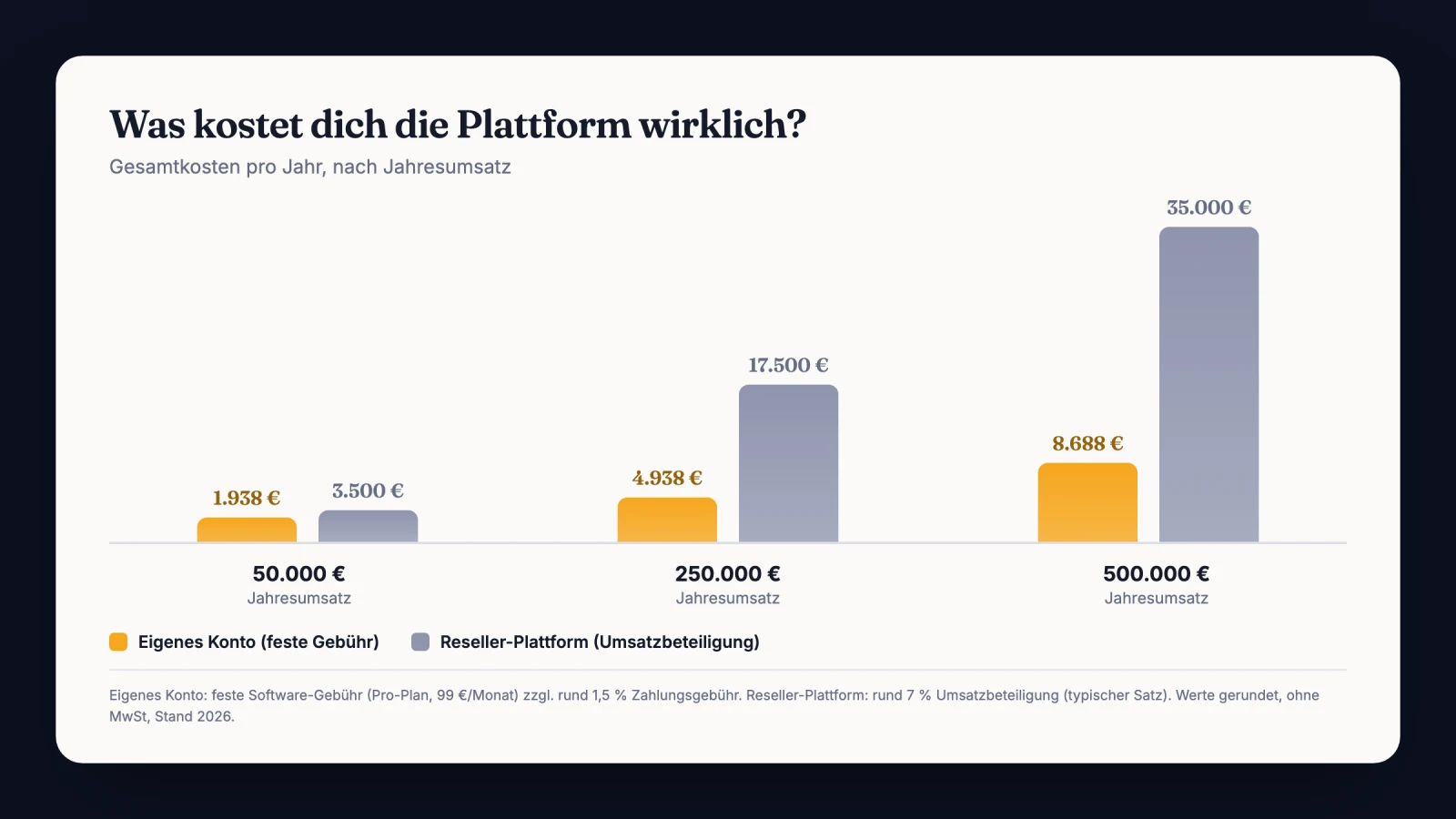
Digistore tiers the fee. On the price portion up to €400, it's 7.9 percent plus €1. On everything above that, only 4.9 percent, and with Klarna or prepayment even 2.9 percent.
So on an €8,000 sale, the effective rate is around 5 percent. Digistore keeps about €405 of that. The full small-amount rate of 7.9 percent only applies right at the bottom.
Your own Stripe account costs 1.4 percent plus €0.25 per transaction on EU cards. On international cards it's 2.9 percent.
Myth
A reseller is cheaper because you don't have to set up your own account.
Reality
The setup is a one-time thing and takes minutes. The revenue share you pay on every sale, forever. With High-Ticket, the recurring percentage cut clearly beats the one-time setup.
What's left from an €8,000 sale
| Model | Fee, roughly | You keep | On 5 sales |
|---|---|---|---|
| Your own account | ~1.4 % plus fixed | ~€7,888 | ~€39,440 |
| Reseller | ~5 % effective | ~€7,595 | ~€37,975 |
| Difference | per sale | around €290 | around €1,450 |
Numbers rounded, as a rough guide. Either way, the gap gets wider the more you sell.
Who writes the invoice and remits the tax
With a Reseller, Digistore is on the invoice, not you. As the seller, Digistore remits the VAT.
With your own account, you do that yourself. More work, but your brand is on it.
Don't underestimate someone else's branding
Your customer pays €8,000 and gets an invoice from an unfamiliar platform. On premium offers, that looks cheap and triggers questions. Worst case, the confusion costs you the customer.
The trap: A typical scenario. The customer can't place the unfamiliar platform invoice. They think fraud and reach out, unsettled.
The fix: That's why my Checkout runs through my own account. My brand, my invoice, zero questions. Digistore isn't the only Reseller. CopeCart and Ablefy, formerly elopage, use the same model too.
The month the percentage cut cost me €2,400
In the beginning, everything ran through a Reseller for me. Convenient, all done, I didn't have to set anything up. Sounded good.
Then came a strong month. Six deals, each around €8,000. I sat in front of the statement one evening and added up the deducted cut. It was about €2,400, gone to the platform. For what exactly, I asked myself. For a Checkout and an invoice.
I ran the numbers on what my own Stripe account would have cost. A fraction of that. The rest would have stayed with me.
That was the moment it clicked. On small amounts, a percentage cut like that doesn't matter. With High-Ticket, it adds up to a real amount every month. I switched the week after. And never regretted it.
Why the cost question isn't the most important one
Most people just stare at the percentages. Understandable. But it's the wrong first question.
With High-Ticket, you don't lose the big money to the fee. You lose it to failed installments that nobody follows up on. A failed split over €6,000 hurts more than any percentage point.
The better metric is called Collect Rate. That is, how much of the agreed amount actually comes in at the end.
Stripe on its own doesn't solve that. It's missing the Checkout, the installment and the contract. That's exactly where a Checkout layer on your own Stripe account comes in. With CloserCart, the Checkout runs through your account, with 0 percent revenue share. Installment payment, which CloserCart calls a split, is embedded directly into the payment page. Every installment is monitored, dunning runs from your own sender address. Which Checkout platform fits which model is shown in our big comparison of Checkout platforms.
What I would do in the first 7 days
You understand the model. Now the roadmap. I didn't need a full week for the switch back then, but better clean than fast. Skip step five and you'll only notice problems on a real customer.
- Work out your real percentage cut over the last three months.
- Set that total against the fixed transaction fee.
- Set up your own Stripe account, it takes minutes.
- Pick a Checkout layer for installments and contracts.
- Test a real sale with a small amount.
- Check payout, invoice and branding on the customer side.
- Migrate the remaining offers one by one.
Before you switch, tick this off
- Percentage cut of the last months in black and white.
- Your own Stripe account verified and active.
- Checkout layer with split and contract is in place.
- Test purchase run through and payout checked.
Frequently asked questions
A few things come up again and again. Answered short and direct. Anyone who stays unsure here gives away real money on the first real sale.
Is Stripe cheaper than Digistore24?
With High-Ticket, almost always. Stripe costs 1.4 percent plus €0.25 on EU cards. Digistore tiers the fee and lands at effectively around 5 percent on large amounts. The higher the sale price, the bigger your advantage with your own account. On small amounts, the difference is minor.
Can I offer installment payment with Stripe?
Not with Stripe on its own as a ready-made solution. You need a Checkout layer on top. At CloserCart, installment payment is called a split and sits embedded directly on your payment page. Card, Klarna and PayPal are possible, and everything runs through your own Stripe account.
Who remits the VAT with Digistore24?
Digistore24, because the platform legally acts as the seller. The invoice to the customer comes from Digistore, not from you. With your own Stripe account, you are the merchant and remit the tax yourself.
Can I switch from Digistore24 or CopeCart?
Yes, anytime. You set up your own Stripe account and migrate your offers. You should transfer existing installment plans cleanly. How the cancellation with the reseller works is in the guide to cancelling CopeCart.
Do I need my own company for Stripe?
For a business account with Stripe, you need a registered trade or a company. As an established coach or consultant, you have that anyway. For your individual case, best to clarify the details with your tax advisor.
Your own Stripe account, with Checkout, installments and contracts
CloserCart puts the complete High-Ticket Checkout on your own Stripe account. 0 percent revenue share, split and contract included.
Start now for €1 14-day trial for €1. Cancel monthly. 0 % revenue share.* This article is not tax or legal advice, it reflects experience and publicly available information. Fees and terms can change. For your individual case, speak with a tax advisor. As of: 2026.