
Digistore24 takes a cut of every sale. A percentage of your revenue, someone else's branding on your payment page, payouts on their schedule instead of instantly. With High-Ticket sales on the phone, the Reseller model costs you real money. Here are the honest alternatives, ranked by what actually matters to you.
If you sell High-Ticket on the phone, you don't need a Reseller platform. Your own checkout on your Stripe account is usually cheaper and cleaner. Digistore24 pays off mainly for lots of small sales with a large affiliate network.
- Resellers like Digistore24 take a percentage of your revenue. On €8,000, that hurts.
- CopeCart and Ablefy are neighbors in the same model, not a fix for the core problem.
- Honest limitation: with your own checkout, you're the seller and you handle the tax.
- For offers from €4,000 up, your own checkout is almost always the better lever.
If you sell €19 ebooks through a big affiliate army, stick with Digistore24 and stop reading here.
Reseller platform or your own checkout?
| Criterion | Reseller platform | Own checkout |
|---|---|---|
| Use case | Lots of small sales and affiliates | High-Ticket on the phone and Zoom |
| Strengths | Affiliate network and tax handled for you | Full control and money instantly |
| Limitations | Revenue share and someone else's branding | You're the seller yourself |
| Cost model | Percentage of revenue | Fixed fee per month |
Why you're looking for a Digistore24 alternative in the first place
Usually it starts with a glance at the statement. You close a coaching deal for €8,000 and see what the platform keeps. With High-Ticket, that absolute amount grows with every deal.
Then there's the branding. Your payment page carries someone else's name. That backfires when a premium client is supposed to pay after the call and suddenly sees an unfamiliar logo.
And the cashflow. The money reaches you on the platform's payout schedule, not instantly. At five-figure months, that's no longer a detail.
Let's be honest. Hardly anyone runs the numbers once, properly. But that's exactly where the leverage is.
Where Digistore24 is strong
- Huge affiliate network for reach without your own marketing
- VAT and invoicing handled for you as the seller
- Buyer protection and experience with lots of small transactions
Where it falls short for High-Ticket
- Revenue share grows with every expensive sale
- Someone else's branding on your own payment page
- Payout on the platform's schedule instead of straight to your account
The Reseller model eats the most at High-Ticket
Let's be honest. Most people compare platforms by the percentage on the price sheet. That's fine at small prices and an expensive mistake at large ones.
Reseller model: The platform formally buys your product and resells it as its own merchant. It appears as the seller on the invoice and remits the VAT. In return, it keeps a revenue share and pays you the rest on its own schedule.
The point is the math behind it. A percentage on €39 is loose change. On €8,000, even with a tiered fee, several hundred euros stay behind on every sale.
With Digistore24, the rate even drops above a certain price threshold. The absolute amount keeps growing regardless. That's exactly what many people miss in a quick percentage comparison.
The expensive mistake when choosing
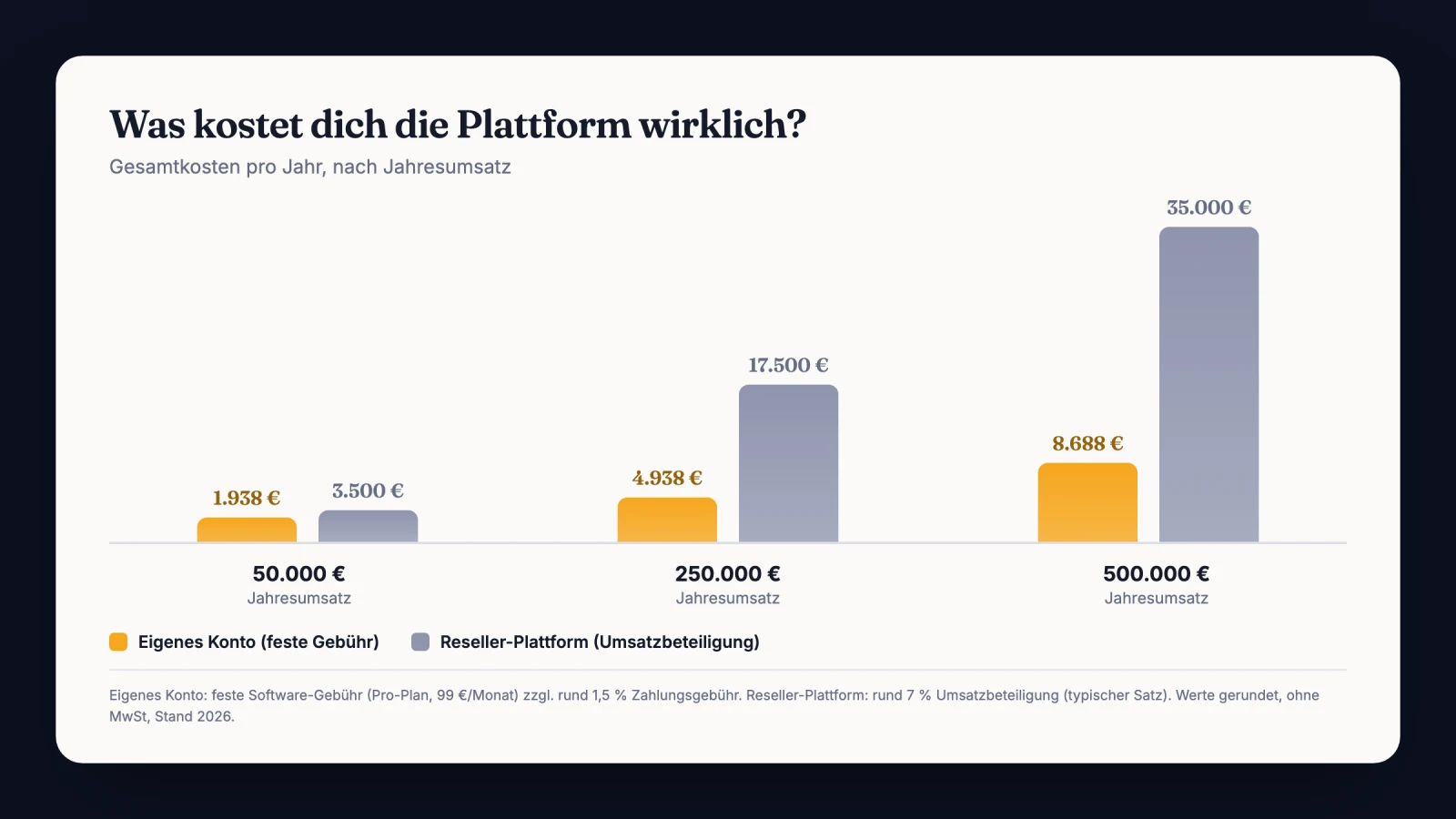
Don't pick the platform by the lowest monthly fee. With High-Ticket, the revenue share often ends up costing a multiple of the fixed costs. Always calculate against your real annual revenue, not the percentage.
Myth
Digistore24 is basically free, it only costs a fee per sale.
Reality
The absolute fee is the most expensive line item at High-Ticket. It grows with the price, even when the rate is tiered. A fixed software fee, on the other hand, stays the same whether you sell for €4,000 or €12,000.
The most important alternatives at a glance
One thing up front. A checkout tool only competes with other checkout tools. Course platforms are a different story.
Here are the relevant options for the DACH market. For a deeper all-around view, see the comparison of checkout platforms.
Digistore24 alternatives at a glance
| Tool | Model | For whom | Cost |
|---|---|---|---|
| Digistore24 | Reseller | Affiliate and impulse buys | Revenue share per sale |
| CopeCart | Reseller | DACH coaches | Revenue share per sale |
| Ablefy (formerly elopage) | Reseller | Courses and memberships | Revenue share per sale |
| Own checkout | Your own Stripe account | High-Ticket on the phone | Fixed software fee |
CopeCart and Ablefy (formerly elopage): the Reseller neighbors
These are the obvious moves. They work well and they're legit. They just often don't solve your core problem.
A quick note on the name. elopage has been called Ablefy since late 2024. It's the same platform, just with a new label.
Why don't they solve the problem? Because they play in the same model. CopeCart also takes a revenue share and appears as the seller.
So you swap the brand, not the principle.
Still, that's fair. If you want to keep the affiliate network and the tax handled for you, switching Resellers is legitimate. Details on making the move are in our guides to elopage alternatives and canceling CopeCart.
Your own checkout via Stripe: a different league
Here you leave the Reseller model entirely. The checkout runs on your own Stripe account. The money lands directly with you, no revenue share.
That's the big difference. You're the seller yourself. No unfamiliar logo, no forced cut, no waiting on the payout.
What I set up first
For every new offer, I build the payment page on my own domain first. Whitelabel, no foreign name. A client paying €8,000 wants to see your name, not that of a payment processor.
With CloserCart, exactly that runs on your Stripe account with 0 percent revenue share. Installments are called Split here and are embedded directly on the payment page, no redirect. On top of that, there's the digital signature in the checkout, which is enforced with financing. You can see how the checkout on your own account works on the feature page.
The trap: I sold through a Reseller for a long time. On a coaching deal for €8,000, several hundred euros went out as a revenue share every single time. Per sale.
The fix: I switched the checkout to my own account. Fixed software fee, the money instantly with me. Across ten High-Ticket deals, that was a four-figure difference per month.
The deal an unfamiliar logo almost cost me
A short story from practice. I had a prospect on a Zoom call. Offer €9,500, the conversation went perfectly. He was ready to pay right away.
Then I sent him the payment link. Through the old Reseller platform. The page showed a company name he didn't recognize and a design that had nothing to do with my brand.
He paused. Wrote back asking whether it was legit. On a €9,500 purchase, that kind of hesitation is poison. I first had to explain that the platform is my seller and everything is in order.
In the end he paid. But the moment cost me two days and almost the deal. A doubting premium client walks away faster than you'd think.
Ever since, every checkout runs on my own domain. Same logo, same colors as in the call. The break in trust is simply gone.
Don't chase the lowest fee
The standard advice is: take the cheapest platform. Sounds logical at first, right? For High-Ticket, it's wrong.
Because half a percent of difference is beside the point when your branding, your cashflow, and your control in the sales call suffer. Those factors bring you more revenue than a marginally smaller fee.
The better metric is simple. Calculate the total cost per year against your real revenue. Don't compare the percentage, compare the actual euros at year's end. That's where the picture flips for High-Ticket almost every time.
What I'd do in the first 7 days
Enough theory. Here's how to tackle the switch concretely, without disrupting your running business.
- List your last ten sales and add up the revenue share that was withheld.
- Put that sum against a fixed software fee per month.
- Set up a Stripe account if you don't have one yet.
- Build a test payment page on your own domain.
- Set up the Split and test a run with a card.
- Confirm with your tax advisor that you're now the seller yourself.
- Take the new checkout live for one offer and measure the difference.
Once the new checkout runs stable, you can cancel Digistore24 cleanly. Move first, then cancel, never the other way around.
Your checklist before the switch
- Revenue share of the last ten deals calculated
- Stripe account verified and one payout tested
- Payment page running on your own domain
- Split run through once in full
- Tax status as the seller clarified with your advisor
Frequently asked questions about Digistore24 alternatives
Is your own checkout really cheaper than Digistore24?
At High-Ticket, almost always. The Reseller takes a percentage of revenue, which as an absolute amount grows with the price. A fixed software fee stays constant. From about €4,000 per sale, the math usually tips clearly in favor of your own account.
Do I lose the affiliate network if I switch?
Yes, that's the honest trade-off. Resellers like Digistore24 live off their affiliate marketplace. But if you sell High-Ticket on the phone and not through affiliates, you usually don't need that network at all. In that case the downside barely matters.
Do I then have to handle the VAT myself?
Yes. Without a Reseller, you're the seller yourself and you remit the VAT. An accounting tool and your tax advisor handle that day to day. Sort out the change of status once, cleanly, before you go live.
Can I offer installments without a Reseller too?
Yes. At CloserCart it's called Split and runs directly on your payment page through your Stripe account. The customer pays by card, Klarna, or PayPal in installments. With financing, the digital signature in the checkout is enforced on top.
Your checkout, your account, 0 percent revenue share
CloserCart runs on your own Stripe account. The money lands directly with you, with embedded Split and signature in the checkout.
Start now for €1 14 days for €1. Cancel monthly. 0% revenue share.