A €24,000 coaching program sells differently than a €30 ebook. And it gets paid for in a completely different way. Let’s be honest, most deals die right at the finish line.
The exact spot where the money is supposed to flow. People lose the deal they had already closed on the call. The reason is rarely the price.
It’s friction and a payment process that doesn’t fit the offer. Add a provider that blocks large amounts or takes a cut. This guide maps out the complete payment stack for offers from €4,000 to €50,000.
Process High-Ticket payments through your own payment accounts, never through a reseller platform. Card and Klarna carry you to around €10,000. Above that, a deposit plus bank transfer or a payment plan belongs in the mix. That keeps the money yours and the fee predictable. And every chargeback becomes provable with a contract.
- Your own accounts beat resellers. 0 percent revenue share, the money flows straight to you, you stay the contracting party.
- No single provider covers everything. Stripe for card, Klarna and PayPal, plus bank transfer with reconciliation and a payment plan.
- Above €10,000, card-only payment turns into a chargeback trap. Deposit by card, remainder by bank transfer.
- A signed contract before payment is your most important safeguard. Not the payment provider.
- When an installment bounces, an automatic dunning process decides your default rate. Not chasing people by phone.
- The strongest lever sits in the call itself, right after the yes. One link, controlled live.
If your offer costs under €1,000 and gets bought on impulse, none of this guide is for you.
Why High-Ticket needs its own processing
With a cheap product, the customer buys on impulse. With an offer above €15,000, they make a deliberate decision. They look closely at who is getting their money.
A standard Checkout that looks like a thousand others works against you here. On top of that comes the structure. High-Ticket often means a deposit plus installments, a signed contract, and an individual price per customer.
A system built for mass-market products doesn’t map that cleanly. This is where most people trip up, because they treat Checkout as a tech question. It’s a trust question.
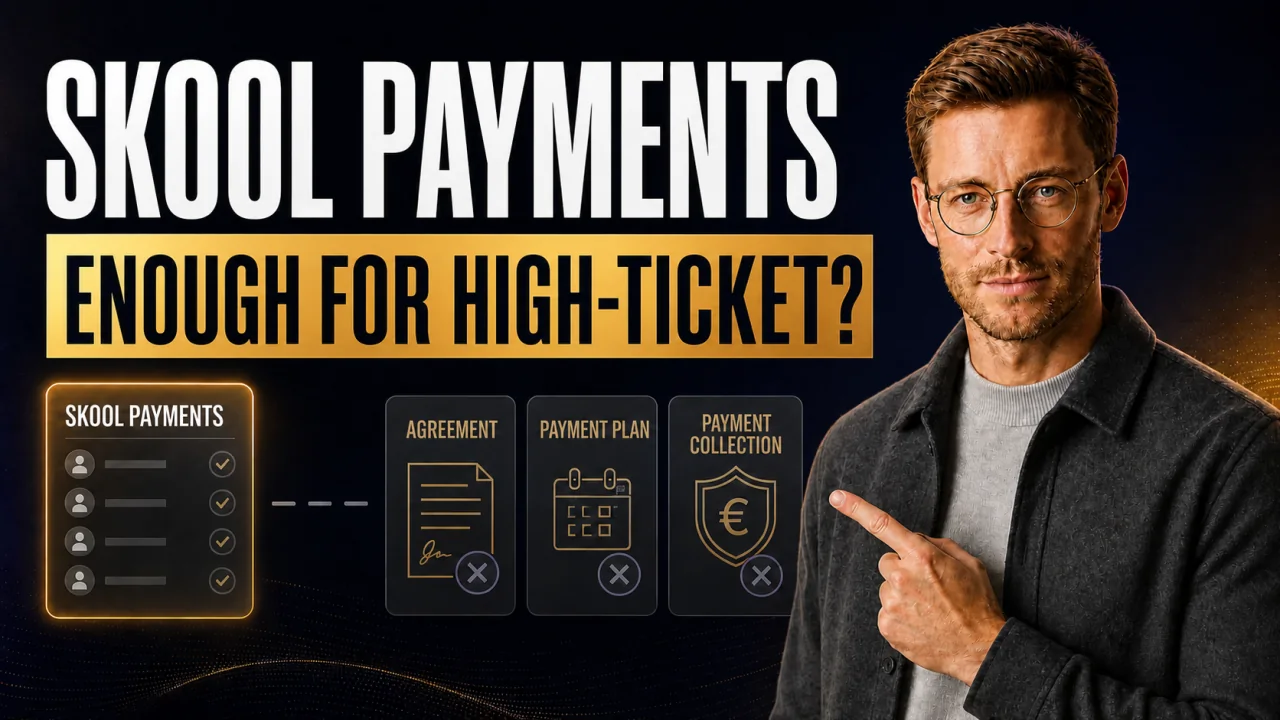
This is exactly where the built-in payment features of course and community platforms hit their ceiling. Whether Skool Payments is enough for High-Ticket comes down to those same three points.
My stance is clear. Send five-figure deals down the same payment path as a mini course.
You give away revenue and security. Which Checkout platform is actually built for large amounts is compared in the overview of Checkout platforms.
High-Ticket payment processing: the complete flow with which a seller collects and secures amounts from around €4,000 up. It covers the payment method, a signed contract, the invoice, the installment structure, and how you handle chargebacks. Unlike with low-cost products, each deal carries five to low six figures. That's why control matters more than convenience.
Which payment methods carry €5,000 to €50,000
There isn’t one single right method. There’s the right one per amount. Card and Klarna are convenient, but they hit limits at high sums.
Stripe processes card, Klarna, and PayPal as direct payment methods. PayPal runs through Stripe here, not through a separate PayPal account. So the payout arrives bundled through Stripe.
On very high single payments, the fraud check Radar can flag a card. Sounds great, right?
Here is where it blows up in your face. A €28,000 card gets declined mid-call, and the customer watches it happen.
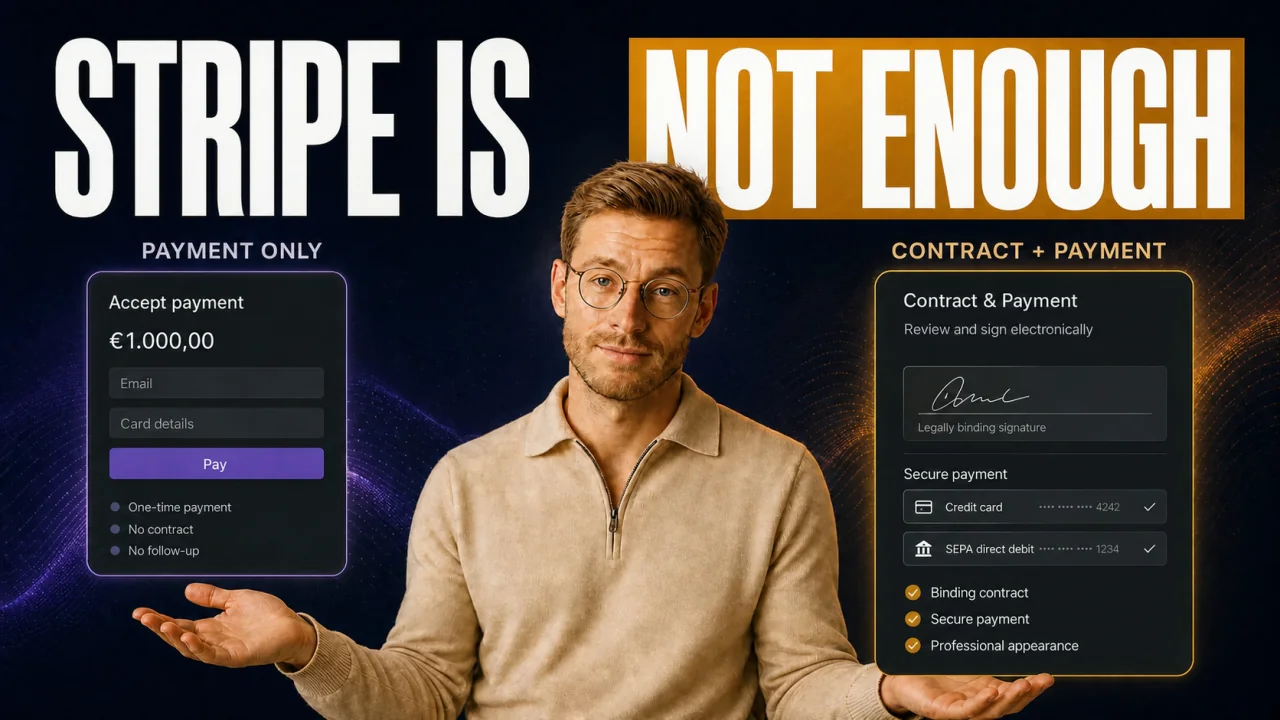
Where Stripe is strong for coaches and where its limits sit is a topic of its own. Short version: Stripe is the engine. You bring the Checkout layer in front of it yourself.
Klarna is a buy-now-pay-later product. It has a credit limit per purchase, usually in the low four figures. For a €30,000 deal, a card-only payment is technically possible but risky.
The most stable base for large sums remains the bank transfer. Combined with automatic bank reconciliation. Behind every one of these methods sits a chain of technology.
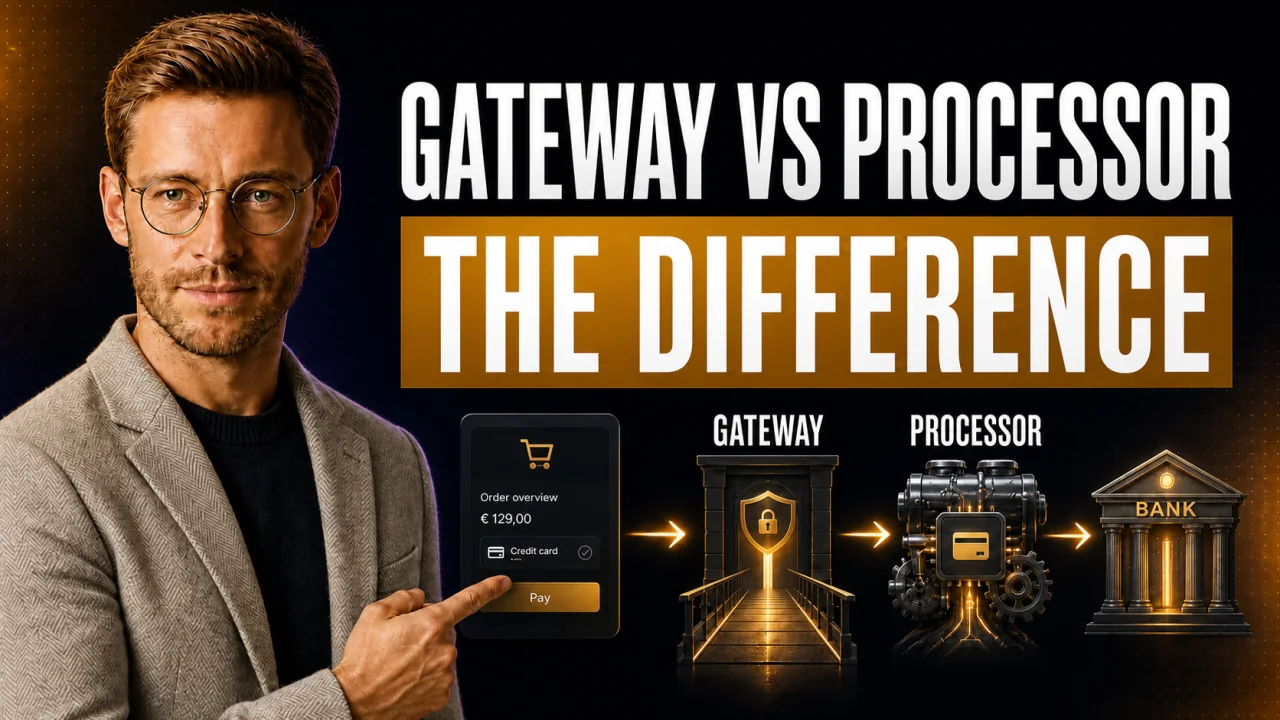
Know the difference between a payment gateway and a payment processor and you see where fees start. And where declines come from. This overview shows which method carries which amount.
Payment methods by amount in High-Ticket
| Method | Carries well up to | Fee (rough) | Watch out for |
|---|---|---|---|
| Card (Stripe) | around €10,000 | approx. 1.5% EU card | Chargeback, Radar flag |
| Klarna | low four figures | higher than card | Credit limit per purchase |
| PayPal | mid-range amounts | similar to card | Runs through Stripe |
| Bank transfer (SEPA) | any amount | close to €0 | Check incoming payment manually |
| Payment plan (subscription) | any amount, split | per installment like card | Manage installment defaults |
One factor many overlook is the payout timing. With Stripe, the money usually lands in your bank account after one to two business days. A matching bank transfer is there as soon as it arrives.
Reseller platforms often add a longer payout cycle on top. At high volume, that throttles your cash flow noticeably. My advice: use several methods in parallel, but choose them by amount.
Not by convenience. Which payment provider specifically fits your setup is covered in its own article in this cluster.
Your own account or a reseller: the fee math
The biggest cost lever isn’t the card fee. It’s the model behind it. Reseller platforms formally buy your product and resell it.
In return they keep a share of the revenue. Here comes the annoying part. Run the numbers on a real deal.
On a €20,000 contract, a reseller platform takes a typical 5 to 7 percent. That’s around €1,000 to €1,400 per deal. Through your own Stripe account, you pay roughly 1.5 percent on European cards, so about €300.
At a six-figure monthly volume, that’s a five-figure difference over a year. On top of that comes the legal side. In the reseller model the platform is your contracting party, not you.
VAT runs through their construct. That bites you the day a customer needs a corrected invoice. You aren’t even allowed to issue one.
The reseller reflex costs you five figures
The most expensive mistake is running High-Ticket through a reseller platform permanently. At a six-figure monthly volume, a revenue share of 5 to 7 percent adds up fast. Think a mid five-figure amount over a year. And you are legally no longer the seller of your own offer.
My position: at this volume, your own accounts are not up for debate. The percentage fee on the card is peanuts next to a revenue share on every €20k deal.
What the convenient shortcut actually cost me
I got this wrong myself for a long time. In one month with roughly €380,000 in contract value, almost everything ran through an external platform. Convenient, no question.
The statement arrived at month end, and I actually read it for once. Over €22,000 in revenue share across four weeks. For a Checkout I could have built myself.
And yes, I messed that up plenty. The real pain came two weeks later, though. A customer wanted his invoice corrected because his company name was wrong.
I couldn’t do it. Legally I wasn’t his seller at all. So three emails to support, six days of waiting.
One visibly annoyed customer on an €18,000 contract. He had paid on time, and I looked like the amateur in the chain.
Not pretty, but it happens. What it really cost me wasn’t just the €22,000. It was realizing I couldn’t help my own customer.
Two months later everything ran through my own accounts. The switch took roughly one afternoon of setup work. I made it two years too late, and those two years were the expensive part.
Structuring installments cleanly
In High-Ticket, installments aren’t a discount. They’re a closing lever. They lower the entry hurdle without you giving anything up on price.
What matters is the structure. A deposit plus 3, 6, or 12 follow-up installments, cleanly scheduled. At CloserCart this is called split.
It runs as an embedded subscription directly on the order page. No redirect to an external domain. Enough of that, here’s the detail people underestimate.
The 30-day payment pause. Today the customer only stores their payment method. The first charge lands 30 days later, which closes deals where the budget frees up next month.
This is where a lot of operators blow it, because they lump installments and third-party financing together. With an installment plan, you carry the default risk yourself. With financing through a third party, the provider carries it, and the customer pays more.
How to set up installments in a legally sound way is covered in the guide to payment plans.
Contract and signature come before the money
The real safeguard in High-Ticket isn’t the payment provider. It’s the contract.
A service agreement with a digital signature, a timestamp, and an IP log changes everything. It turns a payment into a provable close.
For coaching that starts immediately, a cleanly worded waiver of the cancellation right belongs in it. That applies wherever consumer distance-selling rules bite. In the EU and the UK, a consumer can cancel a distance contract within a statutory window.
Unless that right is waived once the service begins with their consent. In the US there is no equivalent federal right for online coaching. A clear cancellation and refund clause protects you either way.
Without it, you can end up having delivered the service and holding no money. So settle the exact wording with local counsel for your market. Honestly, my rule is simple.
No payment without a signed contract. The signature costs the customer ten seconds. Skip that step and you never notice while selling, only eight weeks later in a dispute form.
What I always do before the first payment
I have the contract signed before a single cent flows, never after. In a chargeback, an order with a signature, a timestamp, and an IP log is worth its weight in gold. Add the certificate of authenticity and you show the card issuer exactly who accepted what and when.
Chargebacks and payment default: your risk chapter
The higher the amount, the more expensive a chargeback becomes. On a €24,000 card payment, a single “service not received” is enough. The money is gone for now, plus a chargeback fee.
That one stings. Two things lower the risk considerably.
First, take high amounts by bank transfer. A SEPA transfer isn’t reversed the way a card payment is.
Second, a signed contract with a documented scope of work as evidence in the dispute. Put the full €30k on a card and you’re playing the lottery with your cash flow. The bill shows up later, and it shows up hard.
A deposit by card plus the remainder by bank transfer is the better compromise. Convenience and protection in one.
The trap: A customer had paid €24,000 by card. After eight weeks the chargeback arrived with the reason "service not received". Without evidence, the money would have been lost.
The fix: Since then I split every amount above €10,000. A deposit goes on the card, the larger remainder comes as a bank transfer. Every deal has a signed contract with proof of the service. On the next dispute, the certificate of authenticity won it for me.
How an automatic dunning process systematically rescues bounced installments is a chapter of its own. Chasing people by phone isn’t part of it.
The payment moment on the call
The strongest lever in the whole process is a single moment. The moment the customer says yes on the call. Start hunting for PDFs then and you lose energy, sometimes the deal.
Passing bank details back and forth doesn’t help either. The cleanest path is a single link that the closer controls live. Behind it, they switch amount, payment method, and split in real time.
No second link needed. The customer’s side updates without a reload. This is where the thread snaps, when you put the customer off with “I’ll email that over later”.
Anyway, actively ask for the payment option on the call. Don’t leave it to the customer. The wording decides whether the deposit runs right away.
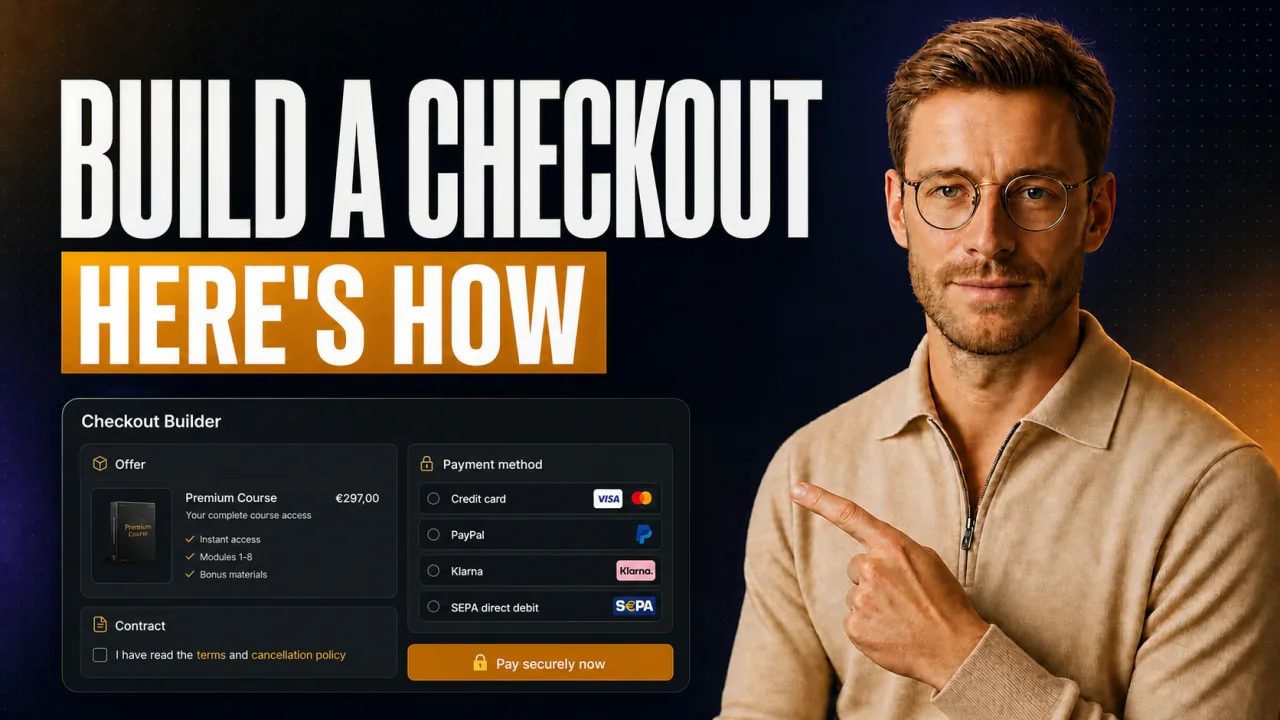
How to build the Checkout page behind it is shown in the detailed article in this cluster. It also covers which fields you can drop in High-Ticket.
The customer isn’t done being looked after once the payment lands. What belongs on a good thank-you page decides your onboarding speed. And the number of questions in the first few days.
Payment in full, installments, or financing: the decision framework
Not every deal needs the same payment form. Decide by deal size, customer type, and your cash-flow needs. Simple as that.
- Budget available right now, amount up to €10,000: payment in full by card or bank transfer.
- Amount above €10,000: deposit by card, remainder by bank transfer, so the chargeback risk drops.
- Customer wants to plan monthly, budget is solid: a subscription plan, deposit plus 3 to 12 installments.
- Budget only frees up next month: a payment plan with a 30-day payment pause.
- Customer wants or needs external financing: a third party carries the default risk, at extra cost to the customer.
My rule of thumb: payment in full where the budget is solid. A payment plan where it saves the close. Third-party financing only when the customer explicitly wants it, because it makes your offer more expensive.
Ignore this grid and hand every customer the same option, and you pay for it. Either in fees or in closes you never get.
The most expensive misconception in High-Ticket payments
One thinking error costs revenue regularly. Installments get seen as an annoying wait for your own money. Plus the feeling that you carry the full risk alone.
Been there. The error costs you deals, because fear of default stops you offering a plan at all. And the customer with the solid budget walks anyway.
Myth
Installments mean I wait months for my money and get left holding the loss on every default.
Reality
With a split embedded through Stripe, every follow-up installment is collected automatically. You never have to think about it. If an installment bounces, an automatic dunning process kicks in with its own payment page and, in the worst case, escalates to collections. You don't wait passively, you have a process.
The second misconception: that more payment methods are automatically better. In High-Ticket, the right method per amount is what counts. Not the length of the list.
Taxes, invoicing, and revenue recognition
Payment processing doesn’t end when the money arrives. It flows into your bookkeeping. A correct invoice belongs with every payment.
Dry, but it matters. Tax gets shown or deliberately not shown, depending on the case. Common setups are net plus VAT for domestic B2B and VAT included for end consumers.
No VAT applies on cross-border B2B under the reverse-charge mechanism, on US structures, or under a small-business exemption. In the US, professional coaching services often fall outside sales tax. Digital products can be taxable, and the rules vary by state.
Whoever wants to get this right sets the tax mode per product. Confirm the specifics with a tax advisor.
Things go sideways when a B2B customer needs a net invoice. Your template stubbornly adds tax anyway.
With installments, the question of revenue recognition comes up. For tax purposes, revenue generally arises with the delivery of the service. Not only with the final installment, and you should clarify that with your accountant.
International customers and other currencies
Sell across borders and you quickly get foreign customers in your Checkout. From the US, the UK, or Switzerland. That touches currency, fees, and tax all at once.
Quick math. A customer abroad often pays in your currency while their bank converts into their own. A foreign-currency fee falls on them in the process.
Cards from outside your own region usually cost you a bit more in Stripe fees. More than local cards do. Make the currency transparent and budget for that markup.
For a €20,000 deal from abroad, a bank transfer in your currency is often the cleanest path. It sidesteps both the card fee and the chargeback risk in one move. Tax on a foreign customer is a topic of its own.
Whether reverse charge applies, or whether you owe VAT or sales tax abroad, depends on the case. Same for whether you must register there. That lands on your desk at invoicing time if you didn’t settle it up front.
From the yes on the call to the money in your account
In the end, what counts is a flow without a break. From the yes to the incoming payment. This is the path I recommend for High-Ticket.
- The customer says yes on the call, and you send a single link.
- The customer signs the contract with a digital signature and a timestamp.
- The deposit or first installment runs directly through the embedded form.
- With a payment plan, Stripe collects the follow-up installments automatically.
- A bounced installment lands in the dunning process automatically and escalates to collections if needed.
- Incoming bank transfers are matched automatically by bank reconciliation.
Break one of those stages and the rest stalls. And then what? Access comes right after that.
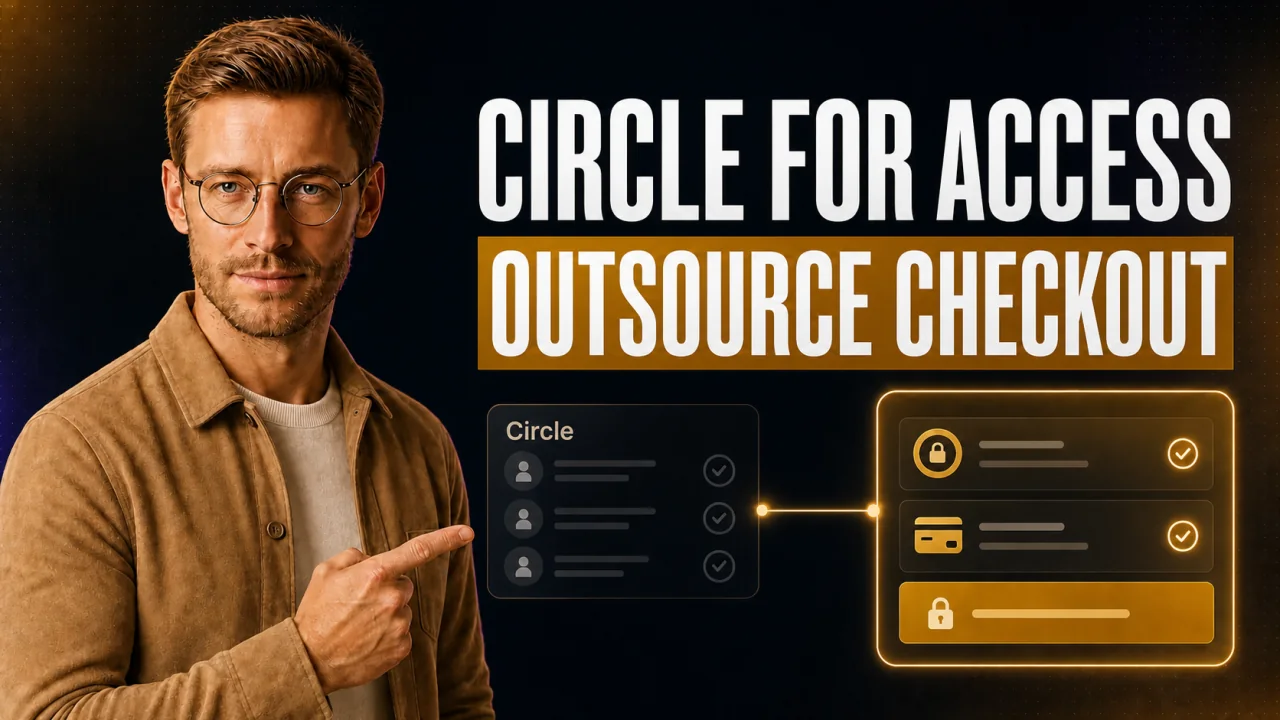
If you run your community on Circle, you can put the Checkout in front of the Circle paywall. After the first payment, the customer lands in the right space automatically.
The point is the automation behind it. Chase installments by phone and tick off bank transfers by hand, and your default rate climbs with your volume. Whether your cash flow is healthy shows up on a revenue dashboard with the right metrics, above all the collect rate.
Your payment clauses in the contract
For the process to hold up in a dispute, a few clauses belong firmly in there. Sounds like paperwork. It’s your protection against default and chargebacks.
What belongs in your payment clauses
- The due date of each installment with a concrete date or interval
- A default rule and from when the dunning stages kick in
- A cleanly worded waiver of the cancellation right when the service starts immediately, where such a right applies
- An acceleration rule that makes the remaining balance due when two installments bounce
- The scope of work as its own part of the contract, so "not delivered" doesn't hold up
- Jurisdiction and governing law
Leave one of those lines out and it gets expensive in an emergency. Usually the exact line you thought was unnecessary. These clauses aren’t distrust toward the customer.
They’re clarity for both sides. A customer who says yes to a clean contract is also more reliable when it comes to payment.
FAQ
Which payment methods suit a €10,000 offer?
Up to around €10,000, card and Klarna carry well. Right at this threshold, splitting into a deposit by card plus the remainder by bank transfer gets safer, because it lowers the chargeback risk of a single high card payment. A pure bank transfer always works but needs payment reconciliation.
Does Stripe have a limit for high amounts?
Stripe has no hard amount limit, but its fraud check, Radar, can flag or decline a very high single payment. The clean path for five-figure deals is a deposit by card and the remainder by bank transfer, instead of running everything through the card at once.
How do I offer installments for a coaching program?
Most stably through an embedded subscription, called split at CloserCart. You set a deposit plus 3, 6, or 12 installments, optionally with a 30-day payment pause. Every follow-up installment is collected automatically, and a contract with an acceleration clause protects you if installments bounce.
What do I do about payment default?
An automatic dunning process with editable dunning stages and a separate payment page catches bounced installments. If the customer still doesn't pay, the case escalates to collections. A contract with a default and acceleration clause makes the remaining balance due immediately after two bounced installments.
How do I protect myself against chargebacks?
Most effectively with a signed contract, a documented scope of work, and a certificate of authenticity as evidence in the dispute. On top of that, process high amounts by bank transfer instead of card, because a SEPA bank transfer isn't reversed as easily as a card payment.
What does High-Ticket mean?
High-Ticket refers to offers from around €4,000 up, often €15,000 to €30,000 per deal in the coaching and agency world. The customer makes a deliberate buying decision rather than an impulse purchase, which is why the payment processing needs a contract, a signature, and its own structure.
Does the money go directly to my own account?
With your own payment accounts, yes, the money flows directly to you at 0 percent revenue share, and you stay the contracting party with your customer. With a reseller platform, the payment runs through their account, they keep a revenue share, and they are legally the seller.
In the end, the whole thing stands or falls on one principle. The money belongs in your own accounts. Not in those of a platform that takes a cut and takes over your customer.
With CloserCart you connect your own payment providers for this. From Stripe with card, Klarna, and PayPal to AffiliCon, Ablefy, and the bank transfer with automatic reconciliation. The Checkout sits on your domain, and the signed contract seals the close.
Split plus dunning keep the cash flow stable. How to connect your accounts concretely is shown on the page about payment providers. It also covers why every euro stays with you at 0 percent revenue share.