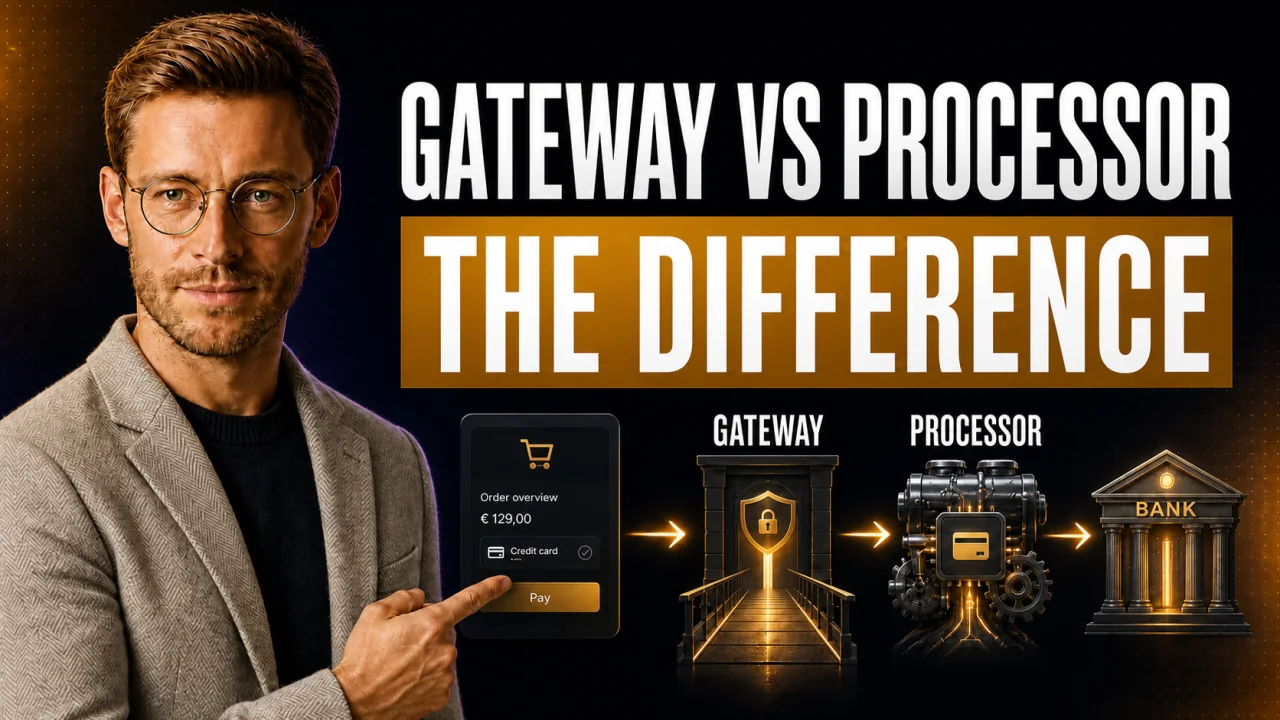
Payment gateway, payment processor, acquirer, merchant of record. Four terms that get thrown around as if they meant the same thing. Here you get all four roles separated cleanly, with Stripe, PayPal and Klarna sorted into the right box. After that you know exactly who does what on a card payment. And what is still missing for high ticket.
Stop hunting for a winner here, because you always need both. The gateway takes the card details, the processor moves the money behind it. With Stripe both roles sit in one account anyway, so the layer above decides everything.
- Gateway = the data layer at checkout, processor = money moving through the card networks.
- Stripe, Adyen and Square cover all three technical roles in one product.
- Merchant of record is none of them, so sales tax and invoicing stay with you.
- Contracts, installment plans and dunning only arrive with a checkout layer above your accounts.
If you are building your own payment stack on direct bank contracts, you can stop reading here.
The title asks gateway against processor. So let's settle exactly that first.
Payment gateway and payment processor side by side
| Criterion | Payment gateway | Payment processor |
|---|---|---|
| Job | Collect payment data at checkout | Route the authorization through the networks |
| Strengths | Encryption, tokenization, integrations | Processing, settlement coordination |
| Limits | Moves no money | Invisible to your buyer |
| Position in the flow | First step, in the browser | Middle, between gateway and banks |
What a payment gateway actually does
The gateway is the part your buyer touches. It is the card form on your checkout page. He types his 16 digits in there.
The gateway encrypts that data immediately. The card number turns into a token, a placeholder worth nothing to a thief. The real number never lands on your server.
Then it passes the request on for authorization. That is the whole job. A gateway moves information, never money.
If you ever have to explain the term cleanly on a call, here is the compact version.
Payment gateway: The technical layer at checkout that collects and secures your customer's payment data. It encrypts and tokenizes the card details, then hands them to the payment processor for authorization. Moving the actual money is handled by the processor and the acquirer one step later.
Sounds unspectacular, right? Without that step your whole checkout falls apart, because you would have to secure raw card data yourself. Nobody wants that without a security team on payroll.
There is a second reason tokenization matters. Recurring charges later run on exactly that token. No stored payment method means no second installment, unless your buyer digs out the card again.
What a good gateway takes off your plate
- Card data gets tokenized, so your server never sees it.
- Authorization runs in seconds and your buyer barely waits.
- New methods like Klarna hang off the same integration.
What a gateway does not solve
- It moves no money, that is the processor and the acquirer.
- It knows nothing about contracts, signatures or installment plans.
- It sends nobody a payment demand when an installment fails.
What the payment processor does
The processor takes over the second the gateway hands off. It formats the authorization request the way the network expects. Then it routes it through Visa or Mastercard.
The network asks your customer's bank. The issuing bank checks funds and fraud signals. Back comes a plain approve or decline.
Later the processor coordinates settlement. That is the moment money actually moves. The processor is the money mover, the gateway is only the messenger.
This is where most people trip. They treat gateway and processor as two words for one thing. It bites you the first time you compare providers without knowing which role each one plays.
The acquirer: the third role in the game
One role is still missing. The acquirer, also called the acquiring bank, holds your merchant account. It credits you the money from your card payments.
No acquirer, no card money landing anywhere. Simple as that. Years ago you needed your own bank contract for it, with underwriting that dragged on for weeks.
Today you usually notice none of it. Providers like Stripe bring acquiring along through banking partners.
If your provider does not, you still need that contract yourself. Exotic gateway setups die on exactly that step.
How do you spot the difference? Look at where the money gets paid out. If the deposit lands in your business account straight from the provider, acquiring is included.
If onboarding asks for your EIN, business documents and a volume forecast, real underwriting sits behind it. Both are legitimate. Only the time to your first payment differs wildly.
How a card payment really runs
Okay, quick detour. Let's put the three roles in motion. Your buyer pays 15,000 dollars for your program by card.
- The gateway collects the card details at checkout and tokenizes them.
- The processor formats the request and routes it through Visa or Mastercard.
- Your buyer's issuing bank checks it and answers approve or decline.
- The answer travels the same path back to the checkout.
- At settlement the processor pushes the money to the acquirer, which credits your merchant account.
The whole thing takes a few seconds. Wild, honestly. Five parties, one click.
Keep the core sentence: The gateway moves information, the processor and the acquirer move the money. See it once and you never mix the terms up again. Miss it and you spend hours hunting a payment problem in the wrong place.
Merchant of record: the fourth role everybody confuses
Now the annoying part. There is a fourth role, and it has little to do with technology. The merchant of record, MoR for short.
The MoR is the legal entity that sells to your end customer. It handles sales tax and VAT calculation and remittance, PCI compliance, refunds and chargebacks. In return its name shows up on your customer's statement, not yours.
Reseller platforms run on exactly this principle. The criticism there is about the model, not about individual providers. Someone else's name on the invoice plus a share of your revenue, that is the deal.
And yes, the model has real strengths. Sell hard into other countries and an MoR takes every foreign tax registration off your desk.
Anyone who would have to build that alone often pays the share happily. For a US seller with mostly US customers the math flips. There the revenue share stands against a sales tax setup your CPA already runs.
What a reseller is in detail sits in what a reseller actually is. Plenty of people get this wrong because they treat MoR as a technical feature. It is a legal role with consequences for your invoice and your margin.
Myth
Stripe and PayPal are merchant of record and handle my sales tax for me.
Reality
Neither one is an MoR. Invoicing and tax toward your end customer stay with you as the merchant. You get clean reporting and fast USD payouts, but the tax responsibility does not travel with them.
Nexus in every state where you cross a threshold stays yours. Something above the gateway has to close that gap, or you close it yourself.
Where Stripe, PayPal and Klarna belong
With the four roles you can sort any provider you know. Honestly. Most comparison articles never manage that.
Stripe bundles gateway, processing and acquiring into one product. Industry sources call that an all-in-one provider or a payment facilitator, and Adyen and Square work similarly. Stripe positions itself primarily as a gateway with processing and acquiring through banking partners.
PayPal is its own closed wallet system with PayFac character. Klarna is something else entirely, a payment method for buy now pay later. It gets connected through a gateway like Stripe or wired up directly.
This sorting is not a vocabulary game. It tells you instantly which question a provider can even answer. Asking Klarna about your sales tax filing goes nowhere.
Mix the categories and you wait on answers that never come. I once watched a support ticket bounce between two providers for three weeks. Neither one was responsible in the end.
And none of them is a checkout or contract layer. That is the category above, more on it shortly. Which provider mix fits coaches specifically is in the best payment providers for coaches and consultants.
Known providers sorted by role
| Provider | Role | MoR? | Contract layer? |
|---|---|---|---|
| Stripe | Gateway, processor, acquirer | No | No |
| PayPal | Closed wallet system | No | No |
| Klarna | Payment method (BNPL) | No | No |
| Reseller platforms | Merchant of record model | Yes | Partly |
What the roles have to do with your fees
Every role wants to get paid. With all-in-one providers it is all baked into one transaction fee. So the real numbers are worth a look.
Stripe charges 2.9% plus 30 cents per domestic card transaction in the US. International cards add another 1.5 percent. Currency conversion costs another 1 percent on top.
ACH Direct Debit costs 0.8 percent, capped at 5 dollars per transaction. There are no setup or monthly fees, everything runs pay as you go. As of July 2026, straight off the US pricing page.
PayPal charges 3.49% plus 49 cents per domestic PayPal Checkout transaction. Pay Later runs 4.99% plus 49 cents. International commercial transactions add 1.5 percent, and currency conversion carries a spread of 3 to 4 percent.
On a 15,000 dollar deal by domestic card you are looking at roughly 435 dollars in Stripe fees. Not nothing. But predictable, with no middleman revenue share stacked on top.
The same deal through PayPal lands near 524 dollars. Pay with a foreign card and Stripe climbs to 4.4 percent. That deal then costs you about 660 dollars.
On foreign currency the conversion markup joins in. One percent on 15,000 dollars is 150 dollars, purely for the exchange. That is the line item people forget on international buyers.
Per deal all of this sounds manageable. Across your monthly volume it looks different.
At 100,000 dollars in monthly card volume you hand Stripe about 2,900 dollars, so roughly 35,000 a year. Run the same volume through PayPal and the bill sits near 3,490 a month. At that size your method mix is a real line in your P&L.
And here sits the actual lever. A percentage revenue share grows linearly with those numbers, a fixed software fee does not.
Which leaves the question of the cheapest method. ACH Direct Debit costs 0.8 percent, capped at 5 dollars. Sounds like the obvious winner.
It is not, not automatically. ACH carries payment volume limits, and a five-figure debit can bounce right off them. Higher limits are something you request from Stripe.
The second catch weighs much heavier than the ceiling.
Your customer can dispute an ACH debit on a personal account for up to 60 calendar days. On a business account that window is only two business days. At five-figure amounts that difference is worth knowing before you pick a method.
Settlement also takes four business days as standard. Eligible US accounts can pull that down to two. On a live call you want the yes right now, and card or BNPL confirms in seconds.
So the payment method is a per-deal decision, not a company policy. Set it globally and you either lose closes or lose margin. Both hurt on five-figure contracts.
The expensive mistake
Confusing an MoR revenue share with a gateway fee. You pay the gateway fee for processing, and the share on top pays for the model. Get both stacked and you pay twice on the same transaction.
The difference is structural. A transaction fee stays calculable, a revenue share grows automatically with every bigger close.
How a vocabulary mix-up nearly cost me a close
Quick story from the field. A few years back a buyer wanted to pay an 18,000 dollar contract in three installments. His accountant told him to check who "the payment processor" was on our side.
I cheerfully said "our gateway" and meant Stripe. The accountant heard reseller, as in somebody else issuing the invoice. He warned the buyer that a stranger's company name would sit on his receipt.
The buyer got nervous and put the deal on ice. Two days of silence. Not fun when a five-figure close hangs on one word.
So I recorded a short Loom. In it I showed that the invoice comes from us. Our name on it, Stripe only handling the card.
The accountant signed off that same evening. The buyer signed the next day.
Since then I explain the roles to every buyer up front. Before his accountant reads a foreign term into it. Costs me two minutes on the call and has killed that whole class of objection.
Forget picking a provider by name
The usual advice goes like this. Pick the payment provider first, the rest follows. I think that is backwards, because processing is the easiest piece to swap today.
Gateway, processing and acquiring come as one solid package from the big providers. For a US seller with USD revenue the differences stay small. What is missing above them decides real deals.
The better question: who issues the contract, who watches the installments, who sends the demand? Skip those and it blows up on you later. A failed installment on a 20,000 dollar contract is a different animal than a refunded 200 dollar course.
So measure providers by the gap they leave you, not by the logo. Enough of that. Let's look at the gap directly.
The layer above it all: the checkout layer
Gateway and processor handle payments. That is it. On a 4,000 dollar offer your problem starts after the authorization.
You need a contract with a digital signature. You need installment plans, waiver documentation and B2B records. And you need a dunning process for the moment an installment fails.
That is what a checkout layer like CloserCart is for. It sits above gateway and processor and is neither a gateway nor an MoR. It orchestrates checkout, the Split of payments into installments, the contract PDF with signature and the documentation.
Processing runs through your own payment provider accounts, so Stripe, Klarna, PayPal, AffiliCon or Ablefy. You stay merchant of record yourself, your invoice, your name, your accounts. How connecting works is shown on the page about connecting your own payment providers.
On money the model is simple. CloserCart takes 0% revenue share and you pay a fixed monthly fee.
That is the difference that counts at six-figure monthly volume. Your software cost stays flat whether you process 50,000 or 500,000 dollars.
Stripe and PayPal fees still go straight to your provider. No markup in between. How that runs through your own account is in setting up Stripe installments.
And failed installments? Gateways and processors ship no dunning for installment plans, only automatic retry logic on cards.
That gap bites when a payment fails and nobody chases it. CloserCart has dunning plus collections through Paywise, live since July 2026.
Insider tip
I draw the four roles as a chain for every setup: checkout layer, gateway, processor, acquirer. On top goes one question, who is MoR here. Five minutes later you can see which links a candidate really covers.
What this means for your high-ticket setup
Let's pull the threads together. For pure processing an all-in-one provider like Stripe is plenty. Gateway, processing and acquiring come as one package with no monthly fee.
On invoicing the rule is simple: without an MoR the sales tax stays yours. With mostly US customers that is manageable, and your name stays on the receipt. With heavy international sales, run the MoR math honestly.
Skip that layer and you notice it on the first failed installment. Then the signed contract is missing and proving anything turns into busywork. How the full setup fits together is in the guide to payment processing for high ticket.
Once you have seen this, you spot it in every provider comparison. The question is never gateway or processor. The question is which roles a provider bundles and which gap it leaves you.
The trap I once burned two weeks on a fee comparison of processors. Spreadsheets, forums, all of it. In the end it came down to tenths of a percent, and my real problem sat untouched.
It was somewhere else entirely: contract, signature and dunning logic. The percentages had been sitting openly on the pricing pages the whole time.
The fix Today I decide in reverse order. First settle the layer that carries contract, signature and installments, then connect the gateway underneath. Processing takes an afternoon to wire up, and the percentage comparison no longer eats two weeks.
What I'd do in the first 7 days
You don't have to become a payments expert. One week is enough to sort your setup cleanly. Here's how I would go at it.
- Draw your current chain: who is gateway, processor, acquirer, MoR?
- Check whose name shows up on your customer invoices.
- Calculate your real cost per deal, transaction fee plus any revenue share.
- Decide whether you want to stay merchant of record yourself.
- Write down the gaps: contract, signature, installment monitoring, dunning.
- Test a checkout layer on top of your own accounts.
- Run one test payment end to end, from authorization to receipt.
Anyway. Step 1 eats the most time, and it pays back the most. An overview of all platform models sits in the comparison of checkout platforms.
Your payment roles check
- You can tell gateway, processor and acquirer apart in one sentence.
- You know who the merchant of record is in your setup.
- Your fees per deal are calculated, international surcharges included.
- Contract, signature and installment monitoring have a clear home.
- Failed installments have a dunning path, not just card retries.
Sources
Frequently asked questions about gateways and processors
Is Stripe a payment gateway or a payment processor?
Both, plus acquirer. Stripe bundles gateway, processing and acquiring into one product, positioned primarily as a gateway. For you as a merchant that means one contract, one fee, no separate agreements per role.
Do I need a gateway and a processor separately?
In practice almost never, because all-in-one providers like Stripe, Adyen or Square deliver every role bundled. Separate contracts only pay off with your own bank relationships. That is not a coach or an agency selling high ticket.
Is PayPal a payment gateway?
PayPal is its own closed wallet system that covers the roles internally. It is not a merchant of record, so invoicing and sales tax stay with you. A domestic PayPal Checkout transaction costs 3.49% plus 49 cents in the US.
What is the difference between a gateway and a merchant of record?
The gateway is technology, the MoR is a legal role. The gateway transports payment data, the MoR legally sells to your end customer. Its name then shows up on the customer statement, and tax plus chargebacks become its problem.
Does a checkout layer like CloserCart handle the payment processing?
No, and that is the point: CloserCart is neither a gateway nor an MoR. It orchestrates checkout, the Split into installments, the contract PDF with signature and the dunning. Processing runs through your own accounts at Stripe, Klarna, PayPal, AffiliCon or Ablefy, with 0% revenue share.
Your providers, your name, a clean checkout on top
CloserCart connects your own Stripe, PayPal and Klarna accounts with contract, signature, Split and dunning. You stay merchant of record, with no revenue share.
Start now for €1 14 days for €1. Cancel monthly. 0% revenue share.