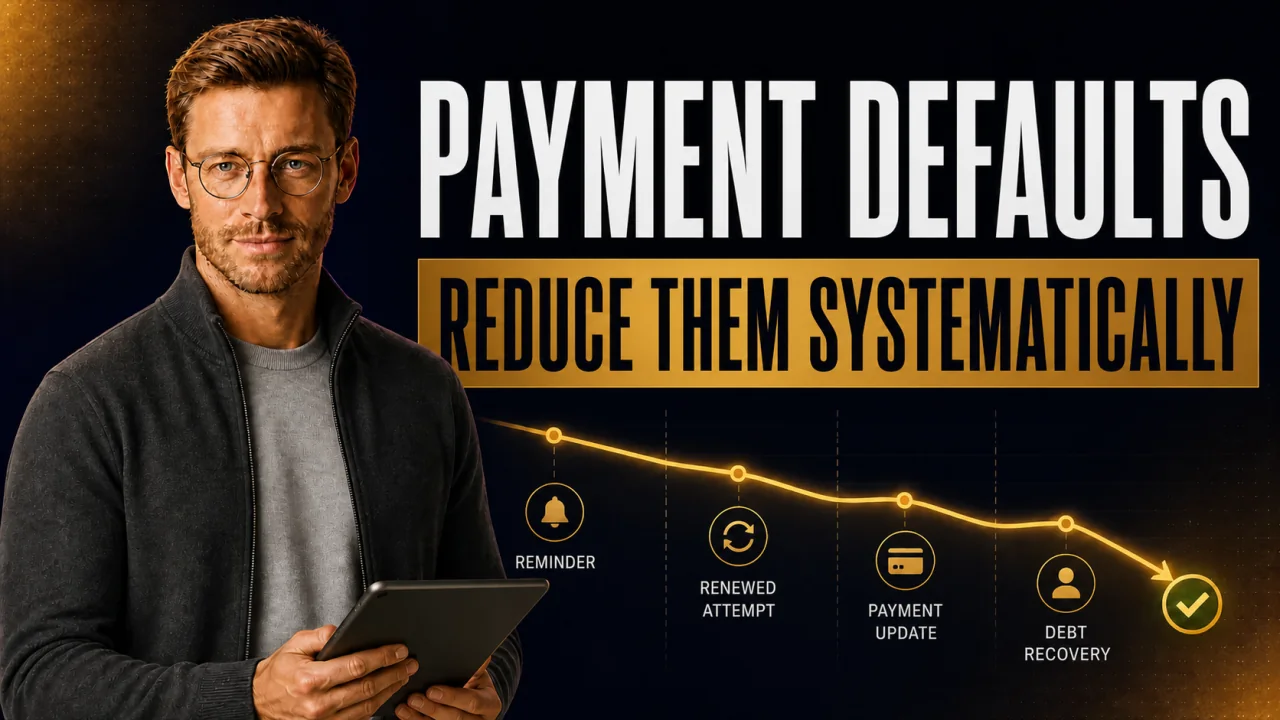
A bounced installment feels like bad luck. It almost never is. Payment default is a systems problem, and systems are something you can build. Here is the full sequence: prevention, early detection, escalation.
Build a three layer system out of evidence, same day reaction and clear escalation. Wait until three installments are open and you negotiate from the weakest position there is. Start on the day it fails and most cases resolve without outside help.
- Prevention: a digitally signed contract that holds up as evidence.
- Early detection: the bounced installment gets worked today, not next week.
- Escalation: a four stage dunning sequence, then collections with the file attached.
- The limit: without clean documentation every escalation is toothless.
If your offers sit under $4,000 and you never sell on a payment plan, you can stop reading here.
Why bounced installments are never random
On high ticket deals with 12 or 24 installments, one will fail eventually. Expired card, empty account, a client in a rough patch. That is statistics, not a surprise.
The real question is not whether it happens. It is what runs in your business in the first 48 hours. That is where predictable revenue splits from silent loss.
Honestly, most sellers find a bounced installment at month end close. By then weeks have passed. The client checked out mentally a long time ago.
The most expensive mistake in payment recovery
Waiting and hoping the client pays on their own. Every week without contact lowers your odds of seeing that money. Run twenty active payment plans and the open balance sits deep in six figures.
What a recovery system gets you
- Open installments get pursued systematically instead of by gut feel.
- Every step is documented and usable as evidence later.
- You stay professional instead of chasing people emotionally by phone.
What it honestly costs you
- You have to set the contract process up cleanly, once.
- A share of cases stays uncollectible even with a system.
- Consistent escalation feels uncomfortable at the start.
What failed payment recovery actually means
The term sounds like enterprise software. Underneath it sits a simple process every coach and agency needs.
Failed payment recovery: The systematic process a seller uses to reclaim payments that failed. It starts with immediate detection of the failed charge and a staged dunning sequence with a documented send log. At the end sits escalation of a valid claim to a collection agency, backed by a provable contract.
The word that carries everything is systematic. One angry email is not a system. A system runs while you are on vacation or in the next sales call.
Scale it up. Sixty active payment plans means a failure almost every week. Cards expire, banks get switched, limits kick in.
Which is why memory does not work as a process. This blows up the moment the overview lives only in your head.
And it starts long before the first failure. It starts at the contract.
Layer 1: Prevention starts at the contract, not the reminder
This is where most people trip. Say payment default and everyone pictures reminder emails. The case is usually decided at the close.
Without a provable contract a dispute is your word against theirs. With a documented close you have facts. At CloserCart the contract PDF has three parts: agreement, scope of services and payment record.
Documented are the digital signature, the timestamp, the IP address and the acceptance log. That documentation is your evidence later, in collections and in chargeback disputes. Skip it and it bites the day a client claims they never agreed to anything.
Withdrawal waiver and B2B documentation ship in both plans, which matters if you also sell into the EU. What that close looks like in detail sits on the feature page for dunning and collections.
Second prevention lever: the payment plan itself. Plans with a down payment, 1 to 36 installments and an optional start delay can be adjusted live on the call. At CloserCart a payment plan is called a Split.
A real down payment filters out clients who cannot carry the deal financially. It costs you a few conversations. It saves you the cases that were never going to work.
Insider tip from practice
I take a down payment on almost every Split before the monthly installments start. A client who wires $5,000 up front has skin in the game. Those people carry the rest of the plan far more reliably than someone starting at zero.
Layer 2: The first 24 hours after an installment bounces
Now the annoying part. An installment fails, and usually nobody meant any harm. Expired card, frozen account, forgotten balance.
Which is why speed beats pressure. In the first days you still catch the client in a cooperative mood. After four weeks of silence you are talking to a wall.
A good system flags the failure immediately. No bank statements to comb through, no spreadsheets to maintain. The alert often lands before the client notices anything.
Some cases clear themselves technically. Processors retry declined cards automatically, and updated card credentials catch another slice. Which tools work in the background there is covered in the article on involuntary churn.
What to do in that moment depends on the case. A long standing client with a clean history gets a friendly nudge first. A client who has already pushed the date twice gets a deadline.
What matters is that something happens at all. Let that moment slide and you are calling three weeks later with nothing in your hand. How to stay human and still consistent is covered in what to do when a customer stops paying installments.
Layer 3: The dunning sequence with a send log
When the friendly phase runs out, you need structure. A staged sequence has proven itself: payment reminder, first notice, second notice, final demand.
CloserCart fires exactly that four stage sequence when an installment fails. It sends from your own sender address, with a complete send log. The client sees your brand, not some tool's.
The log is the underrated part. Sounds boring, right? It is also exactly what a collection agency or a court wants to see later: which stage went out, and when.
Every contract and every notice stays available as a PDF. That keeps you functional in chargebacks and disputes, because you can prove each single step. What the automation looks like day to day is covered in automating your dunning process.
One more thing. The tone across the stages should escalate, not repeat. Four identical emails read like spam, a visible escalation curve reads like a process.
The case that burned this system into me
Okay, quick detour. A story from before I had any of this set up properly.
A client had bought an $18,000 program. Down payment landed, the first installments ran, all relaxed. Then one bounced in the summer and I simply did not notice.
The best month of the year was running. Over $400,000 in contract value in four weeks.
Who is watching a single installment in the middle of that? Not me.
I caught it six weeks later during a reconciliation. Two more installments had failed by then and the client had gone quiet in the community. First no reply, then a long email asking why nobody had ever reached out.
And yeah, I dropped the ball on that one. Not because I was too nice, but because there was no process at all. I recovered part of it and just under $4,000 stayed gone.
Since then the rule is simple. No payment plan without automatic monitoring. That lesson was expensive enough, and it is not happening twice.
Layer 4: Escalating to collections without the drama
At some point the line is reached. Four stages are out, the client is silent or stalling for the fifth time. Now you hand it over.
At CloserCart you push a failed payment to the collection firm Paywise with one click. The signed contract and the authenticity certificate travel with it as evidence. That is exactly what you built in layer 1.
Paywise is a digital, attorney led legal tech collection firm near Munich. It is registered as a legal service provider and works commercial claims only, so it covers the German market.
Selling from the US, you place the claim with your own contingency agency instead. The evidence pack travels either way, and that is the part that decides the outcome. General contingency rates run 25 to 50 percent, often lower on large fresh commercial claims.
Here is the piece Europeans get wrong about the US. Under the American Rule each side carries its own fees. Whether the debtor ends up covering your collection cost depends on your contract, not on a statute.
What else exists around this topic is compared in the guide to debt collection software for coaches and agencies. Either way: collections only works on an undisputed claim. That gets created at the close, not at the reminder.
The trap A friend in the coaching space wanted to collect a $12,000 balance. His contract was an informal email saying "sounds good, let's do it". No timestamp, no signature, no documented scope of services.
The debtor simply disputed all of it, and the thing dragged on for months.
The fix Every deal of mine gets signed digitally now. The contract PDF holds the signature, the time, the IP address and the acceptance log.
If an installment fails later, contract and authenticity certificate go to the agency as evidence. Word against word turns into a file with a paper trail.
What happens after the money lands: reactivation is part of the system
Quick one before we move on. Recovery does not end when the payment clears. The client has to land back in the program cleanly.
After a successful catch up payment CloserCart reactivates automatically. The payment confirmation goes out and community access, Circle for example, gets restored. No manual unlocking, no awkward limbo.
Sounds like a detail. It is relationship work. A client who paid after a rough patch should feel welcome, not punished, and that turns a default candidate back into a normal client who finishes the plan.
The reverse is fair too. Paused access on open installments is legitimate leverage. When an installment fails, a 7 day grace period runs before connected access gets pulled, and people who miss the community daily catch up faster.
The real mistake happens after that. Leave access locked once the money has landed and the client quits a second time, quietly. I missed that for two days once and the conversation afterwards was not fun.
Why leniency is the wrong default strategy
Now the uncomfortable part. The common advice is to be generous, defer the installment and wait it out. Sounds human, but as a default it is wrong.
Myth
Reacting fast and formally to a bounced installment burns the client relationship. Better to wait and show some understanding.
Reality
A fast, factual payment reminder reads as professional rather than aggressive, because it settles the case while it is still small. Relationships break over weeks of silence followed by one frustrated phone call. Leniency stays a tool for individual cases with real reasons behind them, not the default for every failed installment.
Measure something hard instead of how nice you were. The question is this: how many bounced installments are cured after 14 days? That number climbs with systems, not with softness.
And when a client is genuinely in trouble, you negotiate a deliberate change to the plan. That is an active decision with a new schedule, not silent drift. Small difference in words, whole difference in outcome.
Putting recovery rates in honest context
You want numbers. Fair, but honesty is mandatory here. There is no credible universal recovery rate for rescued installments, because results depend on niche, ticket size, contract quality and reaction time.
What can be said is that a receivable ages badly. Commercial Collection Agency Association figures put a 30 day old claim at around 90 percent collectible, and at six months 52.1 percent.
That curve is the whole argument for speed. Early caught technical failures heal far more often than cases dragged out for months. That is practice experience, it varies by niche, and it is not a guaranteed rate.
Anyone promising you a fixed percentage made it up. Run it against your own last twelve months instead.
Three factors move your number the most.
First, the reaction time between failure and first contact. Second, the evidence quality of your contract. Third, the consistency with which you actually run the escalation.
So. Enough theory, here is the whole sequence at a glance.
The escalation chain when an installment fails
| Stage | Trigger | Tool | Goal |
|---|---|---|---|
| Prevention | Before the close | Signed contract, down payment | Provable claim |
| Detection | Installment fails | Instant owner alert | Same day reaction |
| Dunning | No catch up payment | Four stages with log | Cure without collections |
| Escalation | Final demand expired | Handover to an agency | Turn claim into cash |
Where the system hits its limits
An honest section belongs here. No recovery system saves every case. If a client is insolvent, the best agency on earth cannot pull money that does not exist.
Disputed claims are a different game too. If a client seriously alleges your service was defective, a collection case turns into litigation fast. Documentation helps enormously there, but it does not replace an attorney.
And the one click handover assumes B2B. Paywise works commercial claims only and covers Germany. For your typical business with entrepreneurs and consultants that fits, for pure consumer sales you escalate differently.
Not pretty, but true. A system lowers default systematically, it does not take it to zero. The complete overview of the topic sits in the guide to dunning for coaches and agencies.
What this costs and what it does not cost you
Let us run it against each other. One rescued installment out of a $20,000 deal sits in the four figures. Every tool has to measure up against that number.
CloserCart is 49 euros a month on the Starter plan with one product. Pro is 99 euros a month, with unlimited products and your own checkout domain. Annually that is 490 or 990 euros.
One closer is included in each plan, every additional closer is 49 euros a month. You test with full access for 14 days at 1 euro. Cancel monthly, no setup fees.
More important than the price is what does NOT apply. 0 percent revenue share, because the payments run through your own accounts. Connected are Stripe with card, Klarna and PayPal, plus AffiliCon and Ablefy.
The money flows straight to you, not through a middleman. At six figure monthly volume that is the actual difference, not the 49 euros.
And honestly. Layers one through three are doable without software. Templates, a calendar reminder and some discipline carry you a good while.
Except discipline is the first thing to break once the calendar fills up. It gets expensive the moment you save the subscription and write off a five figure balance instead.
What I would do in the first 7 days
You want this standing this week, not eventually. Here is the order I would work in.
- List every active payment plan and flag each open or failed installment.
- Check every live deal for a signed contract with a timestamp and acceptance log.
- Set up your checkout so every new close gets signed digitally.
- Switch on the automated dunning sequence and read all four stages end to end.
- Contact the two oldest open cases personally and offer a concrete catch up deadline.
- Write down your escalation line, for example: after the final demand the case goes to collections.
- Hand your first undisputed old case to an agency and watch how the process runs.
After seven days you do not have a perfect system. You have one that runs. The rest is polish.
Your recovery check before the next deal
- Contract gets signed digitally, with timestamp and IP log
- Payment plan carries a down payment or a deliberate reason against one
- Failed installments trigger an alert to you immediately
- Four stage dunning sequence is live and sends from your own address
- Escalation line to collections is written down
- Community access is restored automatically after the catch up payment
- Every contract and every notice sits in the archive as a PDF
Sources
Common questions about failed installments
How fast should I react to a failed installment?
The same day or the next one. Many failures are purely technical, an expired card for example. Those heal right after a friendly reminder.
The longer you wait, the more the case shifts from oversight to a real payment problem. And the harder that conversation gets.
When is it worth handing a case to collections?
Once your dunning sequence has run in full and the client neither pays nor offers a workable solution. Contingency agencies take their fee out of what they recover, so a dead file costs you little.
General rates run 25 to 50 percent, often lower on large fresh commercial claims. Whether the debtor covers that cost depends on your contract, not on a statute. Court and enforcement steps stay your own upfront cost.
Do I need a signed contract for collections?
In practice yes. Collections only works when the claim is valid and undisputed. That is exactly what you need evidence for.
The digital signature, the logged timestamp and the documented acceptance make it hold. At CloserCart both documents travel with the handover automatically.
Do automated reminders cost me clients?
In my experience it runs the other way. A factual, staged sequence under your own sender address reads as professional. The client gets several chances to sort it out.
Relationships break over weeks of silence followed by confrontation, not over a polite payment reminder.
What happens to community access while installments are open?
While installments are open you are free to pause access. That is allowed and it works. The more interesting direction is the way back.
Once the catch up payment lands, CloserCart reactivates automatically. Community access like Circle gets unlocked again and the client receives the payment confirmation. Nobody has to remember it manually.
Chase failed installments automatically instead of by phone
CloserCart starts the dunning sequence automatically on every failed installment. Undisputed cases hand off to collections with the signed contract attached as evidence.
Start now for €1 14 days for €1. Cancel monthly. 0% revenue share.