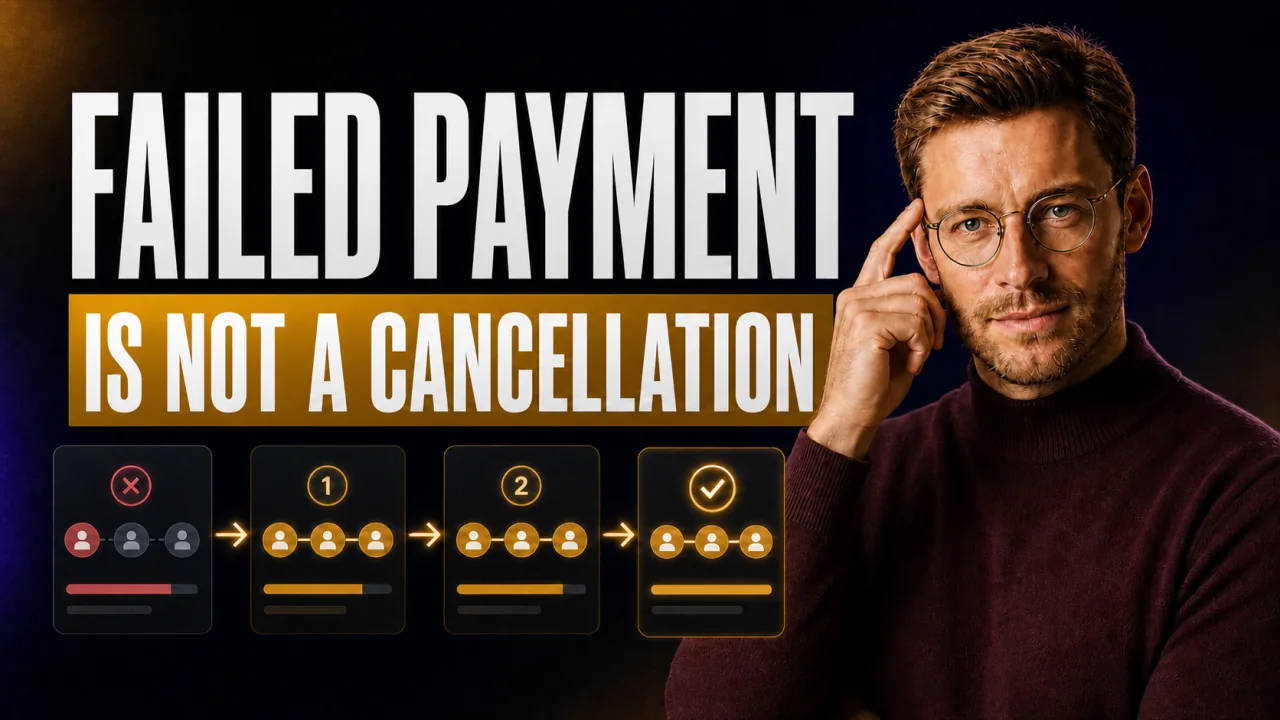
A declined installment feels like a customer walking out. Most of the time it is nothing of the sort. The customer still wants to pay, but the card expired or the limit was too tight. Understand that and you recover four figures instead of writing them off.
Treat every declined installment as a technical glitch, not a cancellation. Most of these customers keep paying if you reach them fast. Follow up weeks later and the money is usually gone for good.
- 20 to 40 percent of churn is failed payments, not cancellations.
- 90 percent of recoveries happen in the 10 day window after the failure.
- The limit: no retry logic beats a customer who simply will not pay.
- Next step: fire the first message automatically on the day it fails.
If you only take one-off payments with no installments, you can stop reading here.
Quick word on the term, so we are talking about the same thing.
Involuntary churn: The loss of a customer who never intended to leave. The payment fails for reasons outside their control: an expired card, a bank switch or a declined charge. The customer is gone even though they never canceled and were never unhappy. It is also called passive churn.
Why involuntary churn hurts twice at high ticket
On a $9 subscription a failed charge is a rounding error. On an $18,000 payment plan every installment is four figures. This is where most people trip.
Run the math for a second. At six figures of installments due each month, a handful of failures leaves a five figure hole. That is not petty cash anymore, that is a hole in your forecast.
The second hit lands later. Treat declined installments like cancellations and you throw out customers who wanted to pay. That backfires the day the customer decides they really are done.
Then there is the term. A 12 or 18 month contract is a long window for technical mishaps. The longer the plan runs, the more certain a failure finds you.
What automated payment recovery buys you
- Willing payers stay, so revenue arrives late instead of never.
- You stop chasing every single installment by phone.
- The relationship survives the payment glitch without drama.
Where this runs out of road
- No retry in the world fixes a customer who will not pay.
- Without a clean sequence, reminders annoy more than they help.
- Recovery rates fall off a cliff after a few days.
The three causes behind almost every case
Recurly names three main drivers of involuntary churn. An expired credit card, a bank switch and a declined charge, usually a limit or balance problem. There is rarely more drama behind it than that.
At high ticket the classic is the card limit. A $2,000 installment hits a card with a tight monthly ceiling. The charge bounces even though the money is sitting right there.
Number two is the card expiring mid contract. Across 12 or 24 installments a card will expire at some point. Not fun, but predictable.
Cause three is the account switch, and it is the quietest of them all. Your customer gets a new company card and thinks of everything except your installments. With business clients this tends to hit mid year, when accounting swaps providers.
None of these three has anything to do with your product. The customer is happy and the program runs fine. Only the wire between their account and yours is cut.
That is exactly why recovery rates are so high here. Miss the pattern and you fight a happy customer over money he already wanted to send.
The most expensive mistake with a failed installment
Letting the failed charge sit and hoping the next attempt clears it. Every silent day drops your recovery odds. After a few weeks you are not discussing one installment anymore, you are discussing the whole balance.
What the numbers actually say
Across industries, 20 to 40 percent of all churn in subscription and installment businesses is involuntary. Failed payments, not real cancellations. Honestly, that is a huge share for a purely technical problem.
Recurly cites an SQmagazine estimate of roughly $129 billion in lost revenue in 2025 from failed payments. That is a projection, not a measured figure.
For your business the small version is what counts. Every installment that quietly disappears. Those are the ones that add up.
There is no reliable public failure rate per billing run for a business your size. As a rough orientation: consumer cards fail more often than corporate cards. The typical range stays in single digits per run.
That varies a lot by niche and card mix. Only the conclusion matters here. Failures are normal operations, not an edge case.
So run the math on your own volume. Charge 120 installments a month and lose 5 percent, and that is six cases. At $1,500 to $2,500 an installment, up to $15,000 is in play every month.
Which is why process work pays off here more than almost anywhere else. One recovered case a month pays for any recovery setup many times over. Skip this math and the leak stays invisible until year end.
Involuntary churn by the numbers
| Metric | Value | Source | What it means for you |
|---|---|---|---|
| Share of churn | 20 to 40% | Recurly | Not a cancellation problem |
| Recovery window | 10 days | Recurly study | React fast |
| Standard retry rate | ~53% | Recurly | Retries alone fall short |
| Network optimized retries | ~71% | Recurly | The rest stays open |
The 10 day rule decides who keeps the money
The key number from Recurly's recovery study: 90 percent of successful recoveries happen in the first 10 days after the failure. After that the rate drops off hard.
The reason is mundane. In those first days the customer still remembers buying and wants the problem solved. Four weeks later they have mentally moved on or resent the silence.
For your process that means one thing. The first message goes out automatically, not when somebody has a free minute. A fixed trigger on the day of failure beats any manual routine.
People forget, systems do not. This blows up in your face if you only review failed installments once a month. By then the window has almost closed on every single case.
Tone matters as much as speed. An early message can sound like service. A late one inevitably sounds like a notice.
From the trenches
I treat day one after a failed installment like a sales task. The customer gets a friendly message with a payment link right away, no blame and no threat. It costs me two minutes and has saved more than one four figure installment.
Dunning is not collections, even if it sounds like it
Okay, quick detour, because people mix these two up constantly. Dunning campaigns are reminder sequences. The customer learns about the failed payment and gets a chance to update their payment method.
Collections is the escalation after that. It deals with an undisputed open claim that a third party goes and recovers. Weeks and a completely different tone sit between the two.
For me that is three to five messages across two to three weeks. Friendly first, then factual, finally with a hard deadline. The first two go out early, while recovery odds are still high.
Blur the two and you burn customers. Answering an expired card with a collections tone is like firing a regular over a typo. How to keep the stages clean is covered in automating your dunning process.
Myth
People who do not pay do not want to pay. A failed installment means a lost customer.
Reality
According to Recurly, up to 40 percent of lost customers never meant to cancel. Cards expire, or charges fail on limits and balances. Most keep paying once they hear about the problem and get an easy way to update.
The standard tools against involuntary churn
The toolbox is small and well documented. Recurly lists five building blocks that catch most cases between them.
- Account Updater: refreshes card data automatically before the charge fails.
- Smart retries: repeat the charge at times with better odds.
- Dunning campaigns: reminder emails with an update link that actually reach the customer.
- Expired card management: flags cards expiring before the installment falls due.
- Backup payment methods: a second stored method catches the failure.
Quick note before we move on. None of these replaces the others. Retries without communication feel mute, and communication without retries leaves easy cases on the table.
The order is not random either. Account Updater and expired card management prevent failures before they happen. Retries and dunning only kick in once the charge has bounced.
In practice that usually means Stripe. The card account updater and automatic retries sit inside its billing product. Charge your installments through Stripe and the card world is largely covered.
One point is missing from almost every list. Plenty of high-ticket installments never touch a card. They run on bank transfers, ACH debits or wires.
An account updater never sees those payments. Cover only the card world and you find gaps no retry could ever catch. For bank payments you need a match between incoming money and open items.
Otherwise the missing installment shows up on a bank statement weeks later. Prevention beats repair, every single time. A card refreshed before it expires never creates a reminder or an annoyed customer.
The best failed charge is the one that never happens.
How an expired card nearly cost me a $24,000 deal
A client had signed a $24,000 program with us, split into twelve installments of $2,000. The first five ran clean. Then installment six came back, and I simply did not see it.
The month was packed. We had just posted the best quarter start in the company's history. Nobody was checking the payment list daily.
Six weeks later a reconciliation showed $4,000 missing. Two installments, silently declined. I called the client and braced for an awkward conversation.
Instead he was confused. His company card had been swapped and the bank had issued a new one. He had never thought about our installments sitting on the old card.
He added the new card while we were still on the phone. Both balances cleared, and he almost apologized to me. And yes, I have fumbled this one myself.
This case burned it in. The customer wanted to pay the entire time. The only thing between me and my money was a missing message in week one.
There are no silent failures here anymore. Every decline creates a task with a name and an amount. Sounds mundane, but it has saved every installment that was still savable.
Why 'just retry more often' is not the answer
The usual advice is to add more retry attempts and let the problem solve itself. Sounds reasonable, right? The data says otherwise.
A single merchant's standard retry logic recovers about 53 percent of failed payments according to Recurly. Network optimized strategies reach roughly 71 percent. Even at best, almost a third stays open.
At high ticket that third is the expensive part. Two open four figure installments weigh more than a hundred failed small subscriptions. Which makes the raw retry rate a fairly useless metric.
Technology does not close that gap. Communication plus a grace period does. The customer has to hear about the problem and get an easy path to update.
Above all, do not cut their access instantly. This is where plenty of people go wrong, because they only ever turn the retry dial. What happens when payments stop for good is covered in customer not paying installments.
How to tell the problem is eating you right now
Most owners know their revenue to the dollar. Ask about their failed charge rate and you get silence. That gap is exactly where the money hides.
Two numbers get you started. First the failure rate per billing run. That is how many installments out of a hundred bounce.
Second the recovery rate. That is how many of those you still collect within four weeks. Compare it to your own previous month, never to somebody else's benchmark.
If the rate suddenly jumps, something is off with your payment methods or charge dates. A common trigger is charging at the end of the month. Plenty of customers have their limit maxed out by then.
The third number is the uncomfortable one. How many days pass between the failure and your first message? Anything over two days means you are losing money inside the recovery window.
Measure it once for your last quarter, honestly and without rounding in your favor. As long as nobody on the team owns the payment list, that number stays unknown forever.
A grace period beats an instant lockout
Here is the annoying part of most setups. Installment fails, access gone, same day. For a customer with an expired card that feels like punishment for their bank's mistake.
The better mechanic is a short, clearly bounded grace period. In CloserCart a failed installment triggers 7 days of grace before connected access gets revoked. A linked community, for example.
The owner gets notified right away. The customer keeps everything for now.
The way back matters just as much. A new payment comes in and access is restored automatically. No ticket, no manual unlock, no awkward 'sorry, my mistake' call.
The grace period is not softness, by the way. It is leverage. You can honestly write in your first message that access stays live for 7 more days.
That takes the pressure off and still sets a hard deadline. What matters is that the deadline actually ends. A grace period without consequence teaches customers to let installments slide.
Clear deadline, clear communication, clear cutoff after. That keeps the system fair and serious at the same time.
Extend the deadline three times and you no longer have a deadline. You have a suggestion.
What CloserCart actually does about involuntary churn
CloserCart is a checkout for high-ticket offers, so the dunning is built for large installments. Failed installments run through a dunning sequence instead of being written off as a loss. The details live on the page for dunning and collections.
Stubborn cases hand off through a built-in Paywise collections connection. Reminder, notice and handover become one process instead of three separate messes. The full chain is laid out in the overview of dunning software.
Paywise covers the German market. Anywhere else you place the claim with your own agency, and the documentation travels either way.
Then there is a point almost every tool ignores: installments paid by bank transfer. A Wise bank reconciliation matches incoming transfers against open installments. Once you have seen that, you realize how much statement hunting used to be normal.
The rest is contract work, long before the first failure. The split builder sets the down payment, the number of installments and any delay. The contract PDF locks it all in with a digital signature.
In CloserCart the payment plan itself is called a Split.
The cleaner that foundation, the calmer the conversation about an open installment later. Leave the plan as a verbal agreement and you end up arguing about amounts instead of a card.
The trap I used to track transfer installments in a spreadsheet and reconcile the bank account once a week. Three parallel plans was fine. At fifteen I missed two incoming payments and sent a reminder to a client who had already paid.
The fix Now the reconciliation runs automatically against the open installments. I only look at cases that are genuinely open after the grace period. The dunning sequence never starts against somebody who already sent the money.
What I would do in the first 7 days
You do not need a quarterly project for this. One week of consistent work gets you basic coverage. The full picture with all dunning stages is in the guide to dunning for coaches and consultants.
Here is how I would start.
- List every active payment plan with its method and remaining term.
- Check each plan for failed or missing installments.
- Contact every open case personally with a direct payment link.
- Define your dunning sequence: day one reminder, then staggered notices.
- Set a fixed grace period before access gets revoked.
- Set up automatic reconciliation for transfer installments.
- Decide the escalation point where a case goes to collections.
Skip step seven and hard cases quietly turn into write-offs.
Your anti-churn checklist
- Every failed installment triggers a message to the customer the same day
- The customer can update their payment method without asking you first
- A fixed grace period separates a payment problem from losing access
- A new payment restores revoked access automatically
- Transfer installments reconcile against the bank account automatically
- The escalation line toward collections is defined in writing
Enough of that. Which leaves the questions I get asked most about this.
Sources
Common questions about involuntary churn
What is the difference between voluntary and involuntary churn?
Voluntary churn is a decision: the customer cancels. Involuntary churn happens with no intent to leave, because a payment fails technically: an expired card, a bank switch or a maxed out limit. The fixes are completely different: one needs a better offer, the other needs better payment recovery.
How fast do I have to react to a failed installment?
Same day, next day at the latest. Recurly puts 90 percent of successful recoveries inside the first 10 days after the failure. Every silent day costs you, so make the first message friendly and give it a direct update link.
Is a dunning email already a formal legal notice?
Dunning campaigns start as reminder sequences that flag the payment problem and offer an update link. Later stages can be worded as a formal notice. Collections is separate and only comes once an undisputed claim stays open after your stages.
Should I cut access immediately when an installment fails?
No, a short grace period of a few days protects the relationship. Most failures are technical, not refusals. The combination is what works: inform immediately, run the grace period, then cut access and restore it automatically on the next payment.
What does CloserCart cost for dunning and payment plans?
CloserCart is 49 euros a month on the Starter plan with one product. Pro is 99 euros a month with unlimited products and a custom domain.
Yearly is 490 or 990 euros, with no revenue share either way. Every plan includes one closer, and each additional closer is 49 euros a month.
Recover failed installments instead of writing them off
CloserCart runs failed installments through a dunning sequence with a grace period, connects Paywise collections and reconciles transfer installments against your bank. More of every Split ends up with you.
Start now for €1 14 days for €1. Cancel monthly. 0% revenue share.