Twenty deals a month at $15,000, each split across twelve installments. Six months in, a six-figure open installment volume runs through your accounts. Spread across hundreds of individual charges.
Any one of them can fail. Not a single one announces itself. Let’s be honest: who checks hundreds of separate charges every Friday?
This is where the most expensive blind spot in the High-Ticket business sits. A failed installment is a four-figure amount. Nobody notices it in day-to-day business.
In the worst case it takes the entire remaining contract down with it. Happens. More often than you would like.
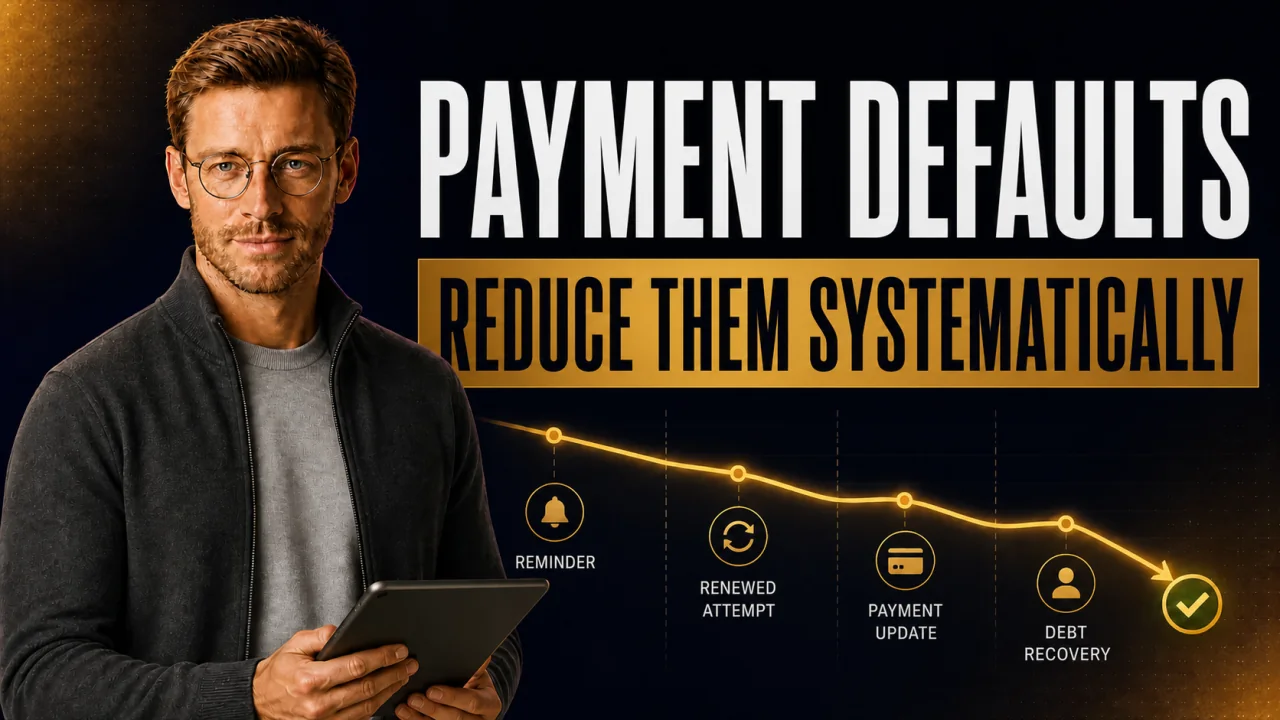
This guide maps the whole field. It shows you why default on installments adds up differently than on an invoice. And which stages the escalation is built from.
Plus: how to dun in a dispute-proof way. And why dunning belongs in your checkout instead of a second tool.
Build dunning into the checkout, not into a second tool. At High-Ticket, every open installment hangs off a signed contract, and that contract is both your dunning trigger and your evidence. Reconcile open installments in a spreadsheet and you lose exactly the ones two emails would have brought back.
- The damage is rarely the installment, it is the remaining contract that goes down with it.
- Most defaults are technical (expired card, low limit), not a wish to cancel.
- The escalation has four stages plus the chargeback, which runs backwards.
- Prevention sits in the contract: due dates, acceleration on default, service pause, waiver of withdrawal.
- Many coaching clients are consumers, and that changes interest and dispute risk.
- Collections pays off early, not late: the older the claim, the less comes back.
If you sell offers under $1,000, you do not need this guide.
Why payment default adds up differently at High-Ticket
For a $47 product, a failed payment is a rounding error. For an $18,000 engagement across twelve installments, that is $1,500 per charge. The contract behind it is worth a multiple of that.
The real damage is therefore rarely the single installment. It is the remaining contract that goes down with it. Someone who drops out after the third installment takes nine more with them.
On top of that comes an effect no bookkeeping makes visible. The deal was closed long ago, the closer already has his commission. Delivery is running.
So the loss does not hit you on the revenue side. It hits your margin in full. Blunt, but that is the math.
My stance is clear: at High-Ticket, default is not a bookkeeping topic, it is cash flow. Run it against your own numbers.
In a month with $300,000 in contract value, a default rate of two percent eats roughly $6,000. About what an additional closer is supposed to contribute in gross margin.
That bites you the day you had already spent those $6,000 on ad budget. Which levers actually push that rate down is covered in the article on winning back failed installments systematically.
Before we get into the stages, a quick word on the term. Everyone uses it differently.
Professional dunning: the structured process a provider uses to collect open claims. It runs from a friendly payment reminder through staged notices with a deadline to handing the case to a collections partner. The goal is not pressure, it is money in the account with the customer relationship intact.
The four stages, cleanly separated
Almost every discussion about dunning jumps straight to the last stage. Collections, lawyers, court claims. That is the most expensive and slowest part.
It only becomes this important because the three stages before it are missing. Here comes the annoying part: separating those stages cleanly is grunt work.
But first things first. The chain has four stages plus a special case that runs backwards. Separate them cleanly and you know where every open installment stands.
The escalation stages at a glance
| Stage | Timing | Channel | Tone | Effect |
|---|---|---|---|---|
| Service reminder | Day 0 to 3 | Email, payment page | friendly, not a notice | fast payment, no friction |
| 1st notice | from day 7 | firm, with a deadline | default documented | |
| 2nd notice | from day 14 | Email, WhatsApp | clear, consequence named | last stage you run |
| Collections warning | from day 21 | Email, post | formal | handover prepared |
| Collections (Paywise) | from day 28 | Provider | out of your hands | debtor bears the cost |
| Chargeback / dispute | any time, backwards | Bank deadline | evidence, not a notice | burden on the seller |
The real stage zero is not in the table. It sits before the default: prevention in the contract. More on that in a moment.
It decides whether you even have an enforceable claim later. No clean contract, no enforceable claim. That is how it works.
The chargeback is the special case. Your customer has already paid and pulls the amount back through their bank. Here evidence counts instead of arguments.
While the bank is reviewing, no notice goes out. Not pretty, but it happens.
This is where a lot of people blow it. They fold stage one and stage two into a single email.
Those seven days of distance are not a luxury. They are the difference between service and pressure.
Straight talk. Phrase the first reminder as a dunning notice and you lose customers. Customers who only had an expired card.
The ready-made copy for each stage and the chargeback playbook sit in the detail articles under this guide. You can run the whole thing without daily manual work, too. The article on automating the dunning run for open installments shows the setup.
Prevention begins in the contract, not in the notice
The cheapest notice is the one that never becomes necessary. And that is decided long beforehand. At the close.
A signed contract changes the starting position. It needs a clear installment agreement, a timestamp, and a documented waiver of withdrawal. Your customer signed something, not just ticked a box.
That same contract becomes your evidence later. Namely at the moment you have to enforce the claim.
These building blocks belong in the contract and the checkout before the first installment runs.
Prevention right in the setup
- A due date per installment, fixed in writing, not just "monthly"
- Acceleration clause: on default the remaining balance falls due at once
- Service pause on payment default, cleanly regulated in the contract
- Withdrawal disclosure and, where permitted, a documented waiver of the right of withdrawal
- A stored card or direct-debit mandate for the recurring charge
- A clear description of services, so no dispute breaks out over the value delivered
My experience: a large share of later dunning dramas are contracts without these six points. That is where most people trip.
This blows up in your face when you write the due date as “monthly” and nothing else. Without a concrete day there is no clean start of default. And without default, no interest.
What such a contract looks like on paper sits in the guide to legally sound coaching contracts.
Dispute-proof dunning: what lawyers target
A slice of the search results on this topic does not come from providers. It comes from lawyers who fight off coaching invoices. That is a signal, not an accident.
Anyone dunning at High-Ticket has to reckon with pushback. The other side will attack the claim itself. No drama, but be ready for it.
The three most common levers are always the same. A missing or incorrect withdrawal disclosure. An unclear description of services, and consumer or distance-education regulation.
In many countries those rules bite on one specific kind of program. Mostly online, running over a stretch of time, with some check on learning progress.
Where such rules apply and you never registered or licensed the program, the contract can be void. Then your whole claim is on the line. No matter how cleanly you dun.
The exact test differs by jurisdiction, in the US even by state. So confirm it with a local lawyer.
Get that wrong and you do not lose one installment, you lose the whole twelve-month plan. This is exactly where an expensive misconception hides.
Myth
If I dun a consumer client hard, I lose in court.
Reality
It is not the dunning that decides, it is the contract. A clean withdrawal disclosure, a clear scope of services, and, where it applies, the distance-education question protect your claim. If the basis is clean, you may dun firmly and in stages, consumers included.
My stance: dunning softly out of fear of a challenge is the wrong reflex. The protection lives in the contract, not in a cautious tone.
When an installment fails: the default playbook
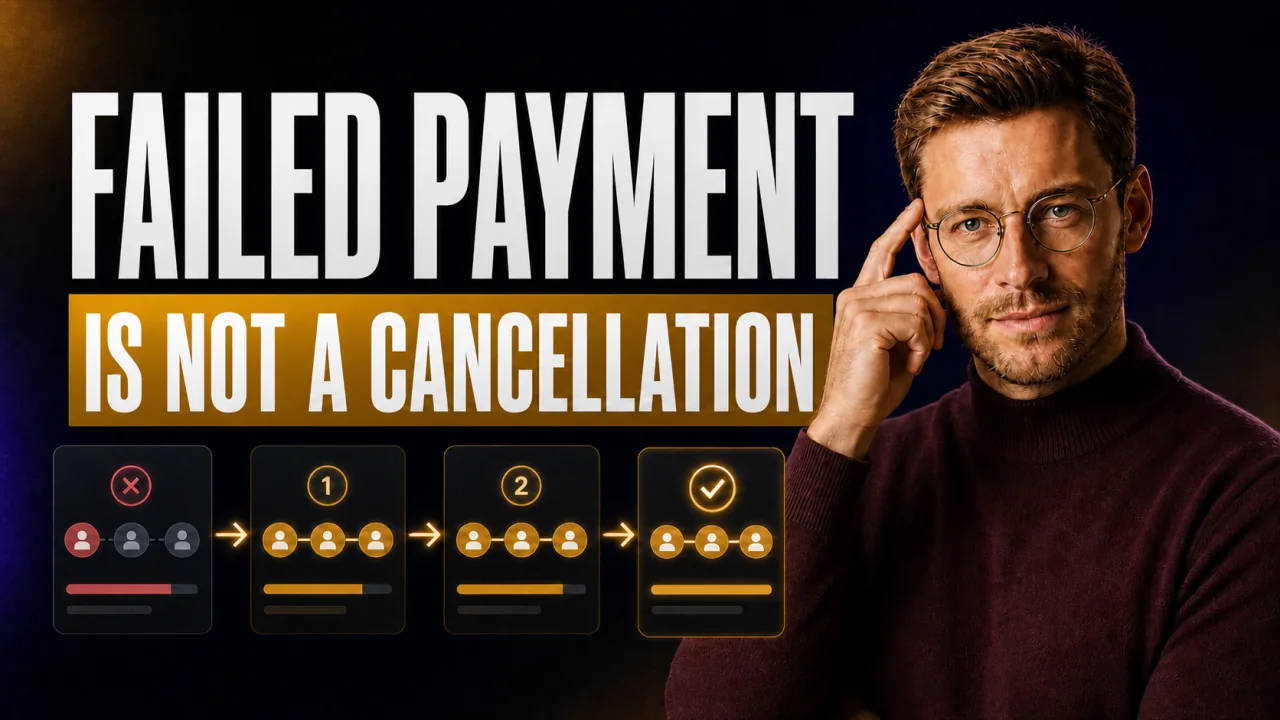
The second most expensive mistake after waiting is simple. You read the failed installment as a cancellation. Usually it is nothing of the sort.
The bulk of defaults trace back to a dead card or a moved limit. Or simply too little in the account on the due date. Not a cancellation, just plumbing.
This involuntary churn caused by failed payments is not a sales problem. It is a process problem. Treat it like a cancellation request and you lose people who wanted to pay.
Never treat a failed installment like a single open invoice. A card that declines once often declines again. Without a retry you lose not one installment, but every one that follows.
The four steps spread roughly across day 0, 3, 7, and 14 after the failed charge.
- An automatic retry of the charge, plus a friendly service email with a direct payment link.
- A second retry, an email reminder, a hint that the card may have expired.
- A personal message by WhatsApp or phone, offering a card update or a new method.
- The first formal notice with a deadline, clearly announcing the service pause.
Uncomfortable truth. Find out about a missing installment at month-end close and you are late. Two weeks late.
You bleed real money here, because within those 14 days the next charge often fails too. Setting up your split cleanly from the start is covered by the guide to offering payment plans.
Fewer installments fail that way. The article further down covers what to do when a customer stops paying the installments.
Dunning without losing the client
With coaching the situation differs from an anonymous invoice. The client might be sitting in your group call tomorrow. A gruff standard notice then costs you more than the installment.
It costs you the mood across the whole community. And an apology will not buy that back.
The answer is not to get softer. Just clearer. Separate the friendly reminder cleanly from the formal notice.
The first is service, the second is default. Simple as that.
Hi [First name], your installment of [amount] from [date] hasn’t reached us yet. In most cases this is an expired card or a limit that’s too low. So nothing to worry about. You can catch up here in two minutes: [payment link]. If something’s come up, just message me and we’ll find a solution. Your access to [program] keeps running as normal. Thanks, and see you in the call, [Your name]
If nothing comes back on that, the tone gets firmer. Never rude. A channel switch often helps at the next step.
A WhatsApp gets read where the third email gets buried. Sounds obvious, right? It is still the step almost everybody skips.
My stance: the call is uncomfortable, but it is the highest lever. A spoken question solves in thirty seconds what three dunning stages need weeks for.
Keep postponing that call and in the end you have no client. You have a case. The full email templates for all three escalation stages sit in the article about writing a dunning notice.
The most common mistake is waiting
Waiting. Out of politeness. Out of conflict avoidance, out of lack of time.
Every week without a follow-up weakens your position. And raises the odds that in the end nothing comes in at all.
The reason is simple. A fresh claim you almost always collect. The older it gets, the more of a grind it becomes.
Memory fades, excuses grow. That is not a theory.
The trap: A client with a $24,000 engagement, installment three of twelve failed. I didn't want to strain the relationship and waited three weeks to follow up. In that time installment four failed too, and the client had long since checked out inside.
The fix: Today the first reminder goes out automatically the same day, from my own sender. The tone stays friendly, but it happens right away. Since then a contract almost never tips over a single installment.
Clear rule: it is not the hardness that decides, it is the speed.
And one more point on roles. Dunning is the creditor’s job. Every notice has to go out from your own sender address.
Not from a foreign system. Your customer should see your name in the inbox. Otherwise the notice reads like a foreign object, and that is what opposing counsel grabs.
Enough theory.
The $41,000 I dunned into the ground
Last spring I had my best month up to that point. $420,000 in signed contracts, most of it on split payments. I was proud, and I handed dunning to an assistant.
She got a standard tool and a template. The sender was the tool’s address, not mine. The tone was the one those tools ship with.
Six weeks later I had four clients on the phone, all complaining. For one of them it was just an expired card. He still got a notice with a deadline and a collections threat.
Two of the four attacked the contract. A third filed a chargeback. In the end I wrote off $41,000 in open installments, plus two lawyer bills.
And yeah, I brought that on myself. The assistant was not the problem, the foreign sender address was. Plus the blind flying: for weeks I never saw who got what.
Today every notice goes out under my name. The first reminder leaves the same day, friendly and without a deadline. Only after that does it get formal.
Those $41,000 were the most expensive process lesson of my career. They taught me that dunning is not a delegation topic. It is a systems topic.
Collections, a lawyer, or a court claim
If nobody responds despite all of this, it becomes a decision. No emotion. Four routes are open.
The choice depends on the amount, the dispute, and the pace. Whatever you pick, doing nothing is not one of the four options.
For an undisputed coaching claim, collections is usually the first external step. On a valid claim the debtor bears the cost. Sounds great, right?
In practice, “valid” means your contract has to hold. A lawyer pays off when the other side attacks that contract. Over distance-education or consumer rules, for example.
Options on an $8,000 claim
| Route | When it makes sense | Who pays | Pace |
|---|---|---|---|
| Dun it yourself | always first | you | days |
| Collections (Paywise) | undisputed, nobody pays | debtor | weeks |
| Lawyer | dispute or challenge | you first, then debtor | weeks to months |
| Court claim | clear open claim | you advance it | weeks |
| Write it off | effort exceeds the rest | you | immediately |
My rule of thumb: under about $500 of remaining claim, writing it off is often cheaper. At $8,000 it never duns itself. So you belong in collections early.
Chase it yourself on the phone for a year and you recover less. Less than the collections partner would have cost you.
Which debt collection software holds up for coaches and agencies is what the detail article beneath takes apart.
Late-payment interest and dunning costs, at real numbers
Being late costs the debtor money. And you are usually entitled to claim it. How much comes down to one question.
Is your client a business or a consumer? In coaching, that is the central fork.
Many coaching clients are formally consumers. In most legal systems that caps what you can add on top.
Consumers typically owe statutory default interest on the overdue amount. In many places only if you told them first. That warning belongs in the contract or on the invoice.
Flat, made-up late fees are the part that gets struck down. Dry stuff, I know.
If your client is a business, the numbers usually run higher. A higher default rate, for one.
Under several frameworks a fixed recovery fee per claim comes on top. The EU Late Payment Directive is one of them.
In the US it works differently. You lean on the late fee in your own contract plus your state’s statutory interest. So the exact figure lives in your paperwork, not in one statute.
Put against the $8,000 claim, this is rarely a profit center. A few hundred dollars of interest per year of delay. Plus whatever fixed fee applies.
The point is not the income. It is that sitting on the claim saves the debtor nothing either.
When default even starts is its own rule, and it varies. A common baseline is a set number of days after the amount falls due.
Often thirty, and only once the invoice has arrived. Against consumers, often only if you flagged that consequence up front.
Look up the exact trigger and rate for your jurisdiction. Or have a local lawyer confirm it. Skip that step and your interest claim quietly evaporates.
My recommendation: treat late-payment interest not as a revenue source. Treat it as leverage to follow up early and firmly. Enough of that.
What a year without a system costs
Back to the numbers. Take an open installment volume of $600,000 across twelve months. Five percent of it fails at some point.
That is $30,000 that was technically already sold. A large part is recoverable if somebody follows up politely in the first few days.
The rest hinges on a single question. Can you prove what was agreed? Without a signed contract and a log of your notices, a claim is hard to enforce.
Run the numbers yourself on what that costs you per year. The second cost block appears in no spreadsheet. It is called attention.
As long as you decide it yourself, every open installment occupies your head. Who gets a notice and when becomes your job.
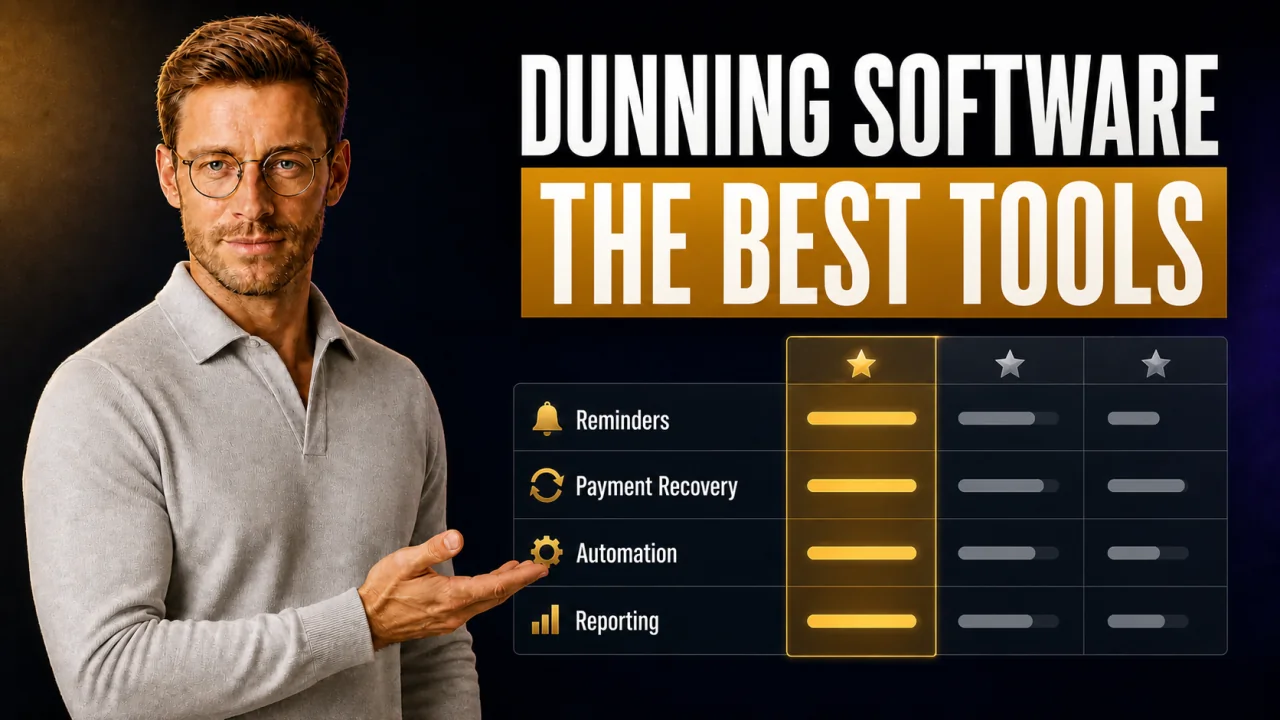
And sooner or later that job slips, usually in the fullest month of the year. Before you buy a second tool for it, look at the common dunning software options compared.
Put plainly: a system costs you a few dollars a month. No system quickly costs you a closer’s annual pay.
Why dunning belongs in the checkout
Classic dunning and receivables software is built for invoices. It pulls open items from the books. Then it escalates in stages and hands over to collections.
For a business with hundreds of individual invoices and an accounting integration, that is the right path. No argument from me.
At High-Ticket the data looks different. The relevant object is not an open item but an installment contract.
Signature and payment plan hang off a single order. Community access and payment history do too.
If dunning lives in a second system, you rebuild that connection by hand. Somebody exports lists and reconciles incoming payments. Then they decide manually who receives a notice.
Exactly this reconciliation is the first thing to slip in day-to-day business. The moment your assistant goes on holiday, the whole dunning run stalls.
A quick reality check on who needs which model. If you invoice hundreds of individual bills a month, take classic accounts receivable software. The established providers are clearly ahead there.
If you sell a few High-Ticket contracts in installments, it looks different. Then dunning belongs at the place the contract is born.
In the checkout the loop is closed. The charge fails, the dunning run starts. The customer lands on a prefilled payment page.
As soon as they pay, the sequence ends by itself. If the installment stays open, community access pauses after a grace period. With the next incoming payment it comes back automatically.
Which tools fit which model is what the comparisons under this guide take apart one by one.
Frequently asked questions about dunning for coaches
What is professional dunning?
The structured process a provider uses to collect open claims, from a friendly reminder through staged notices with a deadline to handing the case to collections. Professional means fixed timing, documented steps, and a tone that gets paid instead of driving the customer off.
What stages does dunning have?
In practice, four: a payment reminder with no formal weight, a first notice with a deadline, a second notice with a clear consequence, then collections or a court claim. With installments the chargeback is a special case that runs backwards, because the customer has already paid.
What dunning fees can I charge as a coach?
You can recover your actual cost of default, meaning statutory late-payment interest and concrete outlays such as collection costs. Flat, invented dunning fees are risky. Business debtors often owe an extra fixed recovery fee under some frameworks, consumers usually do not. Check the rule for your jurisdiction.
When may I dun as a coach?
As soon as the payment is due and has not arrived. Default typically sets in a set number of days after the amount is due and the invoice has been received, and against consumers often only if you warned them of it first. A friendly reminder you may send immediately, any time, since it is not a formal notice.
What do I do when a coaching client won't pay the installment?
First check whether it was just an expired card, the most common cause. Then remind them politely the same day, follow up more firmly if it stays quiet, and switch channels. Only when nothing comes back do you send a formal notice and, later, hand it over.
May I pause the coaching on payment default?
Yes, if your contract provides for a service pause on default. Without that clause it is risky, because you can end up in breach yourself. That is why the clause belongs in every installment contract, cleanly worded and agreed up front.
When does collections pay off for coaching claims?
Early, as soon as your own notices go unanswered and the claim is undisputed. On a valid claim the debtor bears the cost. The older the claim, the less comes back, so long waiting costs you real money.
What if the client challenges the coaching contract?
Then your contract decides, not your dunning. The weak points are the withdrawal disclosure, the description of services, and whether the program falls under regulated distance-education or consumer rules. If the basis is clean, the claim holds and you can keep enforcing it firmly.
Dunning that takes care of itself
Pull it all together and it boils down to one line. Dunning belongs where the contract is created. That is exactly where CloserCart sits.
CloserCart watches every installment of your split. On a failed charge it starts the dunning run automatically, through your own sending address.
You decide whether the collections partner Paywise takes over right after the reminder. Or whether you send the staged notices yourself first. Every notice lands in the log, traceable.
If an installment stays open, access to the community goes quiet. Only after the grace period, and the next payment in brings it straight back.
For bank transfers the system reconciles your account first. So a technical glitch never hurts your customer. What that looks like in practice is on the feature page Dunning and Collections.
No second tool. No export, no manual reconciliation. The loop stays closed, from the signed contract to the last installment.
This guide is not legal advice. It reflects experience and publicly available information, and the exact rules on interest, notice, and consumer protection differ by country and, in the US, by state. For your specific case, talk to a lawyer. As of 2026.