High ticket doesn’t sell through the cart. Nobody buys a $5,000-plus offer in passing. They buy after a conversation.
In that conversation, one person trusts another to solve their problem. That is where your revenue is decided. Not on the sales page.
Most guides on the topic aim right past you. They explain how to become a closer. You are the operator.
You are doing $70,000 to $120,000 a month. You need a repeatable close that scales to $500,000 and beyond. Completely different job.
This guide closes that gap. The full call system, plus the decision to close yourself or hire closers. Then real KPI benchmarks and the last mile from yes to money in the bank.
Build a system, do not rely on talent. High ticket closing is a repeatable process of discovery, objection prevention, and a guided close on the call. Postpone the deal to email and you lose it.
- The deal is won in discovery, not at the end. Find the real problem early and there are barely any objections left to handle.
- The one-call close is the standard for coaching and consulting offers. Two calls only when several people decide.
- Close yourself until the calendar is full, then hire closers. An agency almost never.
- The last mile (payment link on the call, payment plans, contract, dunning) decides your cash, not just the close.
- Honest take: the market is not saturated, but the "become a closer in 30 days" crowd gave the term its bad name.
If you sell offers under $1,000, you do not need any of this.
What High Ticket Sales and Closing Really Are (and Why Most Guides Miss You)
Search Google for high ticket sales or high ticket closing. You land almost entirely on job listings and career guides. How do I become a closer, what does a closer make, remote closing jobs.
For an operator, that is the wrong question. Let’s be honest: the closer career path does not concern you at all. What concerns you is a closing process that runs without you.
You are already doing six figures a month. You want half a million and up. That does not call for career coaching, it calls for a system.
Let us start with a clean definition. Online, everyone means something different by it.
High ticket closing: the structured sale of high-priced offers (roughly $4,000 to $5,000 and up) in a live conversation, usually by phone or Zoom. High ticket sales is the broader craft around it, from the lead to the booked call to the close. The deal does not happen through a cart, but through discovery, objection prevention, and a guided close. The goal is a paid, cleanly documented decision, not just a verbal yes.
The key difference from low ticket selling is simple. You are not selling features, you are selling a decision. And decisions of this size land on the emotional level.
A discount table moves nothing there.
The principles in this guide come from the field. Learned from operators like Matt Ryder, Cole Gordon, and Jeremy Miner. Plus from selling our own high ticket offers day in and day out.
It took me two years to get the process running without me. Two years in which I assumed I was simply good at talking. That is where most people trip.
The bill arrives with your first closer. He gets no system, just an anecdote. Then the owner wonders why nobody but him can close.
The rest of this guide is the exact process I did not have back then.
The Call System: One-Call Close or Two-Call Close
Before you think about scripts, decide the architecture. Do you close in the first conversation? Or do you need two appointments?
My firm take: for most coaching and consulting offers, the one-call close is the standard. A second appointment gives the decision time to cool off. A cooled decision dies.
One-Call Close vs. Two-Call Close, Side by Side
| Criterion | One-call close | Two-call close |
|---|---|---|
| Fits | Coaching, consulting, a single decision-maker | B2B with several decision-makers |
| Decision-maker on the call | yes, able to decide alone | champion, not the final say |
| Main risk | none with clean discovery | deal cools between appointments |
| Cash impact | faster, higher collect rate | slower, more stakeholder buy-in |
The two-call close is not a comfort buffer. It is a deliberate choice for one single case. The person on the call is not the final decision-maker.
Then you deliberately do not close on call one. You turn your contact into a champion. And you coach them to bring every decision-maker to the second appointment.
This blows up in your face when you offer a second call out of nerves. The decision-maker is sitting there alone and you dress up conflict avoidance as strategy. That is the most common source of needless follow-ups.
One example from my own calendar. I once offered three second appointments in a single week, all out of pure cowardice. Not one of them came back.
Not pretty, but it happens. Every needless follow-up costs you close rate.
The Sales Call: How a High Ticket Conversation Is Built
A good call is not a monologue. It is a fixed sequence with plenty of freedom inside it. Know the phases and you always hunt with intent.
It actually starts before the call. A sales page qualifies instead of selling. Its only job is to get the right person onto the call.
The wrong ones it filters out beforehand. How you build a sales page that triggers the call is a topic of its own.
The call itself follows five phases: brief rapport, discovery, transition, pitch, close. The transition is the underrated part. Ideally the customer asks to hear your solution.
You never force it on them. And running a sales call phase by phase is laid out as its own playbook.
My take: the pitch is the shortest part, not the most important. Pitch for 40 minutes and ask questions for five, and you have flipped the order. You then manufacture objections that good discovery would never have allowed.
In the pitch itself you sell the method first, then the product. The customer has to believe your path is the best one. Only then does the price land.
Test that with one simple question. On a scale of one to ten, how much is this exactly what you need? Anything under a nine you handle before the number is on the table.
This is what catches up with you when you name the price at a seven. Once the price is out, any leftover doubt kills the deal. Blunt, but true.
Discovery Decides the Deal, Not the Close
The biggest thinking error in high ticket is assuming the close happens at the end. It happens in discovery.
Find the real problem early and there are barely any objections at the end. What matters is that the customer says it out loud himself. If one shows up anyway, your discovery had a hole in it.
The heart of discovery is honesty about numbers. Prospects almost always quote their best month, not their real one. Someone who says “roughly a million a year” may have done $40,000 last month.
This is how you reach the real number without sounding like an interrogator:
Just as important as qualifying is disqualifying. Someone with $400 in the bank and no access to more does not have an objection. He has a condition.
You do not want those people in the program anyway. Sounds obvious. It is not, because this is exactly where operators talk themselves into bad-fit deals every month.
A simple lead score is enough. Revenue level, real pain or an unmet desire, decision authority, access to capital. Miss one of those hard and you do not have a sales problem, you have the wrong conversation.
The full flow of a discovery call with qualifying questions and no-go signals is written up separately.
Not every customer has burning pain. That is fine. There are two buying drivers: moving away from pain or moving toward an unmet desire.
With an established operator who already has solid revenue, you often work with the desire. You make the gap between where they are and what is possible visible. Pain is the smaller half there.
The strongest moment in any discovery has a fixed shape. The customer tells you, in his own words, the day he had enough. Take him back to that day.
That story holds the emotion that carries the decision at the end. This is where plenty of people fumble it, because they let the weak answer slide. Accept “I just want to improve a little” and you get exactly that non-commitment handed back to you.
Objection Handling: the Real Reason Behind “Too Expensive”
An objection in the final minutes of a call is rarely the real reason. “Too expensive,” “I need to talk to my partner,” “I’ll get back to you.” Almost always stand-ins.
Behind it sits a missing belief. With “too expensive,” cash is rarely the actual blocker. What is missing is the belief that doing nothing costs more than the price.
A business owner with a solid income will call $8,000 too expensive. Not because the cash is not there. Because that belief is not in place.
That one sentence deserves its own choreography. How you take apart the price objection step by step is covered at length. From isolating it to running the cost of inaction.
The first step is never a counterargument. Take the pressure off, then isolate.
No problem. Short pause. Then the real question.
This phrasing takes the transaction out and surfaces the real objection:
Whether you are facing a real objection or just an excuse, you test in under a minute. The isolation question does the work. Apart from this one point, is that the only thing still holding you back?
If a second point shows up, the first was just a smokescreen. Every time.
Operators trace every objection back to a handful of missing beliefs. Pain, doubt about going it alone, the price of standing still. Then a clear desire, the means, support from the people around them, trust in your specific method.
Build those during the conversation and you prevent most objections. They never get raised at all. A whole library of objection handling methods with word-for-word talk tracks sits ready on its own page.
One example from the field: the partner objection. “I need to run this by my spouse” is rarely about permission. It is the search for someone to share the responsibility.
First isolate the customer’s own uncertainty. Then find out whether they are informing their partner or actually asking. Do it the other way around and you are chasing a ghost.
Just as common is the bad past experience. Someone who has been through three agencies carries the fear that it goes the same way again. Instead of arguing, you go back into diagnosis.
Was it the method, the execution, or the customer themselves? Each answer opens a different path back to the close. Anyway, arguing never once helped here.
Naming the Price Without Flinching
The whole call runs with confidence. Then the price comes up and the voice goes thin. That moment kills more deals than any objection.
Name the full price with the same calm as any other sentence. Keep payment plans in your back pocket until you know the financial situation. Then offer exactly the right plan as a deliberate concession.
Under pressure, plenty of people reach for a discount instead. It feels like movement. Sounds good, right?
Myth
A discount gets the hesitant customer over the line.
Reality
A discount almost never resolves a real objection, it only lowers your margin and your status. Wobble on price and you are selling the customer doubt along with it. Wealthy buyers lose respect when you let yourself be talked down instead of holding your value.
The iron rule the moment you negotiate on price: no concession without something in return. Turn full price into a two-payment plan with no strings attached. Then you will hear “thanks, I’ll let you know tomorrow.”
Trade it for a decision right now instead, and the concession keeps its value. And if you do give ground, trade up rather than down.
Every further step costs the customer something new. A case study to be featured in, a faster start date, a decision before you hang up. That way each concession stays a currency instead of becoming a gift.
Negotiating price without cutting price means setting the price against the ongoing losses. Someone leaving $300,000 in potential revenue on the table every month is not negotiating over $15,000. He is negotiating over a fraction of that.
For that to work, the monthly loss has to be a number in the room first. Without that number, your price stays a big figure standing on its own. Against a bare big figure you lose almost every time.
Which closing techniques actually close today and which ones burn customers is broken down separately.
Closing on Zoom: What Changes on Video
I close almost everything on Zoom myself, not by phone. The reason is simple. I want to read body language, and I want the customer to see me.
Camera on is mandatory, on both sides. Someone who will not turn it on you do not crack with pressure. You do it playfully.
Never say “your camera is off.” Ask, slightly puzzled, whether their video is broken. The difference is tiny and it lands instantly.
The most important Zoom move happens at the moment of price:
From the field: put the price on the screen
When the price comes up I share my screen and run the customer's own numbers live. Current revenue, a realistic lift, then deliberately the worst case. When even the conservative math wins, there is no rational no left. And at the price I lean back slightly instead of forward. That takes the pressure off and makes the customer lean in.
Video forgives no dead energy. Raised eyebrows and leaning away signal uncertainty. Leaning in signals conviction.
Your own recordings show you that in two minutes. Honestly, almost nobody ever watches them. Pull up an old call and jump straight to the price moment.
The vibe sells before the words do. Two closers with the same script get completely different results. One sounds calm and certain, the other ends every statement on an upward, questioning note.
What runs differently when you close remotely on video instead of the phone is covered in depth.
A small trick at the start: ask the customer to grab a pen and paper. Someone who cannot, because they are out and about, is not ready to buy. And you notice it immediately.
On Zoom you see it anyway. On audio-only the test is your substitute.
Skip it and you pitch someone who is driving on the side. He was never in a buying situation at all.
Preventing No-Shows: the Show-Rate System
A deal that does not show up is no selling failure. It is a process failure. And show rate is something you can plan for.
The biggest lever is when you book. Call parents during the school pickup at three in the afternoon and you manufacture no-shows. Put the slots where your ideal client actually has time.
In B2C that is often the evening, in B2B during office hours. Here comes the annoying part: you have to measure this, not guess it.
This chain keeps the show rate up without you having to think about it:
- Book the appointment only with a micro-commitment: the customer actively confirms the time and the goal of the call.
- Right after booking, send a confirmation that spells out the clear benefit of the appointment.
- Remind them 24 hours out and ask for a short reconfirmation.
- On the day itself, a brief reminder message one to two hours before.
- Review no-show rates by weekday and time of day and cut the bad slots.
Without that review, your optimization runs in circles. You polish the script while a bad slot empties your calendar.
Every active yes up front is a micro-commitment. Someone who has confirmed three times shows up far more reliably. People want to stay consistent with their own word.
Plenty of teams believe they have a show problem. They are only booking the wrong slots. Measure first, judge second.
Close Yourself, Hire a Closer, or Use an Agency?
The real operator question is not “how do I close better.” It is simply “who closes.” Three options, three clear thresholds.
My take: close yourself as long as you can. Nobody sells your offer with more conviction than you do. Hire your first closer only when your calendar can no longer hold the demand.
And an agency is almost never the right answer. Full stop.
Who Closes, at Which Level of Load
| Situation | Right call |
|---|---|
| Up to about 15 qualified calls a week | Close yourself |
| Calendar full, leads piling up | Hire your first closer |
| Several full calendars, process in place | Build a closer team |
| No sales process of your own, hoping to scale fast | Rarely an agency, and with caution |
My own ceiling sat at roughly 15 calls a week. From the sixteenth on, my prep suffered, and the customer picks that up instantly.
The agency option sounds convenient, but there is a catch:
What an agency is good for
- Fast access to trained closers without your own recruiting
- Useful as a bridge when nobody is available in-house at short notice
- An outside view on obvious process leaks
Why it is rarely the answer
- The closer never knows your offer as well as your own team
- Commission flows out while the sales knowledge stays out of house
- Impressive close-rate promises are often unproven
The deciding threshold is not your revenue. It is your calendar. Hire while you still have gaps yourself and you spread too few leads across too many closers.
Then none of them ever gets going. Enough of that, let us talk selection.
How you find and hire a good closer is described separately. Short version: not by a loud presence, but by how they listen and take objections seriously.
A loud pitch in the interview tells you little about real close rate. Plenty of owners miss badly right here. They hire the best self-promoter instead of the best listener.
The second type of candidate many people overlook is your own delighted customer. Someone who went through your program and got a real result sells with genuine belief. No seasoned salesperson fakes that.
Skills can be trained. Genuine conviction cannot.
What a Closer Costs: Commission, Clawback, and Misclassification
Before you hire, understand the comp. Commission models are not a detail. They steer your closer’s behavior directly.
Two basic questions come first. Pure variable or base plus commission? And commission on cash collected or on contract value?
My clear recommendation: commission on cash collected. Only money that has actually come in is real money.
Commission Models and What They Drive
| Model | Effect | For whom |
|---|---|---|
| Pure variable (commission only) | High pressure, high churn | Experienced closers, high volume |
| Base plus commission | More stable, more predictable | Ramp-up, longer cycles |
| Commission on cash collected | Closer drives payment coming in | Standard recommendation |
| Commission on contract value | Risk on payment default | Only with clawback |
Without a clawback you pay commission on deals that never get paid in full. On a refund or a broken payment plan, the commission has to claw back proportionally. Otherwise you subsidize your own defaults, and that hurts.
There is a point most guides skip entirely: worker misclassification. A closer who works only for you can legally count as an employee rather than an independent contractor.
Fixed hours and full embedding in your processes are the warning signs. In the US that is the 1099-versus-W-2 line, and other markets draw a similar one. Ignore it until it bites and the back-payments land years later.
The most expensive mistake after hiring is leaving the closer on their own.
The offer, the target audience, typical objections, the pricing logic. All of it gets taught in a structured way. Not shouted between two calls.
A good closer delivers after two weeks, not after three months. Assuming the onboarding is dialed in.
Clean onboarding has fixed building blocks. Your best own calls to listen in on. Then a deep dive into the offer, an objection library, daily role-plays in week one.
Throw new closers into the deep end instead and you burn leads. You burn good people along with them. How you onboard new closers to be productive in fourteen days is described step by step.
The Most Expensive Mistake I Ever Made With a Closer
My first closer did not have a talent problem. He had an onboarding problem, and that one was on me.
My calendar had just filled up and I assumed I could simply hand the conversation over. So I gave him a Zoom link, my price list, and three sentences about the offer. Nothing more.
For the first three weeks he got every qualified lead that came in. I did not sit in on a single one of his calls. I was busy and he sounded confident on the phone.
Then came the review. My own close rate sat at around thirty percent, his at barely six. Across the leads of those three weeks, several hundred thousand dollars in contract value simply never happened.
It was the exact month that was supposed to be my best. The bitter part is not the number. Those leads were not bad, they were burned.
Someone who sat through one weak conversation rarely comes back for a second. And yes, I have blown this one myself, even though I knew exactly what good onboarding looks like. I had just never written it down.
It lived in my head, and nobody learns from my head. Today every new closer gets two weeks without deals of his own. He listens in, he role-plays, he is allowed to get it wrong.
Expensive lesson, but a lesson.
KPI Benchmarks: the Numbers You Measure Yourself Against
Without numbers you are flying blind. The most common question is what a good close rate looks like. Not one of the ranking pages gives you a benchmark.
Here is one, from the field. Not from a made-up study. These are typical ranges that swing hard depending on niche, ticket size, and lead quality.
Take them as orientation, not law. No joke, I have seen niches where a 15 percent close rate was excellent.
KPI Benchmarks in High Ticket Sales
| Metric | Typical range | What it tells you |
|---|---|---|
| Show rate | 60 to 80 percent | Quality of your booking and reminder chain |
| Close rate (qualified calls) | 20 to 40 percent | Strength of discovery and the close |
| Cash collected rate | 70 to 90 percent | How much of the contract value actually comes in |
| Follow-up share of revenue | often 20 to 40 percent | The value of your follow-up system |
The most dangerous metric is the one nobody names. The gap between contract value and cash collected. You can celebrate a record month of $400,000 in contract value and still hit a cash crunch.
That is the moment it tips, when only half of it actually lands. The dashboard looks glorious, the bank account does not.
Think in funnel math. From your rates you can back into any target. How many calls for how many shows, for how many closes, for how much cash?
Know your rates and you plan revenue. Miss them and you merely hope for it.
Also measure cleanly when a dip is real. A rut is a fall in close rate of about five percentage points over 30 days. A single weak day is normal variance instead.
Never over-read a small sample.
The Last Mile: From Yes to a Paid Deal
Here is the gap not a single other guide on the topic closes. The deal is not the verbal yes. It is cleared funds plus a clean contract.
The costliest error in the whole high ticket process happens right after the yes:
The most expensive sentence in high ticket sales
Let me just email that over to you. Between the call and the email every decision cools off, and a certain yes turns into "I'll get back to you." With no payment link on the call, no contract, and no dunning process, you lose deals that were already won.
Do the honest math. Your deals run between $15,000 and $30,000.
Let a share of your verbal wins cool off after the call. You are quickly talking about six figures a year.
A concrete example. Say you win ten commitments a month on the call at an average of $20,000. If only two of them cool off, that is $40,000 a month.
Across twelve months that is nearly half a million. Nothing about that is a selling issue. It is pure process, and no exaggeration.
The second loss is quieter: open installments. Offer payment plans without a dunning process behind them. By year end you sit on a six-figure open balance that nobody is tracking.
That is exactly what happened to me early on:
The trap: a $24,000 deal, agreed verbally, then a payment link sent over by email afterward. The customer paid the first installment, the second one failed, and with no automatic dunning process the case sat unnoticed for three weeks.
The fix: the payment link on the call itself, a contract with a signature built into the close, and failed installments flowing automatically into a dunning sequence. Since then the decision is made in the conversation, and the cash comes in predictably.
That last mile is what CloserCart takes off your plate. You or your closer sends a link. Behind it you control the price, the payment method, and the payment plan live.
No hanging up, no new link. If the customer wants to pay in installments, you offer the plan right on the order page. Optionally with a 30-day payment pause.
How the payment plan with a payment pause works under the hood is on the feature page.
The close becomes legally sound in the same step. Contract as a PDF, digital signature, and a certificate of authenticity with a timestamp and IP log.
What matters in legally sound coaching contracts is explained on its own. How contracts with a digital signature are created in the checkout, likewise.
And if an installment does fail, the automatic dunning process kicks in. How you set up dunning for coaches cleanly is laid out in detail. What the built-in dunning with collections takes over, as well.
Skip this chain and you sell well but collect badly.
The practical advantage on the call: your closer builds price points and payment plans himself. He never sees your payment providers. No waiting on you, no link chaos in notes apps.
And no lost deals because you happen to be away from your computer. Minimal permissions for the closer, full flexibility for the customer.
Reality Check: Is High Ticket Sales Saturated or a Scam?
High on the Google results sits a Reddit thread full of skepticism. Right next to it: “is high ticket sales saturated” and “is high ticket sales legit.” Both deserve an honest answer, not marketing chatter.
The short version: the market for selling high-priced offers is not saturated. What is saturated is the market of “become a closer in 30 days” promises. That is what gave the term its bad name.
Most closer trainings sell a job that does not exist in the promised quantity. For you, the operator, that is good news. A genuinely good closer is rare, and a clean closing process is a real competitive advantage, not a commodity.
As an operator you are looking at this from the other side anyway. You do not care whether there are too many wannabe closers. You care whether your offer solves a real problem.
When your process holds up too, demand is not your bottleneck. Frankly, that is the best news in this entire guide.
The scam skepticism almost always comes from one corner. Aggressive high-pressure sales to people who cannot afford it. That is unethical, and it is also bad business.
Those deals come back as refunds or chargebacks. The bill often arrives months later. Qualify cleanly and name who the offer is not for, and you build trust instead of burning it.
An honest look at the field. The good content on the topic is rare.
Most of it targets the closer job. The rest is a thinly veiled course funnel with a conflict of interest.
You are building a real offer with a clear process. Barely anyone out there is writing for your side.
Follow-Up: the System After the Call
A large share of salespeople quit after the first no. That is exactly where the money sits. Follow-up is not pestering, it is service, when you do it right.
The thinking error is the supplicant frame. “Hey, just checking in to see if you’ve decided yet.” That makes you small.
Following up with value and a clear next action holds your status. Trouble is, most people do the exact opposite.
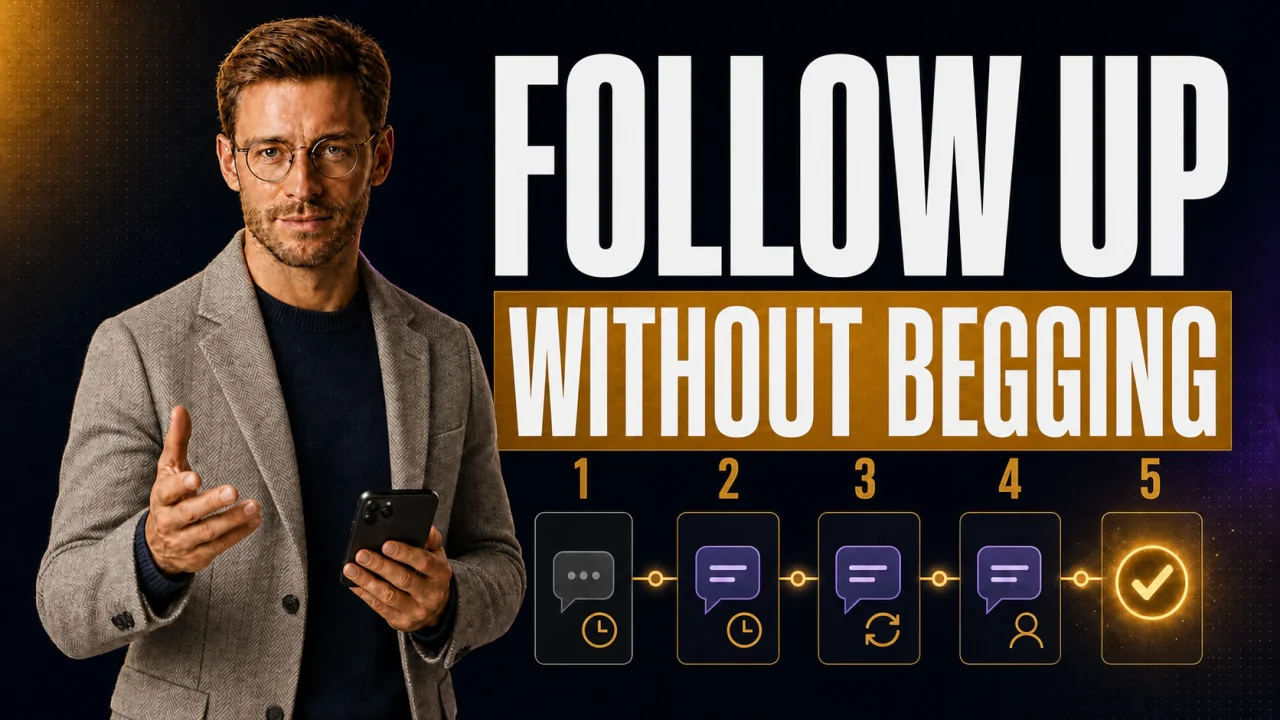
Here is how you follow up without turning into a supplicant:
A simple system beats talent. Fixed follow-up slots at the end of the day instead of chasing on the fly. Twenty uninterrupted minutes will do.
Think of the deals with a money objection from two weeks ago. If nobody followed up, those are often the easiest closes of all.
If you send something after the call, do not send a bare quote. Send a short, explanatory summary. Your contact can forward it internally.
With several decision-makers, that document keeps selling for you when you are not in the room. Afterward you always schedule the next step. A vague “get in touch once you’ve read it” is a lost deal on a delay.
Referrals are brute force. You ask a hundred people, ninety-five ignore you. But one sends you ten.
Ask everyone, and frame it up front. “I ask everyone for referrals as a rule, so just ignore me if it’s annoying.” The complete system for following up after a sales call comes with ready templates.
FAQ on High Ticket Sales and Closing
The most common questions around high ticket sales and closing, answered short and straight.
How much do high ticket closers make?
High ticket closers usually work on commission, typically around 8 to 15 percent of the money that actually comes in (cash collected). On deals between $15,000 and $30,000 with a solid close rate, experienced closers land in the mid four to low five figures per month, and top performers well above that. The commission basis is what matters: paying on cash collected protects you from paying commission on deals that never get paid.
Is high ticket sales saturated or still worth it?
Selling high-priced offers is not saturated, and good closers are rare. What is saturated is only the market of trainings that promise everyone a closer job. As an operator with an offer that solves a real problem, a clean closing process is a competitive advantage, not an overcrowded field.
What are the biggest mistakes in high ticket sales?
The three most expensive ones: first, postponing the price ("I'll email it over"), second, folding on price and discounting, third, ignoring the last mile. No payment link on the call, no contract with a signature, no dunning process. The sale does not end at the yes, it ends at the paid deal.
What is a good close rate in high ticket sales?
On qualified calls, a typical range is 20 to 40 percent, depending on niche and ticket size. Just as important is the cash collected rate, how much of the contract value actually comes in, where 70 to 90 percent is common. A high close rate paired with a low cash rate is a warning sign.
How do you become a high ticket closer?
A closer learns discovery, objection handling, and closing, and usually works on commission for an existing offer. This guide is deliberately written from the operator's side, for the side that builds the process and hires closers. If you want to become a closer yourself, there are dedicated resources on the career, the pay, and how to get in.
One-call close or two-call close, which is better?
For most coaching and consulting offers, the one-call close is the standard, because every postponed decision cools off. The two-call close is the right choice when your contact does not decide alone and you need to bring several stakeholders on board. A second call out of nerves is usually conflict avoidance in disguise.
What is different about closing on Zoom versus the phone?
On Zoom you read body language and the customer sees you, which builds trust and control. Camera on is mandatory, a screen share at the price makes the math tangible, and leaning in signals conviction. On the phone alone you lose all of that, and you cannot tell whether the customer is even in a position to buy.
The Deal Is Won on the Call, Not After
One idea survives all of this. High ticket closing is a system, not a talent. It is decided long before the price.
Discovery, objection prevention, a calm close, and a tight last mile. That is the whole thing.
The thread running through it all is momentum. Between yes and payment sit three weeks in the bad case. Three minutes in the good one.
Switch between a one-time payment and a payment plan on the call and you sign in the conversation. Adjust the amount and get the contract signed right there, same result. All without hanging up.
Postpone instead, and every deal starts from zero again.
This is what live control in the closer console was built for. One link per customer, behind which you steer price, plan, and method in real time. Your closer works without touching your payment backend.
That way the momentum you earned on the call stays intact.