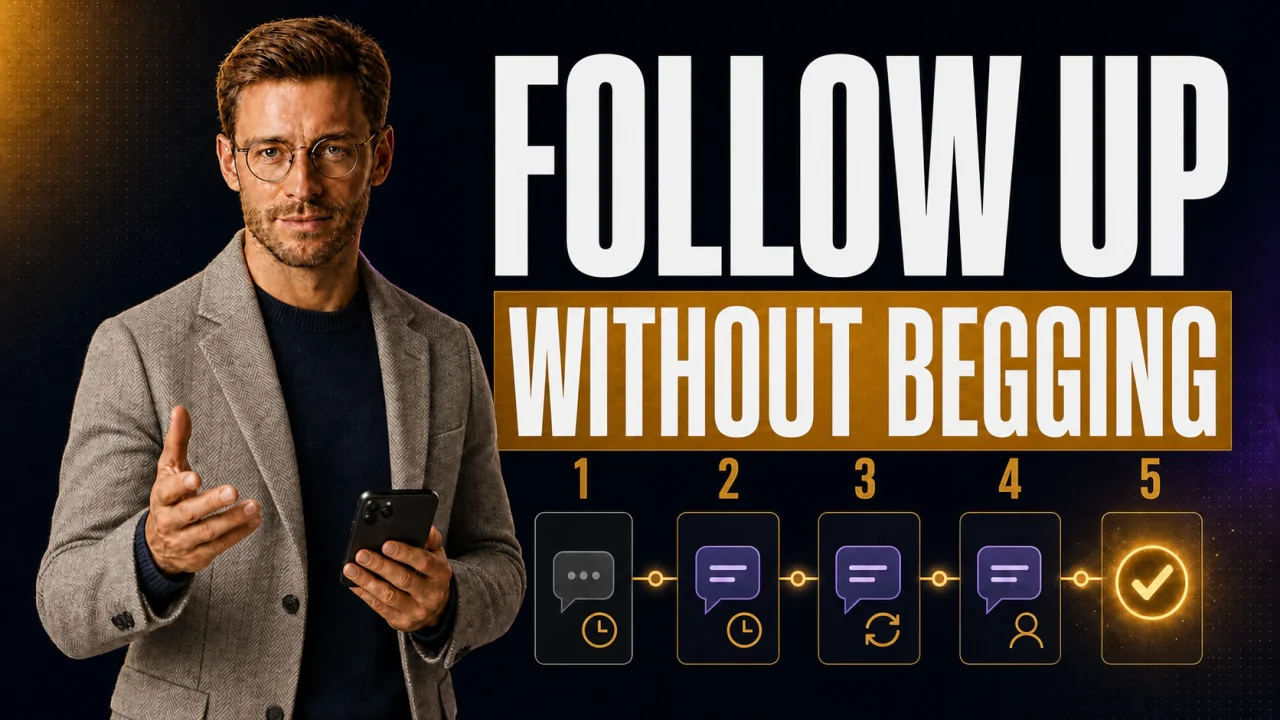
The call went well. The prospect almost said yes. Then radio silence, and your $20,000 offer gathers dust in the inbox. Here you get five ready follow-up email templates and the system to follow up without begging for it.
Follow up systematically, never like a beggar. You get five email templates here for day 1, day 3, day 7, day 14 and the break-up. Each one ends the message with a clear next step.
- Five email templates cover the whole sequence, from day 1 to break-up.
- Every message ends with a scheduled next step.
- Limit: templates cannot save a badly qualified call.
- The break-up email pulls back the most dead deals.
If your deals always close on the first call and never need a follow-up, you can skip this one.
The follow-up is the last mile in high-ticket closing. Almost nobody says yes right after a strong sales call. They need time.
That is exactly where you lose them. Or win them back. The difference is a system.
Why strong offers die in the follow-up
The prospect was hot in the call. A $22,000 offer, clear pains, real budget. Two days later he answers nothing anymore.
It is rarely the price. The brain puts off decisions because anything new feels uncertain. Without a fixed next step, procrastination always wins.
This is where most people trip. They hope for a reply instead of setting a time. Whoever just waits loses the deal to the silence.
Quick definition, so we are talking about the same thing.
Sales follow-up: The deliberate outreach to a prospect after an offer or sales call to drive a decision. It is not a reminder and it is not begging. A follow-up is a guided sequence of several touchpoints. Each point has a clear goal, clear timing and a defined next step for the prospect.
A fixed sequence has clear upsides. It also has limits you should know.
What a fixed sequence buys you
- No deal slips through the cracks anymore
- You skip agonizing over every wording
- The prospect feels structure instead of desperation
What it does not do
- Templates cannot save a badly qualified call
- Copy-paste with no personalization gets spotted instantly
- Too many touches in a short window read as desperate
The beggar frame is the most expensive mistake
"I just wanted to politely check in." That sentence costs you the deal. It puts you below the prospect.
On an $18,000 offer you are no beggar. You are the expert who solves a problem. Your follow-up has to sound like an equal, never submissive.
Not pretty, but that is how it is. One word gives the beggar away instantly.
Cut the little word "just"
"I just wanted to follow up again" devalues you and your offer. The prospect reads uncertainty, pushes the price down or disappears entirely. A $20,000 deal tips on three words.
The five email templates: your sequence from day 1 to break-up
Each template has one job. It starts the same day as the call. Whoever copies a template word for word gets caught at the first name.
Day 1: the short confirmation email
Out on the day of the call. Short, concrete, no selling. You sum up and set the frame.
Day 3: the value email
Now the part a lot of people hate: staying on it without being annoying. So you give instead of asking. Deliver a short answer to his biggest objection.
Day 7: the decision email
A week is up. Now you ask directly, but calmly. Is there a real objection or just an excuse behind it?
Day 14: the last real shot
Two weeks of silence are a signal. Now you come with a new angle, not the same question. Urgency that is real.
The break-up email: the door that opens doors
Sounds paradoxical, but that is how it is. The break-up email pulls back the most deals. You close the door politely, and that is exactly what wakes them up.
One more detail that makes the difference.
My trick for the subject line
I always reply in the same email thread, never with a new subject. The history holds the context, and your message does not land like cold outreach. On important deals I also send day 7 as a short voice message.
The follow-up sequence at a glance
An overview helps you not botch the timing. Hold the gaps. Too tight reads desperate, too wide lets the deal go cold.
Your follow-up sequence at a glance
| Timing | Goal | Channel | Tone |
|---|---|---|---|
| Day 1 | Confirm and set the frame | Factual, short | |
| Day 3 | Deliver value | Helpful, easy | |
| Day 7 | Push the decision | Email or call | Direct, calm |
| Day 14 | New reason | Urgent, real | |
| Break-up | Close the door | Friendly, clear |
The $24k deal I burned myself
I had a prospect for a $24,000 program. The call was strong, he really wanted it. The next day I sent the first message, all good.
Then I got nervous. He did not answer right away, and I started hunting.
Day two an email. Day three a text. Day four another "just checking in."
Every message sounded a little needier than the last. I did not even notice. I thought I was working the deal, when I was actually pushing it away.
On the fifth day the answer came. One single sentence: "I do not think this fits right now." No price objection, no timing. He had simply lost trust.
The mistake was not the follow-up. The mistake was the frequency and the tone. I had acted out of fear, not out of a system.
Today I have fixed gaps and fixed templates. I follow up less often, but with more aim.
That same customer came back nine months later, by the way, through a clean break-up email. That is how you learn.
Why "just keep following up" is the wrong advice
Everywhere you read: stay friendly on it until they answer. That is dangerous nonsense. Contact count is not a strategy.
Do not measure how often you write. Measure whether every message schedules a next step.
A clean follow-up is part of your closing techniques, not an add-on. A follow-up without a scheduled step is just hope with a send button.
One myth is especially stubborn here.
Myth
Following up is pushy and annoys the prospect.
Reality
Pushy is only someone who keeps going after a clear no. A good follow-up delivers value and shows how you work later as a provider. Many prospects even thank you for it. I learned that from practitioners like Cole Gordon and Matt Ryder.
An example from my own calls.
The trap: I used to end calls with "Reach out when you have thought it over." Nine out of ten never reached out. The ball was in the prospect's court, and he let it sit.
The fix: Today I set the next appointment right in the call. Fixed time, calendar invite immediately. My follow-up after that only confirms the appointment instead of begging for attention.
The strongest next step is a link, not another call. The prospect clicks, and the closer switches price, plan or split live behind it. That is exactly what live closer control from CloserCart is built for.
What I would do in the first seven days after the call
No deal should die from a missing routine. You build this order once and use it for every prospect. Here is how I would start.
- Save the five email templates as snippets in your mail tool.
- Set the next appointment right in the call, with a calendar invite.
- Send the short confirmation with the offer link the same day.
- Set fixed reminders for day 3, 7 and 14.
- Write every template fresh per deal, never pure copy-paste.
- End every sequence cleanly with the break-up instead of nagging forever.
Before you hit send, a quick look pays off.
Check before every follow-up
- No "just" and no "quick" in the message
- One concrete next step with a date
- Name, amount and detail set individually
- Reply in the existing email thread, no new subject
- A clear endpoint for the sequence defined
Common questions about the follow-up email
How often should I follow up on an offer?
Three to five targeted touches are almost always enough. More important than the number are the spacing and the reason. Our sequence uses day 1, 3, 7 and 14 plus a break-up. After that it is over, or it tips into begging.
What is the best time for the first follow-up email?
The same day as the call. The context is fresh and your offer is present. The first message only confirms and sets the next appointment. The longer you wait, the more details fade for the prospect.
How do I follow up without coming across as pushy?
Deliver value instead of just reminding. A fitting example or an answer to his objection helps him decide. End every message with a clear question. Following up without pressure means you lead, you do not beg.
Does a break-up email really work?
Yes, surprisingly well. When you close the door politely, many prospects react after all. The effect is not a trick, it is real relief. The open loop closes, and that triggers a reply.
Follow-ups that end in a close, not in silence
A strong follow-up needs a target: a link where your closer switches price, plan and split live. That is exactly what CloserCart delivers.
Start now for €1 14 days for €1. Cancel monthly. 0% revenue share.