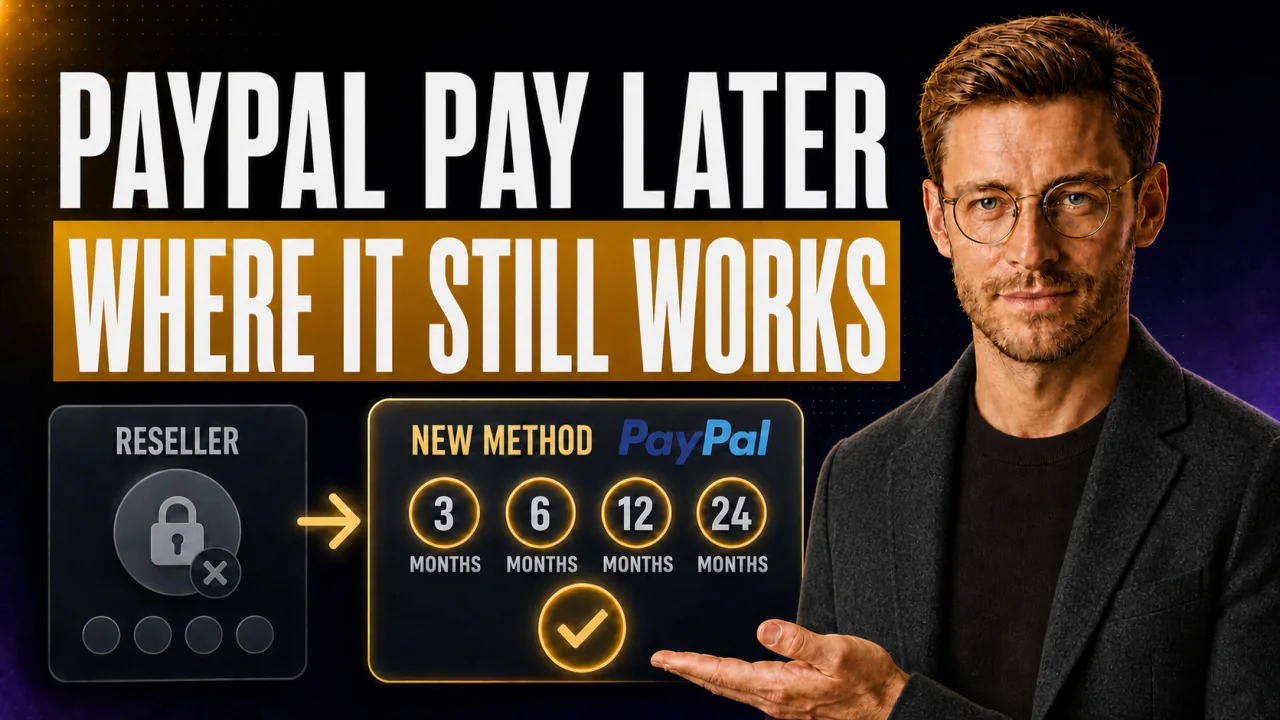
Your customer says yes on the call but doesn't want to pay 4,000 euros in one go. PayPal used to solve that: the customer pays around 190 euros a month, you get the full amount immediately. That exact option has practically vanished for coaching offers on the big payment platforms. Here you'll read why it happened, why it's not coming back there, and how you keep offering PayPal installments through your own account.
Get your own PayPal business account and connect it to your CloserCart checkout. On reseller platforms, your customer pays the platform, and PayPal installments for coaching simply don't show up there. When the payment runs through your account, your customer sees their financing options in the real PayPal window.
- PayPal installments cover 99 to 10,000 euros, over 3, 6, 12 or 24 months. You get the full amount immediately.
- PayPal has heavily restricted installments and pay-after-delivery for coaching products in Germany since summer 2025. Reseller platforms don't offer the option.
- Honest limit: whether a buyer sees the option is PayPal's call, per person and per amount. Nobody can force it.
- The route that remains: your own PayPal or Stripe account in your CloserCart checkout.
If you sell products under 500 euros in self-checkout, you don't need to read on here.
Reseller platform or your own account: who can do PayPal installments?
| Criterion | Reseller platform | Own account in your CloserCart checkout |
|---|---|---|
| Who collects the money | The platform, which pays you out later | You directly, into your PayPal or Stripe account |
| PayPal installments | Not offered for coaching, usually only standard PayPal | Customer sees their PayPal financing options if PayPal approves them |
| Installment alternative | Klarna or platform-run installments paid out installment by installment | PayPal, Klarna via Stripe, or your own split, your choice |
| Payout on installments | Often only installment by installment | With PayPal installments, the full amount immediately |
What happened in summer 2025
Let's be honest, most people only noticed it at checkout. Customer wants to pay, and the installment option is simply gone.
Behind it sits a decision by PayPal. Since August 2025, PayPal has heavily restricted the installment and pay-after-delivery options for coaching products and online courses in Germany. Ablefy announced it officially at the time.
The trigger is the German distance learning act, the FernUSG. Under current case law, customers can claim their money back on coaching programs if the ZFU approval is missing. With installments, PayPal fronts the money and no longer wants to carry exactly that clawback risk.
This is where it blows up in your face if you built your sales process on an option a corporation can switch off at the push of a button.
How PayPal installments actually work
Real quick before we move on. Many people mix up two different things here.
PayPal installments: A Buy Now Pay Later financing option from PayPal for amounts from 99 to 10,000 euros. The buyer pays PayPal in 3, 6, 12 or 24 monthly installments. The merchant receives the full amount immediately and carries no default risk, because PayPal handles the credit check and collection.
That is something completely different from an installment plan you grant yourself. With your own split, you wait for every single installment. With PayPal installments, your money is fully there the next day.
For the details on activation, there is a dedicated article: offering PayPal installments. It comes back to bite you the moment you sell the option without knowing the amount limits.
What speaks for PayPal installments
- You get the full amount immediately, no waiting on 24 installments.
- PayPal carries the default risk, failed installments are not your problem.
- The customer knows PayPal and trusts the screen, which lowers the barrier on the call.
Where the limits are
- PayPal decides per buyer and per amount whether the option appears. Nobody can guarantee it.
- For coaching without ZFU approval, the option has been heavily restricted since 2025.
- The buyer pays interest, typically around 11.5 to 12.5 percent effective per year.
Why the monthly installment closes the deal psychologically
Let's run the numbers on your offer. Say your mentoring costs 4,000 euros.
As a one-time payment, that is a blocker for many customers, even when the money is there. Financed over 24 months, it reads as a monthly installment around 190 euros, interest included. That is less than many people pay for a car lease.
The point is not that your customer is broke. Your ICP makes good money. The point is cashflow: entrepreneurs want capital working in their business, not in yours.
From the trenches
On a call, I never lead with the total and the installment together. First the price, then the question about their preferred way to pay, then the installment as the solution. Bring up the 190 euros too early and you cheapen your own offer.
Why reseller platforms won't help you here
Now for the annoying part. On a reseller platform, legally speaking, it's not you selling, it's the platform.
Your customer pays the platform, the platform pays you out. The PayPal account in the checkout belongs to the platform, not to you. Whether financing is offered there is decided by the platform together with PayPal, and you have exactly zero influence on it.
The current state is clear. CopeCart runs PayPal without installments and points to Klarna for installment plans. Digistore24 handles installments through a platform-run model where you get paid out installment by installment. Ablefy communicated the PayPal restriction itself and actively advises against classic installment plans.
This is where many people blow it, because they wait months for a feature that was never announced.
The expensive thinking error
"The platform will surely switch it back on" is hope, not a strategy. Every month without a financing option costs you the deals where the customer wants in but can't pay all at once. On a 4,000-euro offer, two lost customers a month is enough for 96,000 euros in yearly damage.
Why the option isn't coming back there either
Quick reality check. For PayPal installments to reappear on a reseller platform, PayPal would have to accept the clawback risk for tens of thousands of bundled coaching products at once.
That bundle is exactly the problem. To PayPal, the platform is a single merchant with a catalog full of distance-learning risk. PayPal can't decide per coach there, so the option stays off across the board.
With your own account, the situation is different. There, PayPal rates you as an individual merchant and your customer as an individual buyer. Simple as that.
Myth
PayPal has completely banned installment payments for coaches.
Reality
PayPal restricted financing options for coaching products, it didn't abolish them. Mainly affected are offers without ZFU approval running through bundled platform accounts. Through your own business account, PayPal reviews the individual case, and the buyer can still be shown financing options in the PayPal window.
The moment the model clicked for me
A case from last winter, no names. An acquaintance of mine sells a sales mentoring for 5,000 euros, his best month before that was over 300,000 euros in revenue. So things were working, in theory.
Then he sat in a closing call with a customer who wanted to start immediately. The customer asked about installments. The closer sent the platform link and said the line he'd been saying for months: you can split it with PayPal. The customer opened the link, found only the standard PayPal payment, and asked on the call whether he was missing something. He wasn't. The option had been gone for weeks, only nobody had noticed, because the platform never sent an email about it. The closer improvised, offered an in-house installment plan, but first had to ask the owner, because no such link existed. The customer said he'd get back to him after the weekend. He never got back to him. The deal died, not on price, not on product, but on ninety seconds of awkward silence at checkout. Only after that did the owner sit down and take the payment flow into his own hands. Own PayPal business account, own checkout, own installment logic as a fallback. Not pretty, but that's what happened. And yes, I've botched a situation like that myself in the past.
The route that works: your account in CloserCart
The solution is unspectacular. You need two things: your own PayPal business account and a checkout that uses it.
That is exactly how CloserCart is built. You connect your own PayPal and your own Stripe account, and every payment goes directly to you. No middleman, no bundled payouts, no third-party account in your checkout.
Your customer clicks "Pay Later" on the payment page and lands in the real PayPal window. There, PayPal shows them their options, from "pay in 30 days" up to installments over as long as 24 months. If your PayPal runs through Stripe, the same applies: the buyer picks their financing inside the PayPal flow, as Stripe confirms in its own docs.
The trap: I used to bet everything on a single financing option. When it disappeared, I stood on the call with no plan B and left two deals on the table in one week.
The fix: Today I run three tracks. PayPal installments as the first option, Klarna via Stripe as the second, and my own split through CloserCart as the third. If one option fails, the closer switches to the next one on the same call.
What PayPal decides and what you control
Now the part almost nobody tells you honestly. Even with your own account, PayPal ultimately decides whether your customer sees the installment option.
PayPal checks each application for the buyer's creditworthiness, the amount, and its own risk position. PayPal itself lists the parameters: 99 to 10,000 euros, terms from 3 to 24 months, a German PayPal account with a linked bank account.
You control the other half. Whether your own account is in play at all, whether your CloserCart checkout offers the option, and whether your closer has a plan B ready. If you only look at PayPal's half, you hand over responsibility for your own revenue.
This is where most people stumble, because they treat a PayPal decline as the end of the line instead of a switch to the next payment method.
The numbers on the table
Okay, quick detour for the calculators among us. The terms decide how you position the option on the call.
The buyer typically pays PayPal around 11.5 to 12.5 percent effective annual interest. You as the merchant pay your normal PayPal fees, the financing itself costs you nothing extra. There is even a 0 percent variant where you as the merchant cover the interest.
PayPal installments in numbers
| Item | Value | Who carries it | Source |
|---|---|---|---|
| Amount range | 99 to 10,000 euros | Set by PayPal | PayPal Help |
| Terms | 3, 6, 12, 24 months | Buyer chooses | PayPal Help |
| Effective interest | around 11.5 to 12.5 percent | Buyer | PayPal Business |
| Payout | full amount immediately | Merchant advantage | PayPal Business |
Sample calculation for your 4,000-euro program: over 24 months, the installment lands around 190 euros including interest. Typical range, the exact figure depends on the buyer's interest rate.
A discount is the wrong answer to "too expensive"
Now for the uncomfortable claim. Most coaches respond to price objections with a discount, and that is exactly the mistake.
A discount cuts your revenue by ten to twenty percent on the spot and trains your market to always negotiate. Financing cuts your revenue by zero percent, because PayPal wires you the full amount and the customer pays for the stretch.
The better metric is therefore not close rate alone, but average order value alongside it. With installments in your checkout, you keep the price stable and still solve the customer's cashflow problem. Once you've seen it play out, you get it.
You'll find more routes in the overview of installments via Stripe and Klarna installments.
What happens to BNPL from November 2026
Real quick before we get to the game plan. From November 20, 2026, the new EU consumer credit directive CCD2 applies in Germany.
Buy Now Pay Later then falls under consumer credit law. That means a documented credit check before every contract and BaFin supervision for the providers, as covered by Payment and Banking.
For you as a merchant, little changes, the obligations hit PayPal and Klarna. It still matters: providers typically tighten their approvals ahead of a deadline like this rather than loosen them. One more reason to set up your payment flow cleanly now instead of later.
What I would do in the first 7 days
Enough theory. Here is what the week looks like if you start today.
- Set up a PayPal business account or check that your existing one is fully verified.
- Set up your CloserCart checkout and connect PayPal and Stripe with your own credentials.
- Make a 100-euro test purchase and check which Pay Later options PayPal shows.
- Define your fallback chain: PayPal installments first, then Klarna, then your own split.
- Build the installment into your sales script, as the answer to the cashflow objection, never as the opener.
- Brief your closers: which option first, what to do on a decline, who activates the fallback.
- Check your ZFU status, because it affects how payment providers classify your product.
Checklist before your next closing call
- Own PayPal business account is verified and connected to the checkout
- Test purchase done and the displayed financing options documented
- Fallback payment method set up in case PayPal declines
- Monthly installment pre-calculated for every price package
- Closers know how to switch between payment methods on the call
- No deal depends on a single financing option anymore
Sources
Frequently asked questions about PayPal installments
Why don't I see PayPal installments with my provider anymore?
PayPal has restricted installments and pay-after-delivery for coaching products in Germany since summer 2025. On reseller platforms, the payment runs through the platform's account, so the option is off across the board there. Through your own PayPal business account, PayPal reviews the individual case, and your customer can be offered the option again.
Up to what amount do PayPal installments go?
According to PayPal, the range is 99 to 10,000 euros per transaction, with terms of 3, 6, 12 or 24 months. So a 3,000 or 4,000 euro coaching fits in principle. Whether a specific buyer gets approved is decided by PayPal's credit check.
Do I get my money immediately or installment by installment?
With PayPal installments, you get the full amount into your PayPal account immediately. PayPal collects the installments from the customer, and the default risk sits with PayPal. That sets the option apart from platform-run installment models, which often pay you out installment by installment.
Can I build PayPal installments into my checkout with a guarantee?
No, and be skeptical of anyone who promises that. You can connect your own PayPal account and offer the Pay Later flow. Whether a buyer sees the installment option is decided by PayPal per application. That's why you always need a fallback payment method like Klarna or your own split.
What does the financing cost me as a merchant?
In the standard variant, nothing extra, you only pay your normal PayPal fees. The interest of around 11.5 to 12.5 percent effective is carried by the buyer. Optionally, there is a 0 percent financing where you cover the interest portion to make the installment more attractive for the customer.
Offer the financing reseller platforms no longer have
With CloserCart, you connect your own PayPal and Stripe account. Your customer splits the payment comfortably, and with PayPal installments you get the full amount immediately.
Start now for 1 € Test 14 days for 1 euro. Cancel monthly. 0% revenue share.* For this article, we researched PayPal's terms, the help pages of the platforms mentioned, and the state of the CCD2 implementation, all linked in the sources block. Status: July 2026. This is not legal advice. Payment providers' terms and approvals can change, and your individual case may differ. For a binding assessment, talk to a lawyer.